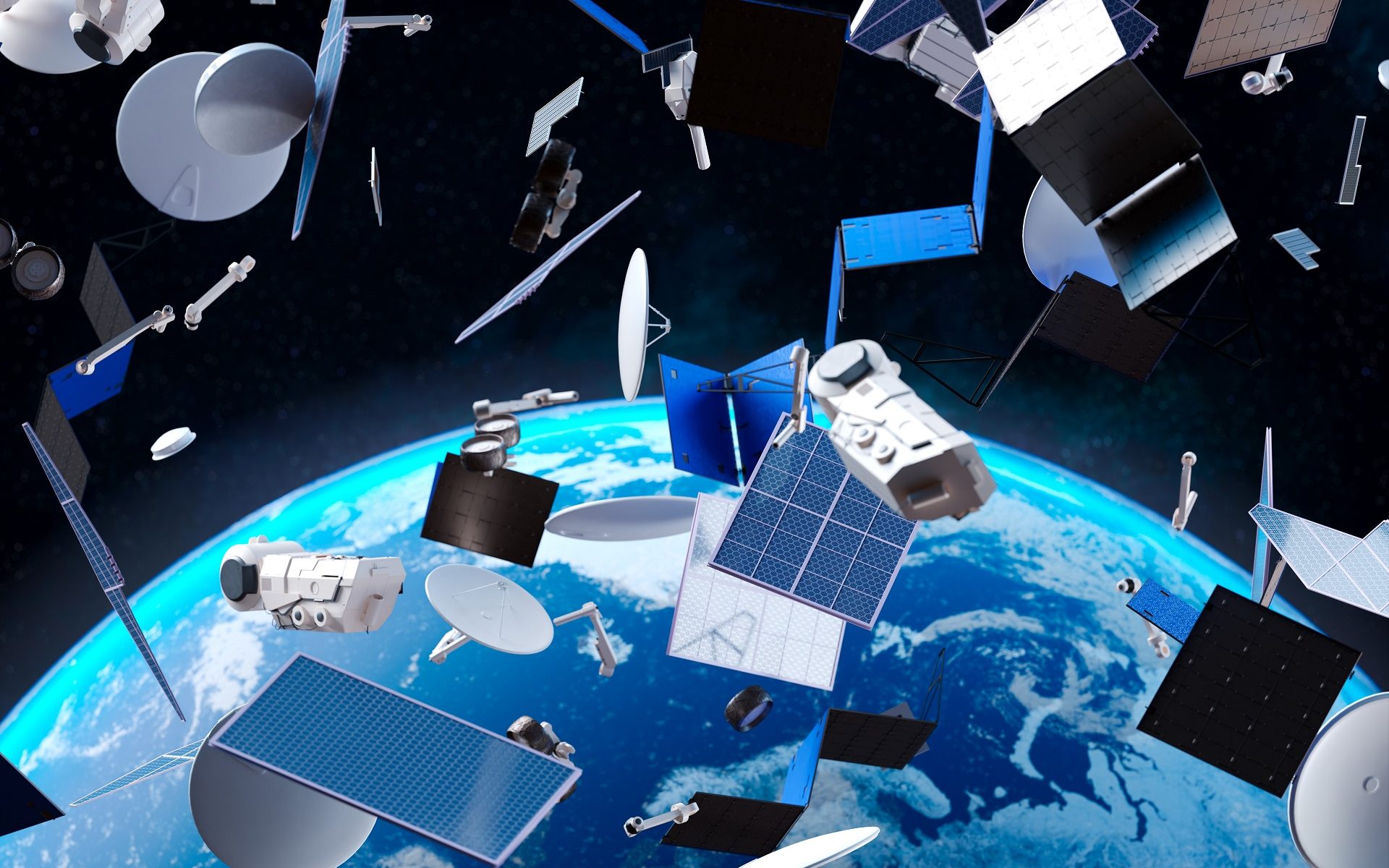
A new era in tracking space debris

As space debris becomes an increasing threat to operational in Earth’s orbit, researchers from Khalifa University have developed a new approach to tracking it using vision sensors aboard satellites and advanced data fusion techniques.

Traditionally, most space debris is tracked from the ground, using radar and telescopes. Ground-based tracking is limited by weather, atmospheric distortion and visibility constraints, but satellites equipped with the right sensors can continuously monitor debris from space, independent of weather and lighting conditions. The challenges lie in making these systems both accurate and efficient.

The research, published in Acta Astronautica, tackles this by developing a data fusion framework that processes and combines measurements from multiple satellites to improve tracking accuracy. Beyond tracking space debris, this framework could be used for future space operations, including interplanetary exploration, space tourism and satellite-based internet services.

More: Cleaning up our space

AQUA BOTS

In a world hungry for nutritious food, aquaculture is clearly a winning idea.

It isn’t a new one, either. Humans have been farming seafood for millennia. In more recent years, aquaculture has expanded to land-based tanks, where farmers raise fish and other seafood. Those tanks, however, take up increasingly valuable space on land and worsen competition for scarce water and other supplies.

Hear the writer read this story

This has more farmers looking back to the sea, where space is abundant and water and nutrients are free. Mariculture, the subset of aquaculture in the open seas, however, presents additional challenges.

A UAE tradition

Robotics could be on tap to move traditional Emirati fishing techniques into the future. Read more›››

The robots Lakmal Seneviratne and his team are working on at Khalifa University could eventually be employed to clean and repair hadra – fence traps placed perpendicular to shore – and gargour – fishing traps woven from palm leaves into a semicircular form, he says. ‹‹‹ Read less

Traditional mariculture relies on intensive manual labor to clean and repair equipment, monitor conditions, inspect nets and care for the plants and animals raised for human markets. That kind of manual labor is expensive, requiring trained commercial divers who are increasingly spread thin as aquaculture operations expand. It can also be dangerous work for those divers, particularly as farms move out into deeper and more perilous waters.

Mariculture can also pose threats for the environment, spreading disease, antibiotics and parasites or allowing farmed fish to escape and negatively affect native species.

Eleni Kelasidi, a senior researcher at SINTEF, one of Europe’s largest independent research organizations, thinks those issues could have a common solution: robots.

Putting a robot into the open water can be a bigger challenge, however, than putting a robot on the land.

For one thing, Kelasidi says, it’s important that autonomous systems do not harm farmed fish and/or damage the flexible structures.

This is both an ethical and economic consideration, she says. The ethical consideration: “We cannot harm any living thing and/or let them to escape from the fish farms.” The economic: “The fish are the profit of the industry.”

Happy fish

Kelasidi and her team have access to industrial scale fish farms and operate full scale research facility to investigate how robots stress or otherwise affect fish using equipment originally designed for the oil and gas industry. They test systems to see how well they function but also to observe how fish react to, say, different colors, sounds or lights. The goal is to learn what stresses fish and ensure healthier fish stocks and better profits.

Humans on the surface currently perform many aquaculture jobs using remotely operated machines, she notes.

“Our job is to cut the dependence from the humans to get the robotic systems to operate themselves. They need to understand their environment and make sure they don’t collide with structures,” Kelasidi says.

Another challenge for researchers, she says: making remote-operating vehicles “more clever.”

‘An exciting frontier’

Self-operating aquatic systems is an issue Lakmal Seneviratne, director of the Center for Robotics and Autonomous Systems at Khalifa University, is working on as well, and he’s optimistic.

CAPTION: Aquabots from Khalifa University

“It’s a very exciting frontier in underwater robotics,” he says, noting that 70 percent of the Earth is water but humans have explored only 5 percent of that.

Seneviratne and his team are also working on land-based agricultural robots such as “dogs” that can step lightly between rows of crops; “hands” that can gently pick fragile fruits; and robots on rails that can move up and down a field to monitor individual plants for signs of disease or readiness for harvest.

But ocean farms present a different set of challenges for autonomous systems.

“The problem isn’t that aquaculture is very deep, but (maintaining) navigation and control,” Seneviratne says, echoing Kelasidi’s concerns.

GPS doesn’t work beneath the water’s surface and robots have to be able to navigate currents and waves without damaging each other or farm structures.

Cameras, to capture images, and artificial intelligence, to sharpen and analyze those images, are important to managing these conditions, he says.

Looking to nature

But being able to see in the murky depths is only part of the issue for mariculture robotics. The machines also need control. So researchers are looking at life forms already adapted to aquatic environments for inspiration. Although not specifically designed for aquaculture, the biomimicry could prove useful in ocean farms. Among the ideas:

Aquaculture’s promise and challenges

As the world’s population grows and climate change puts more pressure on traditional terrestrial farming, sustainable aquaculture could play a key role, says Naveed Nabi, an assistant professor at Chandigarh University. Read more›››

“In the present times, when food security is a matter of serious concern, aquaculture has played a key role to mitigate this crisis, supplying about 178 million tons of food in which 20.2 kg per capita is destined for human consumption,” he says. “Aquaculture not only adds resilience to the global food system through improving resource-use efficiencies, but also by diversifying the farmed species.”

But he warns that farmed fish present challenges to the environment including fish escapees that harm native species and the spread of disease and parasites.

There’s also the issues of eutrophication, in which water becomes overloaded with nutrients, leading to deadly algae blooms; antibiotics in the environment through unconsumed food or fish waste; and threats associated with pesticides. ‹‹‹ Read less

A team from Harvard and the University of South Carolina in 2021 presented the Finbot, which uses four independently controllable fins.

In 2023, a team from Zhejiang University, China, in 2023 published results of their Copebot, designed to mimic the copepod, a small crustacean known to escape from predators with explosive jumps. Their bot, they report, was able to leap out of the water, land on a small pad, transmit data and jump back into the water.

Back at Khalifa University, meanwhile, researchers have other ideas.

“Looking at aquatic environments, many animals evolved flexible or completely soft bodies to improve their swimming capability and adaptability to the intricate underwater world,” says Federico Renda, who heads the team. “For instance, octopuses can squeeze into small apertures to hide or catch prey, and jellyfish developed the most efficient locomotion strategy of all. In my team, we take inspiration from soft creatures to build new underwater robots capable of replicating these functionalities while understanding the physical principles involved.”

One of KU’s designs mimics flagella, the whiplike structures that propel bacteria through liquid to solve another issue with underwater robots: Many are tethered. While the tethers allow the machines to be operated from the surface, they can also become tangled together.

“Recently, we have developed an untethered underwater robot inspired by flagellate microorganisms capable of efficient and safe locomotion in close proximity to sensible underwater habitats,” Renda says. “Furthermore, each flagellum can be used as a coiling gripper in addition to propulsion, achieving redundancy and multifunctionality, which can significantly simplify underwater operations.”

To test robots’ ability to navigate choppy waters, Khalifa University built a wave pool that simulates currents. Stanford University’s Oussama Khatib recently used it to run Ocean One, a humanoid robot designed to perform such tasks as monitor coral reefs and offshore oil rigs, through its paces.

SINTEF’s Kelasidi would like to see robots replace human divers or assist them on highly risky operations. Seneviratne likewise expects robots to allow human divers to inspect more often and longer.

“We see robots as helping divers instead of replacing them,” he says.

A golden opportunity for medical
devices

A new way to embed gold nanoparticles into 3D-printed hydrogels could improve medical implants, optical devices and even contact lenses for colorblindness.

Scientists at Khalifa University published their research in Materials & Design. It introduces an eco-friendly method that places nanoparticles exactly where they are needed, without waste or extra chemicals.

3D-printed materials with nanoparticles are not new: The particles have previously been mixed into the printing material or applied as a coating afterwards. Both approaches limit device performance.

This new approach allows for better control over nanoparticle placement, making it useful for drug delivery, biosensors and light-based medical treatments.

From Nobel-winning breakthroughs to
local innovation

Advances in protein design and the use of AI for predicting protein structures made the headlines with the 2024 Nobel Prize in Chemistry. But closer to home, researchers at Khalifa University in Abu Dhabi are leading the way in using computational methods to predict the crystal structures and properties of materials.

This foundational work is driving progress in energy storage, drug development and the creation of components for advanced optoelectronic devices.

Listen to the Deep Dive

“The basic idea is to use computers to predict the atomic arrangement of solids before we synthesize them in the lab,” says Sharmarke Mohamed, head of the Chemical Crystallography Laboratory (CCL) at Khalifa University. “If we can do this accurately for all target molecules of interest, then this gets us one step closer to answering the scientifically interesting question of what experimental conditions are necessary to target the crystallization of a material with this particular structure.”

Using computers is time-saving, cost-effective and minimizes trial-and-error experiments. But why is this important?


Today, the challenge is not whether we can use computers to predict crystal structures, but how the predicted crystal structures can be used to guide experiments in the synthesis and discovery of functional materials.

Sharmarke Mohamed, head of the Chemical Crystallography Laboratory (CCL) at Khalifa University


Crystallizing proteins allows scientists to understand their structure in detail.

Proteins are complex macromolecules, and their shape determines how they function in the body. By creating crystals of proteins, researchers can use techniques like X-ray crystallography to study their 3D structure. This helps in designing medicines that fit a protein perfectly to treat diseases. It also advances understanding of conditions like cancer and Alzheimer’s by revealing malfunctions in the protein structure.

CAPTION: Sharmarke Mohamed (from left), Praveen Managutti and Thomas Delclos

“Fifteen years ago, when I was doing my Ph.D. in chemical crystallography and computational structure prediction, the question of whether computers can predict crystal structures was still an open question. The problem was also somewhat niche and confined to the academic community because very few industrial researchers were engaged in method development and testing. Today, most pharmaceutical companies around the world have some sort of computational crystal structure prediction research program in-house,” Mohamed says.

But the field has developed immensely over the past couple of decades thanks to a little healthy competition.

Critical Assessment of Structure Prediction (CASP) is a biennial event where researchers assess the performance of methods used to predict protein structures. Scientists worldwide participate in testing algorithms that aim to determine how proteins fold into their 3D shapes based solely on their amino acid sequences. Given the importance of protein structure in areas like drug development and disease research, CASP plays a critical role in advancing computer-based biology research and guiding improvements in prediction methods.

A similar blind test has been ongoing since 1999 for assessing progress in using computers to predict the crystal structures of small molecules.

The Crystal Structure Prediction (CSP) Blind Tests, organized by the Cambridge Crystallographic Data Centre, bring together scientists from academia and industry to evaluate their methods on real-world examples in a controlled setting. These tests also foster collaboration within the CSP community.

Mohamed and his team — including M.Sc. student Mubarak Almehairbi, Ph.D. student Zeinab Saeed and postdoctoral research fellows Tamador Alkhadir and Bhausaheb Dhokale — participated in the most recent CSP blind test.


“This seventh blind test featured the most challenging target molecules to date,” Mohamed tells KUST Review. “The results show that the field has progressed significantly since the first blind test in 1999, as reflected in the success rate in both structure generation and ranking. But as with all advancements in science, when we make progress in one area, new questions and challenges arise.

“Today, the challenge is not whether we can use computers to predict crystal structures, but how the predicted crystal structures can be used to guide experiments in the synthesis and discovery of functional materials,” Mohamed says. “This is now the focus of many researchers in the field, including our group in the Chemistry Department of Khalifa University.”

For example, machine learning has improved how we rank predicted crystal structures, helping researchers identify which ones are likely to form successfully under normal temperature and pressure conditions.

Ranking crystal structures helps researchers figure out which ones are most likely to be observed under real-life conditions. This saves time and effort by focusing on the best options for experiments.

Mohamed’s group is developing new methods and codes to help experiments target new materials with desirable solid-state properties. For example, the team recently created the MechaPredict code, which is able to predict the mechanical properties of crystals on any surface of interest without the need for sensitive nanoindentation experiments.

CAPTION: MechaPredict code summary IMAGE: Khalifa University

This code is already being used by academics around the world and has attracted interest from pharmaceutical companies for its potential to extend the shelf life and improve the solubility and stability of drug products. Additionally, the code can be applied in designing new materials like hole-transport layers for solar cells, which can lead to more efficient, versatile, cost-effective and longer-lasting solar panels.

But with all the advances made in computational CSP methods, a well-equipped crystallography laboratory is necessary to validate the accuracy of the computational predictions.

“The Chemical Crystallography Laboratory (CCL) is the best-equipped crystallography lab in the UAE for performing single-crystal X-ray diffraction, the gold standard for determining the crystal structures of materials,” Mohamed says. “The CCL provides experimental crystallographic services to Khalifa University researchers as well as to collaborators in the UAE and around the world. The synergy between experimental chemical crystallography and computational CSP methods is the key to seeing further advances such as those recognized in the 2024 Nobel Prize in Chemistry.”

IN SEARCH OF THE METAVERSE

My office isn’t the most inspiring. It’s not bad, per se, but it’s not the peaceful lakeshore cabin conducive to creative thought and productivity that I’d like. If only it were socially acceptable to don my virtual reality (VR) headset and immerse myself in a futuristic cityscape or tropical haven and get all my work done. I want to pretend I’m floating among the stars on a spacecraft while replying to emails and writing my stories.

LISTEN TO THE DEEP DIVE

Jamie Gilpin, CMO at social media management tool Sprout Social, tells me that what I actually want is the metaverse. Sprout is one of many companies that have transitioned to a remote-first approach for its workers.

“Going to work in the metaverse may sound far-fetched but it may hold the answer to engaging workers in a virtual workspace. If your dream workspace is a beach, you might run into issues with sand getting into your keyboard,” she says. “The metaverse makes it possible to work wherever you want, without the limitations of the space. Allowing yourself to work in the environment where you feel most productive can yield incredible results.”

I had been thinking of VR, plain and simple. Is Gilpin right in saying the metaverse is the answer? What even is the metaverse?

As analysts for McKinsey and Co. wrote in a 2022 think piece, “if you’ve ever done a Google search for the term ‘metaverse,’ you’re not alone.”
Who hasn’t heard of the metaverse?

“The metaverse [was] the buzzword of 2022 in the same way that NFT was the buzzword of 2021,” says QuHarrison Terry, author of “The Metaverse Handbook: Innovating for the Internet’s Next Tectonic Shift.” “The metaverse is a fictional place imagined long before our current consumer-tech obsessions that has manifested into real progress. While the metaverse is far from a finished destination, there are thousands of people building it every second of every day.”

Herbert B. Dixon Jr. retired from the Washington, D.C., Superior Court in 2014. Before his retirement, he was overseeing the U.S. courthouse’s most modern prototype courtroom: high-def TV screens and all. Now, he’s a regular contributor to the American Bar Association’s Judges’ Journal and wrote in 2023: “The metaverse is a rapidly evolving idea. Describing the metaverse in 2023 is akin to explaining air or space travel to residents of the horse and buggy era. Every year, we see new technological advancements that a decade before would have seemed like science fiction.


“The metaverse makes it possible to work wherever you want, without the limitations of the space.”

Jamie Gilpin, CMO at Sprout Social

“The metaverse has been referred to as the three-dimensional internet and the future of the internet. My description of the future metaverse involves a digital universe (which may be real-world or imagined images) that your avatar enters to interact with other avatars.”

I don’t necessarily want an online representation of myself; I just want to pretend I’m working somewhere inspiring and quiet. But should I want to remain in my beautiful digital workspace, I’ll need an avatar to collaborate with my colleagues. They need a visible object in their digital environment that they can call “Jade” and I’ll need their avatars too. Yes, OK, online meeting platforms exist and I can change my background there and pretend I’m somewhere exotic but I want full immersion here.

Mariapina Trunfio, associate professor of economics and business management at the University of Naples, says the metaverse “defines a collective, persistent and interactive parallel reality created by synthesizing virtual worlds where people can use personal avatars to work, play and communicate with each other.”

In her 2022 Virtual Worlds paper, Trunfio explains that virtual technologies enhance the perceived immersion with the character realness of the avatars and residents: “Usually networked and situated with intelligent agents, they allow users to interact with virtual objects and intelligent agents freely, and to communicate with each other. In multiple forms, these worlds can be experienced synchronously and persistently by an unlimited number of users.”

I like the concepts of persistence and perceived immersion in Trunfio’s definition.

The McKinsey think piece also highlights that the metaverse means different things to different people:

“Some believe it’s a digital playground for friends. Others think it has the potential to be a commercial space for companies and customers. We believe both interpretations are correct. We believe the metaverse is best characterized as an evolution of today’s internet — something we are deeply immersed in, rather than something we primarily look at.”

In other words, as per the consultancy group’s working definition: “The metaverse is the emerging 3D-enabled digital space that uses virtual reality, augmented reality, and other advanced internet and semiconductor technology to allow people to have lifelike personal and business experiences online.”

ACCESS POINTS

To access the metaverse, says former-judge Dixon, the user needs “a computer programmed to access the computer-generated environment, a head-mounted visual display or goggles to see the virtual environment, an audio headset, and hand- and body-tracking, motion-detecting controllers and sensors to provide a sense of touch and feel while traveling within the environment.”

Ernesto Damiani is the senior director of the Robotics and Intelligent Systems Institute and director of the Center for Cyber Physical Systems at Khalifa University. His definition of the metaverse focuses the most on the technology needed to access the metaverse: “The metaverse is a digital, virtual space that humans wearing haptic interfaces (like helmets, gloves and visors) can enter and roam by projecting their presence as avatars. The metaverse puts together virtual reality, augmented reality and low-latency multi-party communication technology to allow people to have lifelike interactive experiences through their avatars.”

GRAPHICS: Abjad Design

I own a (VR) headset. I mostly use it for gaming. The virtual reality offers me that escape from the real world — again, picture my peaceful and inspiring work-environment goals. This total immersion isn’t the only feature of the metaverse though, and it’s not entirely practical for going about your everyday life. Enter augmented reality (AR).

Leslie Shannon likes the AR side of things. She authored “Interconnected Realities: How the Metaverse Will Transform Our Relationship With Technology Forever.” For her, the metaverse is a partly or fully digital experience that brings together people, places and information in real time in a way that transcends that which is possible in the physical world alone. She wants the metaverse to solve our problems — to be useful, not just entertaining.

“The problem is that smartphones and computers have done too well at solving the problem of delivering information and entertainment to us, exactly when and where we want it. To get this spectacular convenience, we’re prepared to pay a surprisingly high cost in terms of our connection to the people, places and things physically around us, and it’s a cost that we’re paying quite thoughtlessly today. You can probably name an incident in your own life within just the past week in which looking at a screen, rather than being present in your immediate surroundings, created a situation that caught you out socially, or made you neglect someone, or was even potentially dangerous. We’re all complicit in this one.”

How could an immersive digital world be the answer, Shannon asks. It’s not. But: “If we start thinking about a spectrum of experience, in which the far-left-hand side is 100 percent physical experiences, and the far-right-hand side is 100 percent digital experiences, then there also exists a middle point that is 50 percent physical and 50 percent digital, and sliding proportions of digital/physical mixes on either side of that middle point.”

Shannon says it’s the digital/physical mixes that deserve our attention. She calls this “interconnected realities.”

IMAGE: Abjad Design
Making the ‘metaversity’

By: Suzanne Condie Lambert

Khalifa University thinks the metaverse will be vital to the way students learn in the future. That’s why it teamed with Microsoft UAE and Hevolus Innovation for the 2023 Metaversity Hackathon, inviting student teams to create metaverse classrooms to remove physical barriers, making immersive, engaging and collaborative experiences inclusive and accessible. “One day we will have a university that is fully in the metaverse,” says Dr. Arif Sultan Al Hammadi, Khalifa’s executive vice president and KUST Review’s editor-in-chief. “Students will get the best education in the world wherever they are.” Read more›››

KU wants to be in the vanguard, and the hackathon, he adds, is a first step to getting there. Higher institutions would benefit as well, requiring fewer physical resources. Al Hammadi points to the example of medical school cadavers, which are expensive and may pose ethical concerns.

Schools are already using interactive 2D screens to reduce the number of cadavers required to teach anatomy, he says. A 3D metaverse could be the next leap forward. There are downsides, Al Hammadi says. Cheating is harder to detect. The physical experience of labs and experiments can’t yet be fully replicated. And distance learning doesn’t offer the same social life as on-campus classes.

But Al Hammadi says that as models improve, students will eventually be able to get much of the same experience in the metaverse. Hadi Otrok, a KU professor of electrical engineering and computer science, sees promise especially in using avatars to free instructors from small tasks, like running tutorials. “The challenge will be,” he says, “how to get the students … engaged with you instead of on the phone.”

It will take courage to take these ideas and create a fully interactive online experience, Al Hammadi says, suggesting that a potential “metaversity” could start with just one degree to prove the concept. And Khalifa University, he says, wants to be on the front end of imagining that future. ‹‹‹ Read less

“This concept of the metaverse is a world in which we can have the compelling, fascinating, relevant content that we currently access on screens, but integrated visually into our physical world in a way that enhances our lives, rather than removing us from them. This concept of the metaverse imagines the digital and physical aspects being incorporated with each other on a constantly sliding scale, so that sometimes we are fully immersed in a digital world, when that serves the purpose of the moment, but it is also possible to spend significant time fully immersed only in the physical world.

“This metaverse of interconnected realities will be a place where we combine digital information or entertainment from the world of the internet with our physical surroundings so that we can be more efficient, more informed, more delighted and more aware than we are today. A simple example of this enhanced future might be a sensor in my oven that connects with my AR glasses and, when the oven is on, displays its current temperature in a visual digital overlay when my gaze lingers on my oven for more than one or two seconds -– useful when I’m on the other side of the kitchen.”

Are we talking about a heads-up display (HUD) fixed permanently in my vision? I’d quite like that. I wear glasses anyway. It would be so helpful if people in real life had little tags above their heads to remind me of their names — facial recognition in VR land. Or a mini-map in the corner of my field of view so I’d never get lost again, video game-style.

After all, HUDs aren’t new. In aviation, they date to the end of the Second World War when rudimentary systems were installed in a few military aircraft.

The modern-day fighter pilot helmet boasts an impressive HUD, and Iron Man had one too. Granted, Iron Man belongs to the realm of fiction, but plenty of technology emerged from the minds of creators and novelists — including the term “metaverse.”

“The term ‘metaverse’ was coined by author Neal Stephenson in his 1992 novel ‘Snow Crash,’” says Matthew Ball, author of “Metaverse and How It Will Revolutionize Everything.” “For all its influence, Stephenson’s book provided no specific definition of the metaverse, but what he described was a persistent virtual world that reached, interacted with, and affected nearly every part of human existence.”

There’s that persistence again.

The “affecting nearly every part of human existence” thing I’m not so keen on.

EVERYONE EVERYWHERE ALL AT ONCE?

“The metaverse is a vast, immersive virtual world simultaneously accessible by millions of people through highly customizable avatars and powerful experience creation tools integrated with the offline world through its virtual economy and external technology,” Wagner James Au says in his book “Making a Metaverse That Matters: From Snow Crash and Second Life to a Virtual World Worth Fighting For.” He also says, however, that the metaverse is not for everyone:

“Chances are you’ve seen more than several tech evangelists across various media outlets insist that we’ll all soon be in the metaverse. I can tell you from painful — but also amusing — experience that this is unlikely ever to be the case. And, no, you probably won’t wear a VR headset on a regular basis either.

That said, it’s also safe to say at least one in four people with Internet connectivity will be part of the metaverse on some level. At a very conservative estimate, over half a billion people worldwide already use one or more variations of a metaverse platform now, from Minecraft and Roblox to Fortnite, VRChat and Second Life. That’s about 1 in 10 of the 5 billion people across the planet who use the internet.”

The majority of Au’s examples are games. Gaming companies are the pioneers in the metaverse space, well known as early adopters and prototype metaverse builders. Minecraft and Fortnite offer virtual worlds where players meet as avatars to play games and chat. They offer in-game payment systems and in-game assets that travel with players across platforms: from PC to console to mobile. They are also social spaces where gamers forge online relationships and communities.

IMAGE: Abjad Design

This gaming-world innovation correlates closely with many working definitions I found of the metaverse concept. Indeed, Ian Khan, author of “Metaverse for Dummies,” says the metaverse refers to virtual reality-based online worlds and notes that many of these worlds are gaming environments or online games. “Others function more as online virtual places where you can do other activities such as meet people, learn new things or simply hang out. And the types of virtual worlds you can find in the metaverse continue to expand and are likely to continue to evolve.”

Many of the experts I found, however, wouldn’t say we have a metaverse yet.

Dixon says the metaverse does not yet exist, but “its ultimate scope is constrained only be the limits of human imagination.”

Aakansha Saxena, assistant professor at the School of Information Technology, AI and Cyber Security, Rashtriya Raksha University, calls the metaverse a “concept”: “It can be understood as an infinite universe where communities of people can collaborate and enjoy the mechanisms of augmented reality, virtual reality, extended reality, online life and much more.”

That sounds like many of these games to me.

Khaled Salah, professor of electrical engineering and computer science at Khalifa University, throws a spanner in the works with his definition, saying: “A metaverse is an immersive and 3D virtual world in which people can interact through avatars to carry out their daily interactions, unlocking the potential to communicate, transact and experience new opportunities on a global scale.”

I’m struck by his use of article: “a metaverse” not “the metaverse.” Of all the people I asked, books I read and research articles I consulted, Salah was the only person to raise the question of multiple metaverses. Does each gaming platform or each individual game have its own metaverse?

And if each platform has its own, how can we move seamlessly between them all?

Maybe Mark Zuckerberg, CEO of Meta, has the answer. He said on the Lex Fridman Podcast that the metaverse is not a construct of connected virtual places:

“Instead, the metaverse is the point of time when we do and spend large portions of our everyday digital work and leisure in immersive 3D environments with VR and AR glasses.”

Meta, of course, used to be Facebook, and the company changed its name in 2021 to highlight its new direction. The company has since announced a U.S.$2.5 million investment supporting independent academic research across Europe into metaverse technologies because “since no one company will own and operate the metaverse, this will require collaboration and cooperation.”

Terry, author of “The Metaverse Handbook,” sums it up:

“Let me clear the air and first tell you what the metaverse is not. The metaverse is not a single technology. It’s not just a place we’ll visit in VR. It’s not something that can be created and claimed by the next Bezos or Gates. In fact, the metaverse is about as boundless and unownable as the internet, if not more so. Sure, there are entities that have contributed more to the internet than others. Of course, there are innovations that steered the course of the internet and influenced the experience of the web. But we didn’t wake up one day with the internet we see now. It was an ever-evolving thing.”

WHERE ARE WE GOING WITH THIS?

“The metaverse in the early 2020s is the equivalent of the mid-1990s in the development of the internet: Many people are talking about it, a few people are already building it, but no one can really define what it is, or what it will be able to do for us, or even if it will be relevant to anyone at all once it’s here,” Shannon says.

Khan, author of “Metaverse for Dummies,” agrees that in terms of development, the metaverse today is where the internet was in the 1990s:

“The early internet was shaped by new ideas, technologies and ways of doing things. With the right investments, adoption and usage, the internet grew into the internet we know today. Similarly, the metaverse today provides an interesting place for many activities, but many of them are still in the early days of development. The investment and attention put into building the metaverse over the next five to ten years will determine what the metaverse ultimately becomes and the value it creates.”


“The metaverse becomes more real every time we replace a physical habit with a digital equivalent.”

QuHarrison Terry, author of The Metaverse Handbook: Innovating for the Internet’s Next Tectonic Shift

Per University of Naples’ Trunfio:

“The metaverse, like many innovations, is shrouded in mysticism and skepticism. If many believe it will be revolutionary and fully transform how people work, shop, socialize and play, others are skeptical, and see it as a fad. However, whether or not we think of the metaverse as a technological revolution, it is undeniable that the massive diffusion of this technology will impact on nearly all aspects of life and business in the next decade, allowing interaction in virtual and augmented spaces and a blend of both.”

Whether you’d say the metaverse is here already or well on its way, it’s clear that it’s the next big disruptor, the new place to be for all aspects of life.

After everything I’ve read and all the people I’ve spoken to, I think it’s funny that the definition of metaverse that resonates most with me is much more abstract than the very scientific approaches I’d usually turn to.

Shaan Puri, tech entrepreneur, posted a tweet in 2021 that sums it all up pretty nicely:

“The metaverse is the moment in time where our digital life is worth more to us than our physical life.”

Or as Terry puts it: “The metaverse is not just a place we’ll visit in VR. It is not a destination. The metaverse is a movement — a movement toward the digital-first livelihood we’ve slowly been adopting year over year, app by app. The metaverse becomes more real every time we replace a physical habit with a digital equivalent. We, the digital citizens of the internet, are manifesting the metaverse by trading time in the physical world for time online.”

I’m OK with this.