The age of plastics

If you’ve ever spent time in a museum, you’ll note artifacts that date back thousands of years. They tell us pertinent information about the past — from lifestyle to medicinal treatments and everything in between.

It’s our history. But have you ever considered what will be uncovered in archaeological sites thousands of years from today? It’s highly likely it will be a whole lot of plastic, but where’s the value in that?

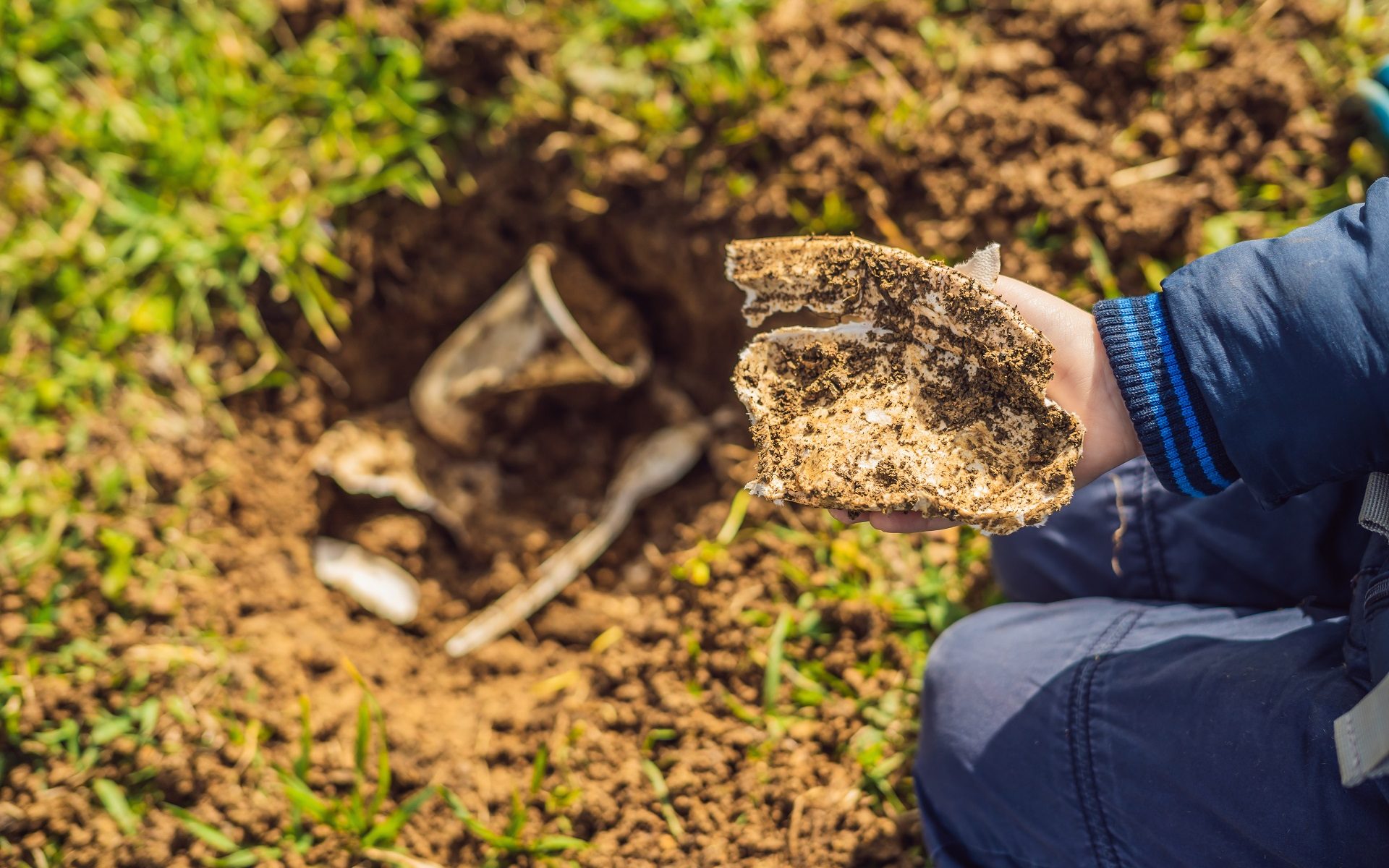
A new paper published in Cambridge Prisms: Plastics argues that while plastics get a bad rap and wreak sustainability havoc on the environment, they’ll be the defining “type fossils” of our era.

“The type fossils are not stone, metal, or ceramic, but plastic, creating an archaeological record that is resilient and toxic, as well as ubiquitous,” the paper says.

IMAGE: Shutterstock

Plastics travel all over — they’re resting in landfills, drifting in the oceans, freezing into polar ice, embedding in farm soils, lodging in animals and even orbiting Earth. They may shrink into micro-plastics and nanoplastics, but they never really go away.

The authors suggest plastics and “the behaviors responsible for their distribution, produce an archive that may hold some historical and evidential value for society.”

They say plastics at the moment of discard enters them into the archeological record, “comprising material culture that represents human activities occurring at any time in the past.”

Such a record could contribute to understanding the full environmental impact of plastic and indicate the worldview of the “Plastic Age.”

The bottom line? Plastics still bad, information good.

More like this: Google Earth shines light on ancient Roman camps

Solar panel sunscreen

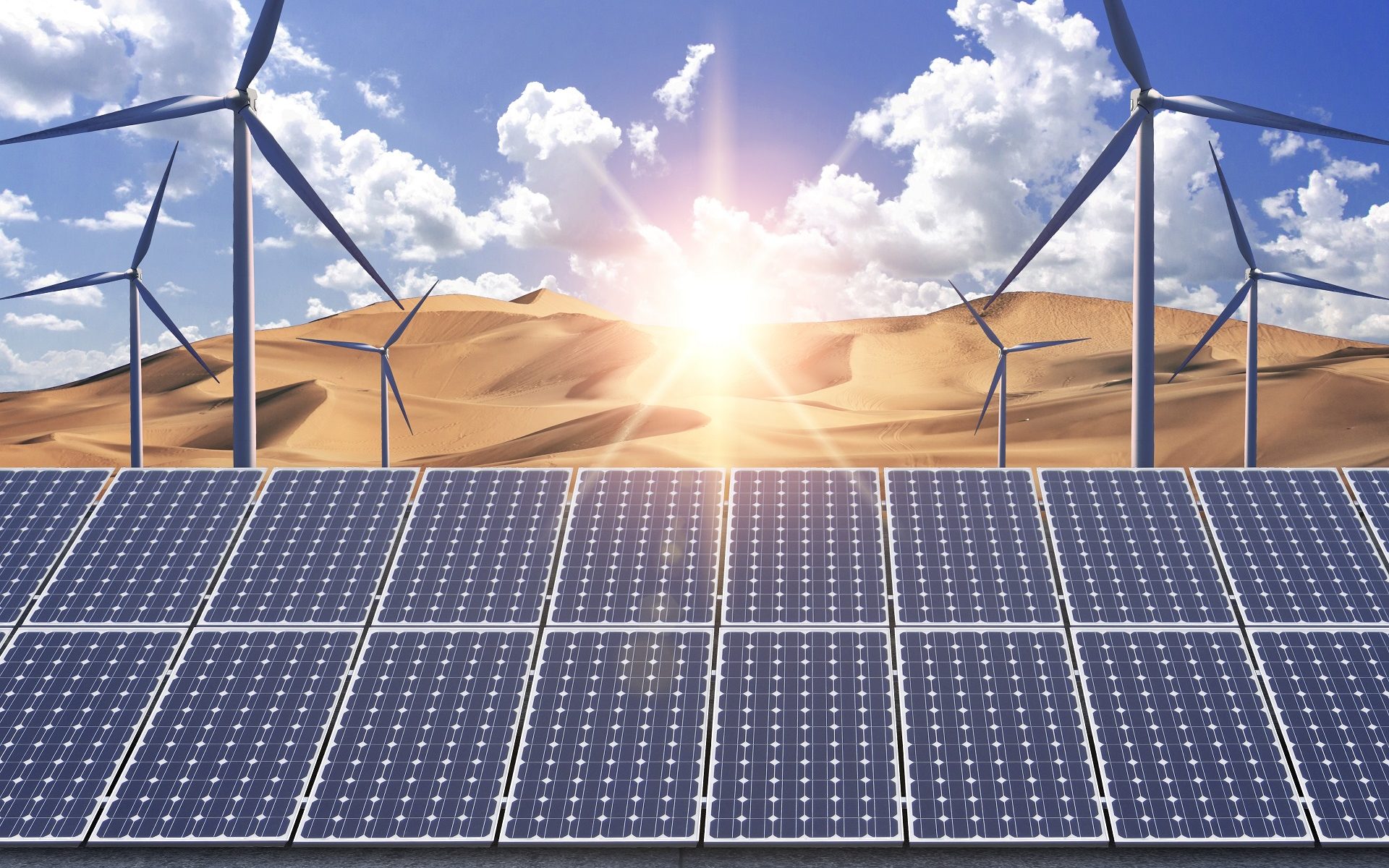
Solar panels, or photovoltaic panels (PVs) are a great clean energy solution. But while these PVs enjoy fun in the sun, extreme heat impacts their efficiency, resilience and ultimately their longevity.

The world’s scorching deserts are generally thought of as unforgiving environments, but the sizable, sun-exposed landscapes have proven suitable locations for vast solar parks.

Above 25 degrees Celsius, solar panel efficiency begins to slow. This is why researchers are on the hunt for ways to ensure climates with extreme temperatures, like the deserts of the Middle East, can capitalize on the numerous sunny days as efficiently as possible.

Researchers at the King Abdullah University of Science and Technology in Saudi Arabia have developed an all-natural hydrogel that might be the answer.

The gel, made up of everyday polymers and salts, behaves similar to a sponge. It absorbs water from the air at night and slowly releases the water as vapor during the day, cooling the panels more than 14 degrees Celsius.

The result is more energy conversion, panels that may last up to twice as long and lower price tags on maintenance and cooling systems.

More like this: Wear a coat

To flock or not to flock

Bird-watching has been on the incline around the world since the pandemic, and according to Audubon Magazine, there are an estimated 96 million birders in the United States alone. This makes up more than 30 percent of U.S. adults. And these adult birders spent U.S.$107 billion in 2022 alone on anything and everything a birder needs. It makes sense, then, that the birding tourism industry is also on the rise, but birders are selective about their destinations. But it’s not just about the birds.

The birds are, of course, a big part of the draw to a specific location, but a recent study shows that social stability and a country’s development level play more of a role. Even the flashiest toucans won’t attract this tourism facet if they feel unsafe or upon arrival.

Countries like Costa Rica and Colombia are booming with birding tourism, but other nations like Venezuela, even with their feathered diversity, are missing out on those tourism dollars due to social or infrastructure obstacles.

The study published by the British Ecological Society concludes that assisting under-visited countries to build up their tourism facilities and safety could help local economies and in addition support conservation.

The challenge is that the growth of avitourism must be done responsibly, ensuring the benefits to local communities and support and protection of fragile ecosystems that could be negatively affected by a surge of curious eyes peering through binoculars.

More like this: Angry birds

FLOOD INSURANCE

Storms are becoming stronger, wetter and deadlier. You can thank a warmer, moister atmosphere and heating oceans as the extreme storms they feed produce more rain, stronger winds and heavier flooding. In 2024 alone, hurricanes Helene and Milton left hundreds of billions of dollars in damages while flooding in Afghanistan and Pakistan was blamed for more than a thousand deaths.

Watch video on sponge cities here.

Cities, in particular, may be feeling the effects of these killer storms more intensely than the countryside.

For one thing, urban areas draw more rain: Skyscrapers often slow storms, letting them drop more precipitation in a relatively small area. Pollution like auto exhaust also seeds clouds. And heat rising from pavement and concrete creates convectional rainfall.

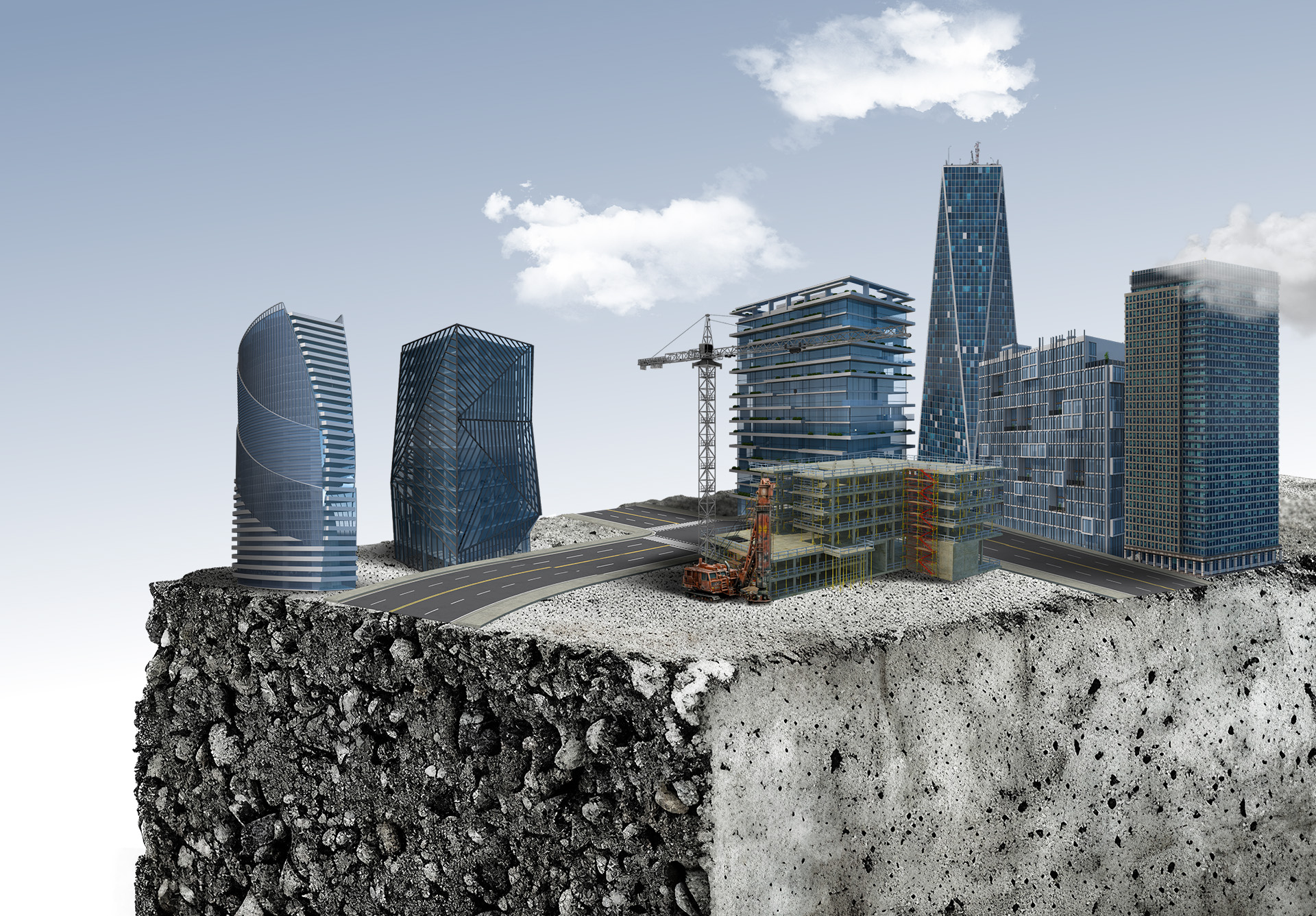
IMAGE: ABJAD DESIGN
Protection from heat too

Sponge cities don’t just protect residents from flooding. They also provide relief from extreme heat, says the University of Adelaide’s Scott Hawken. “In cities like Adelaide, heat waves are even more deadly than flooding. They kill a lot of people: the vulnerable, the young and the old. We need to think about how to keep our cities cooler during these extreme events and design parks and gardens to generate cool airflows and bring the surface temperature down,” he says. Read more›››

The best way to do that is to use well-watered and irrigated vegetation to set up cool airflows throughout the city, Hawken says. “It’s not just having a park here. It’s strategic, like a natural air conditioner. We need to think of these larger park systems woven in amongst our cities. These parks need to be well-watered, but that shouldn’t be a problem if resources are used wisely, he says. “Most of the time there is plenty of water in our cities, but we just don’t use it carefully,” he says.

“Many cities around the world are running out of water, but those cities often don’t take care of their water. It’s only when the drought kicks in that the penny drops. But by then it’s too late. We don’t have the systems in place.”  Urban oases in Abu Dhabi helped cool surrounding temperatures by up to 2.2 degrees Celsius, according to a study by Mohamed bin Zayed University of Artificial Intelligence and the tech giant IBM.

Artificial intelligence-enabled technology helped analyze decades of satellite data and provided insights on how vegetation and water bodies make a significant impact on heat islands in the city.   Masdar Park in the Masdar City neighborhood had a 2.2-degree cooling effect in that area, the researchers found. Umm Al Emarat Park, one of the largest and oldest parks in the city, brought down the surrounding temperature by 1 degree.

The researchers suggest the technology can enable sustainable design and help urban planners identify other areas that could benefit from green spaces.  ‹‹‹ Read less

A study published in the Proceedings of the National Academy of Sciences says the effect has become more pronounced over the past two decades.

Listen to the story here

“This is everywhere,” Dev Niyogi, a professor at the University of Texas at Austin and paper co-author, tells the Washington Post. “The magnitude of the impact will vary. But just the way we treat urban heat islands, we should start treating urban rainfall effect as a feature associated with urbanization.”

And some cities that have not previously been associated with flooding are finding that the changing climate may require a different kind of urban planning.

Exhibit A: Abu Dhabi, where record-breaking April 2024 storms brought a year’s worth of rain to the Gulf city in just a day. 

FROM THE GROUND UP

Chinese landscape architect Kongjian Yu has been thinking about that different kind of urban planning for decades.

He won the Cornelia Hahn Oberlander International Landscape Architecture Prize (“Oberlander Prize”) in 2023 for his concept of “sponge cities,” which has inspired projects not only in China, but France, Russia, Indonesia, Thailand and the United States. Yu’s company Turenscape has contributed to more than 600 projects in 200 cities.

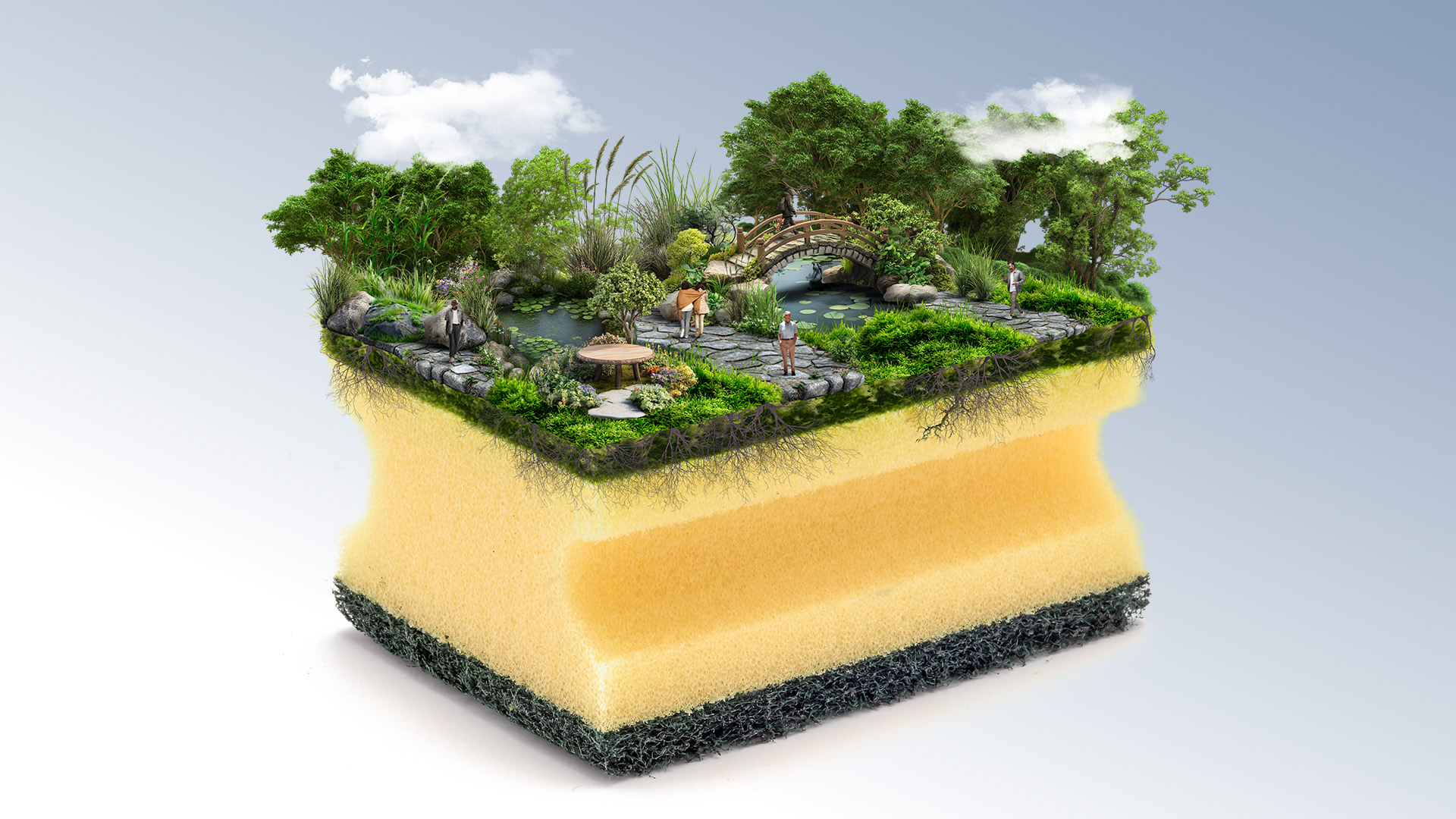
The concept relies on nature – through trees, parks and ponds – and good design to protect cities from flood waters. In essence, rather than rely on concrete drainage systems and flood walls, it makes the city itself a “sponge” to better absorb rainfall.

“There’s a misconception that if we can build a flood wall higher and higher, or if we build the dams higher and stronger, (then) we can protect a city from flooding,” Yu tells CNN. “(We think) we can control the water … that is a mistake.”

Watch: Climate Change, the Classroom Crisis

The stakes are high. An Intergovernmental Panel on Climate Change report says 700 million people live in areas where rainfall extremes have risen. This number is expected to grow as global temperatures increase.

CELEBRATING THE WATER

Scott Hawken, director of the Landscape Architecture and Urban Design program at the University of Adelaide’s School of Architecture and Civil Engineering, uses sponge city principles in his work. It’s about celebrating the water on site, he says.

“This development of the sponge city is about the necessity to manage water in a more intelligent way. It allows water to infiltrate into the landscape and slow it down, to manage it on site rather than what has been done throughout most of the 20th century, which is to expel the water from the city rapidly,” he tells KUST Review.

As Hawken tells it, preparing urban areas to better withstand flooding isn’t just an issue with physical infrastructure, like swapping out concrete gutters for absorbent plants and sandier soils. It requires a change in social perspectives as well.

“The 20th century perspective (sees) water or flooding being a problem or a nuisance.

That’s one cultural perspective that inspired overengineered approaches which haven’t really valued water in the way that it should be valued.


Instead, Hawken suggests looking to communities that consider flooding a part of life, like the cities and settlements of Southeast Asia that have weathered monsoon climates for hundreds of years and longer.

“Floods there are not viewed as a risk. But in the Western context we really fear floods. They’re out of mind until they’re around us, and then we panic rather than thinking into the future and planning to live with floods and work with them on site.”

And where you can’t work with them?

“We’ve also built in a lot of areas which we shouldn’t, like on flood plains.”

MANAGING THE WATER

Hawken isn’t just concerned with creating a landscape that better absorbs water but cities that manage the rain wisely.

“The irony is often you have a very wet landscape that has a lot of water but also has to pipe water in because it’s not using water in a smart enough way. It isn’t recycled, filtered and reused.

“People have a resistance to that. But some of the traditional societies have been reusing and recycling water in intelligent ways for a long time. We need to get over that. The technology is certainly there.

“The filtered and recycled water is often much cleaner than the water that’s not,” Hawken says.

Singapore, he says, is an example of a city that is successfully reusing and recycling its water resources.

“A lot of the technology that was developed in Australia has been exported to places like Singapore. Now they’ve taken those ideas and run with them, probably doing a better job than anywhere else.”

DESERT SOLUTIONS

Dubai entrepreneur Chandra Dake has also been thinking about managing flood waters and collecting rain for reuse. His inspiration: the United Arab Emirates’ desert sands.

Dake and his company, Dake Rechsand, use the plentiful sand to create permeable materials that not only allow water to pass through but filter it on its way to underground honeycomb storage tanks. These tanks keep the water fresh without chemicals or electricity.

“Every nook and corner, every junction, can become a storage house of water,” he says. “That reduces the burden of centralized storm management, which is normally implemented in advanced cities across the globe.”

He points to a project in Beijing that used his technology to address chronic flooding problems that led to frequent traffic jams.

“This area that used to flood is now able to harvest every drop of water. The surface is now used for a recreational facility. All the rainwater goes underneath it. After implementing it for the last two, three years there’s no more flooding, not even one traffic jam. And the water? It’s literally like distilled water.”

Saving the water from just one storm would be a huge benefit for UAE cities that rely mostly on energy-hungry desalination technology, he says.

That record-breaking 2024 storm? The water could have been used for two or three months cleaning roads, improving irrigation and watering greenery, he says.

Instead, it went to waste. “All of that water was discarded. Not even one cubic meter was used.” Dake says his technology can easily be integrated into an existing infrastructure. “You can build a road. You can build paving. You can build anything. And these can be retrofitted as well.”

The materials are suitable for both hot and cold climates, Dake tells KUST Review. “And one important element is these materials are made from desert sand. Desert becomes a solution for global problems.

“We will see enormous social, environmental and economical benefits,” he predicts.

More like this: A river runs over it

Sands of change

Sand dunes form when wind blows sand into piles, creating shapes depending on the wind speed and direction. Sand blows up the windward side of a dune and slides down the leeward side. Like a game of leapfrog, the dune slowly moves.

This movement is glacial — incremental movements as small as a grain of sand each time — but over time these movements add up. And climate change could change their speed, shape and direction.

Deserts around the world are already encroaching on civilization, threatening farmland and infrastructure. The rate at which dunes move varies, depending on the velocity of the wind and the topography of the region.


“Sand dunes in arid regions are conspicuous mobile landforms that require adaptation and mitigation strategies to protect human infrastructure and economic assets from encroachment, and (they) play a substantial role in desertification and atmospheric dust emissions,” says Andreas Baas, professor of aeolian geomorphology at King’s College London. “Desert dunes and sand seas cover approximately 20 percent of the world’s arid zones, and their morphology and patterning are an important diagnostic of environmental surface conditions, not only on Earth, but also on other planetary bodies.”

Baas’ latest research focused squarely on terrestrial sand as he and King’s College London colleague Lucie Delobel investigated how the shape, migration speed and direction of mobile desert dunes are projected to change by 2100 around the world in direct response to changes in wind patterns. The researchers say a changing wind climate plays a key role in this — and climate change is in the driver’s seat.

“We were surprised to find many regionally significant future increases in potential sand drift and changes in wind regime, which can impact the migration and shape of desert dunes,” Baas tells KUST Review. “The general assumption previously was that global warming leads to smaller temperature differences around the world (because poleward regions are heating up more) and that these smaller temperature differences would lead to weaker winds. We found that the poleward expansion of monsoon systems in particular will have a major impact on dunes in places like Oman and Mauritania.”

Baas points out that while most dunes around the world are unlikely to change their shape due to changes in winds, around 10 percent will, and some dune fields are likely to change their direction of movement.

Watch: The Global Impact of Middle East Dust Storms

“We found that 73 percent of the current desert dune areas are projected to experience a significantly different drift potential,” Baas says. Drift potential is defined as the total amount of sand transportation by wind. “Around one-third of desert dune areas will see an increase, while the other two-thirds will see a decrease.”

CAPTION: These photos are not of tropical forests in Brazil nor the country side of Italy, but of south of Saudi Arabia. IMAGE: Shutterstock
Longer springs, warmer nights

The arid and semi-arid regions in northern Africa and southwest Asia have been expanding, exacerbated by rapid population growth and climate warming, according to a study in Scientific Reports from Khalifa University’s Diana Francis and Ricardo Fonseca. Read more›››

The study investigates atmospheric circulation changes and their effects on clouds, moisture, dust and radiation across northern and equatorial Africa, southern Europe, the Middle East and southwest Asia.
The researchers note that daily nighttime temperatures are increasing faster than daytime temperatures, particularly in summer, due to higher atmospheric moisture and dust levels.

In winter, convective regions have shifted eastward in Africa, increasing low-level clouds in subtropical regions and shifting dusty areas southward. Future climate projections (2066-2100) suggest longer springs and shorter autumns.

The subtropical highs over North Africa and the Arabian Peninsula are projected to migrate poleward by 1.5 degrees in latitude, a trend statistically significant at 95 percent confidence level, in line with the projected expansion of the Hadley Cells. The Hadley Cells are the convective cells over the tropics. As they expand, the southern Arabian Peninsula (currently subtropics) may shift toward a tropical-like climate with increased rainfall frequency per year

The study highlights the importance of accurate, high-resolution climate models that account for dust and pollutants in the MENA region. Such models, the researchers note, are crucial for reliable climate projections and for supporting climate resilience and mitigation initiatives, including the transition to renewable energy sources.‹‹‹ Read less

Dune movement will still be very slow and incremental, but over time it could cause serious problems to infrastructure and the fragile ecosystems surrounding areas of sand.

“In many desert countries, the layout of settlements and infrastructure has been historically adapted to the local dune shapes and dynamics,” Baas says. “In the UAE, for example, there are many villages and infrastructure — even airports — that are built in between long seif dunes that run from west to east. If those seifs break up into smaller dunes, they may migrate towards a more southerly direction and those settlements will become buried by sand. In other places, such as Rajasthan, sand dunes may migrate faster and become a bigger problem to deal with where they’re overrunning agricultural fields.”

The researchers note that changes in dune behavior may need to be considered in planning and management efforts as mitigations designed for the current wind climate, such as sand fences and green belts, may become locally less effective — under a changing wind direction, for example — or even unnecessary, if dunes transform from a migrating to an elongating type. More precise models are needed for site-specific recommendations.

“The planet’s history has seen many vast changes in deserts and dune fields in its long history, but now is the first time that humans have come along and have built assets in between the dunes,” Baas says. “Our projections based on a global climate-change model suggest that potential sand drift in the UAE may decrease somewhat in the future, but these global models are not good at representing regionally important weather events like the shamal. And other studies predict that such extreme events will become stronger, in which case future shamal winds may kick up more dust and move more sand.”

More like this: Dust busters