Thirsty? Science hops to it

A changing climate is putting more pressure on the world’s supply of clean water. But an amphibian might have the answer.

A team of researchers at the University of Nevada, Las Vegas, has developed a material that harvests atmospheric water more efficiently than current technologies. And it’s all thanks to a frog.

Listen to the Deep Dive:

Frogs don’t consume food and water the way we do. Food is taken in orally, but the eyeballs fall inward to push it down the throat. Water, however, is absorbed through their skin.

It was this process that inspired a new ultra-absorbent material that came exclusively from studying hydrogels. The gels create a barrier that keeps out contaminants but allows water to pass through.

CAPTION: Jeremy Cho, assistant professor, Department of Mechanical Engineering
IMAGE: University of Nevada, Las Vegas

“A hydrogel is a soft polymeric material that can swell with water, meaning it is very permeable to water, just like skins in organisms,” says Jeremy Cho, one of the researchers on the team.

A hydrogen membrane and a liquid desiccant was the winning combination that permits rapid capture and large quantity storage for freshwater distillation.

“We observed that it could capture water at incredibly fast rates. We captured two to six liters per day per square meter of membrane area in Las Vegas air — the driest city in the United States,” Cho says.

The liquid desiccant attracts water and absorbs water vapor from the air, even when the relative humidity is as low as 10 percent.

The most challenging obstacle was to filter outside air particulates and contaminants. A hydrogel membrane was added between the desiccant and the air.

It sounds like an easy solution, but finding the just-right hydrogel took two years of experimentation resulting in two published papers. “It took a lot of careful hydrogel synthesis and experimentation to verify our theory,” he tells KUST Review.

| What’s new?

Though atmospheric water harvesting processes have been around for a long time, often repackaging old technologies, the team’s method is based on new tech.

“Our work is different in that we are not creating a new sorbent to be cycled, or relying on an old tech developed for a different application. We are presenting a new membrane-based method where water can be continuously captured into a liquid desiccant and released (distilled) in another location.

The segregation of processes is what’s key here as it allows you to separately optimize and control each process for better overall performance and efficiency. It gives us flexibility in how we can design a complete water-harvesting system. If we want to be solar or waste-heat or electrically powered, we can build different systems that still rely on the same membrane-based capture approach developed because of this flexibility,” Cho says.

| It’s not just for drinking

The majority of the market is focused on drinking water, which is only a fragment of overall water consumption, so the team initiated a start-up company with hopes its tech has a massive impact on sustainability and water sourcing.

Cho adds, “This approach was invented with water-stressed arid regions in mind, and sustainability has been part of the vision from the very beginning.”

This includes considering the current level of water stress and how their tech can impact water usage, conservation and regulation. Regulators are consistently looking toward lower consumption and water reclamation, and companies that look to environmental, social and governance factors when making investment calls are seeking to be water-neutral or water-positive.

Regulators in Nevada sometimes try to put off businesses from setting up there, based on their water-consumption forecasting. Cho and his team are hoping to eliminate this market barrier, enhancing the local economy.

| At what cost?

The problem is that these water solutions are more costly than tap water, but Cho says his team’s goal is to ensure their start-up company, WAVR Technologies, is focused on developing solutions to supply water to make up for these consumptive losses.

| Who is willing to pay the price?

Cho says there are many industries in Las Vegas looking for solutions, including real estate, hospitality, construction and high-tech manufacturing. “We’ve been talking to them, they’re all looking for a solution and are willing to pay for it. And from what we can tell right now, the amount they’re willing to pay seems to be achievable from a technoeconomic standpoint when we scale up our technology.”

“Climate change is real, and whether or not you accept the science that we are causing it, you are paying for it. In arid regions, it is extremely visible through our water resources, our utility bills, and our abilities to do business and live in our communities. We should be more responsible in how we use our water and do what we can to reclaim it. And whatever water we cannot reclaim, let’s consider sourcing that from the air—a hidden resource that surrounds us all,” Cho tells KUST Review.

The team at WAVR Technologies expects its first prototype to be ready by the end of 2025.

APOCALYPSE WOW!

Welcome to the KUST Review traveler’s guide to the world. If you’re looking for a travel destination that either has been ravaged by climate change or is about to be, this is the brochure for you.

2023 was officially the world’s hottest year on record. The average global temperature for the year was 1.48C warmer than the 1850-1900 pre-industrial average, according to the European Union’s Copernicus Climate Change Service. That’s perilously close to the 1.5C limit set under the 2015 Paris Agreement — certainly close enough to make planning your post-1.5 world travel dreams a reality very soon.

Beat the rush – if not the heat – with our guide to the top 6 destinations.

As summer fades, New England transforms into a canvas painted with the fiery hues of autumn. From the rustic charm of Vermont’s country roads to the coastal serenity of Maine, the journey promises a symphony of fall foliage. A classic road trip surrounded by a kaleidoscope of red, orange and yellow leaves could be yours for as long as the trees stay standing.

Global warming-driven increases in hurricanes mean they might not be around for much longer.

Shersingh Joseph Tumber-Davila is a Dartmouth College terrestrial ecosystems ecologist studying the response of ecosystems to global environmental change. He says a single hurricane hitting New England might result in the release of more than a tenth of all the carbon stored in the area’s forests.

As you wander through the autumnal beauty, look around and notice that woodland covers about 75 percent of the New England land area. Take a moment of gratitude for the trees that remove some 16 million tons of carbon dioxide from the atmosphere each year.

Tumber-Davila’s team used computer models to calculate the carbon losses that would occur in storms with 8 to 16 percent higher wind speeds than those of the 10 biggest New England storms of the 20th century. These higher wind speeds are possible as a result of global warming. They found that even a storm of the same wind speeds as the Great New England Hurricane of 1938, which downed 70 percent of standing trees in some areas, could release 120 million tons of carbon if it were to occur today. Make the winds 16 percent faster and that number jumps to 250 million tons.

“The emissions are not instantaneous, however,” Tumber-Davila says. “It takes approximately 19 years for the downed carbon to become a net emission, and 100 years for 90 percent of the downed carbon to be emitted.”

Tumber-Davila also points out that these estimates are conservative, but no matter: 70 percent of the New England forest could end up on the floor, joining the soft rustling of leaves beneath your feet.

Let New England’s fall beauty captivate your senses but maybe don’t count on these forests being a carbon sink for your travel emissions much longer.

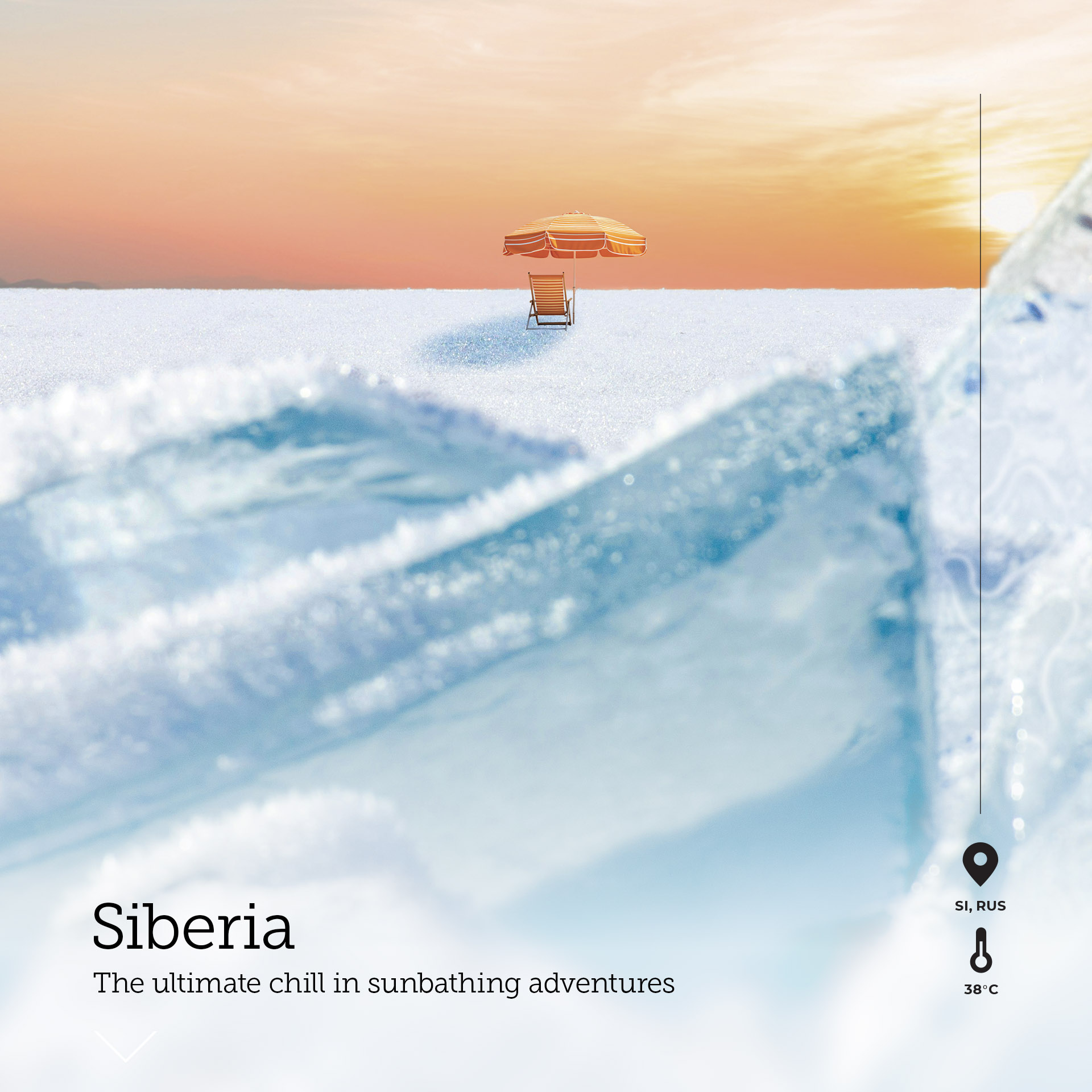
Forget the Caribbean, the Mediterranean is so last season, and who needs the Maldives to stay above water anyway? Siberia is the hottest new destination to catch some rays.

The Arctic is warming faster than any other region on Earth, according to Rashit Hantemirov from Russia’s Ural Federal University: “Siberia is among the regions with the strongest warming worldwide, and heatwaves have reached a disturbing new level in recent years, especially in 2020 when temperatures soared across Siberia to reach a record-breaking 38C inside the Arctic Circle.”

Scientists say “disturbing” — we say “opportunity!”

Be among the first to experience the great Siberian tanning tour across the most sun-soaked, formerly frost-kissed locations the Arctic Circle has to offer. And who says sunbathing is a midday activity? In the far north, the summer brings the midnight sun, giving you 24-hour opportunities to catch those rays.

Bask in record temperatures this summer for the low, low price of devastating, cascading effects on local ecosystems, human communities and the built environment. Remember to get your
shots before you go.

Ancient viruses frozen in the Arctic permafrost could soon be released and unleash a major disease outbreak, and no one wants to be ill on holiday. Anthrax is a killer accessory to a nice tan.

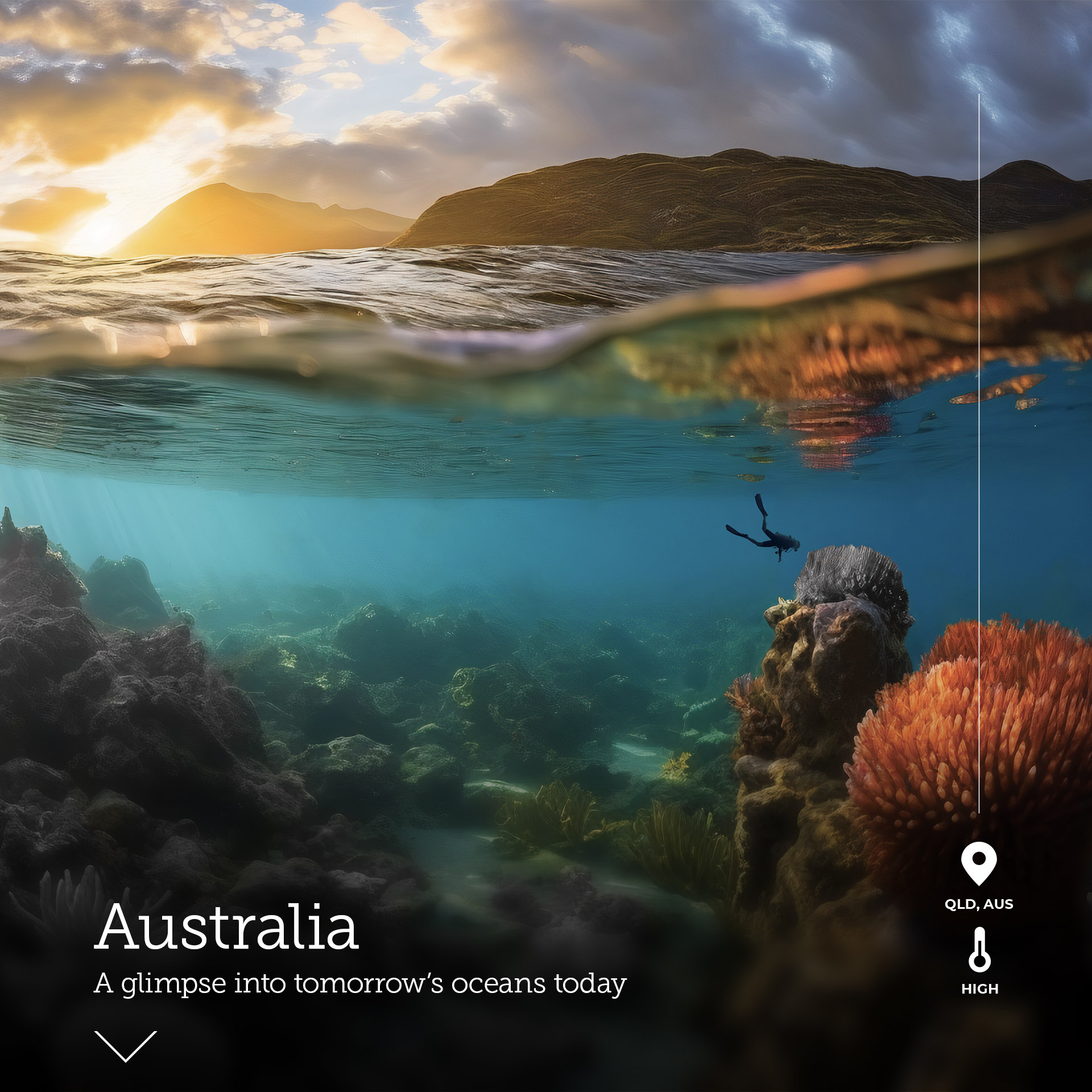
Dive into the future in Australia with a trip to the bleached coral of the Great Barrier Reef. Welcome to the future of underwater adventure, where the vibrant colors of life meet the stark reality of change. Australia’s coral reefs, once bursting with life, now offer a different kind of beauty — a ghostly, otherworldly landscape just beneath the waves.

An estimated 80 percent of the Great Barrier Reef has suffered severe bleaching in rising ocean temperatures, and you can now embark on a guided tour through the most famous underwater graveyard. Our expert guides will narrate the tale of once-thriving coral ecosystems, now standing as silent sentinels of the sea.

Since 2016, the Great Barrier Reef has experienced five mass bleaching events, say researchers at the Great Barrier Reef Marine Park Authority, which monitors the health of the coral. In 2024, the latest event was caused by heat stress and affected two-thirds of the reef. The authority’s chief scientist, Roger Beeden, says it’s too early to say what the full consequences of this event are, but hopes that if conditions cool, much of what’s bleached could recover.

In the meantime, glide over ghostly coral gardens, where the absence of color tells a thousand stories. For an optional extra, take part in one of our neon night dives. As the sun sets, dive into an eerie underwater neon party. Special UV lights reveal the fluorescent glow of the bleached corals, creating an unforgettable luminescent spectacle: nature’s own discotheque!

If an autumn trip isn’t an option, you could summer in the rainforest and still experience the fall beauty. Embark on the hottest journey of your life and forget the cool, lush canopies of yesteryear: This Amazonian adventure promises an up-close encounter with the sizzling future of the tropics.

Already, a small proportion of leaves in the canopies of tropical forests are dying from heat stress (about 0.01 percent), but Christopher Doughty at Northern Arizona University is far more pessimistic: “We are predicting total leaf death,” he says. “Even a small change in temperature could greatly impact tropical plant species.” His team placed temperature sensors on leaves in the upper canopy of Amazonian rainforests. As temperatures increase, more leaves are affected, and the more leaves that are affected, the warmer the existing forests become.

After about 47C, leaves can’t photosynthesize as the cells that capture energy from sunlight are too damaged. Plus, in hotter temperatures, the stomata on leaves close to prevent water loss. Without the cooling effects of evaporation — or plant sweat — the leaves get even hotter.

But hey! On this tour, glide through the treetops on a zipline, where the leaves are so sparse, you won’t need to worry about the obstructed views! Witness firsthand — and at speed! — the impact of extreme heat on the rainforest’s once-teeming biodiversity. What fun!

After your thrilling zip across the forest, find your way down to the banks of the Amazon River, now warmer than your average hot tub, not to cool off, but to catch a glimpse of the world-famous pink dolphins. Don’t look too far out to water though: You’re much more likely to spy one washed up dead on the shore.

The dolphins may be on the International Union for Conservation of Nature’s red list of threatened species, but your chances are good to spy a carcass or two. The Amazon basin is experiencing its most intense dry season in more than a decade, and extreme temperatures could be picking off the wildlife.

At least 125 dolphins died in a single Brazilian lake in 2023, but with an estimated 13,000 left in the wild, there’s still time to go dolphin-watching.

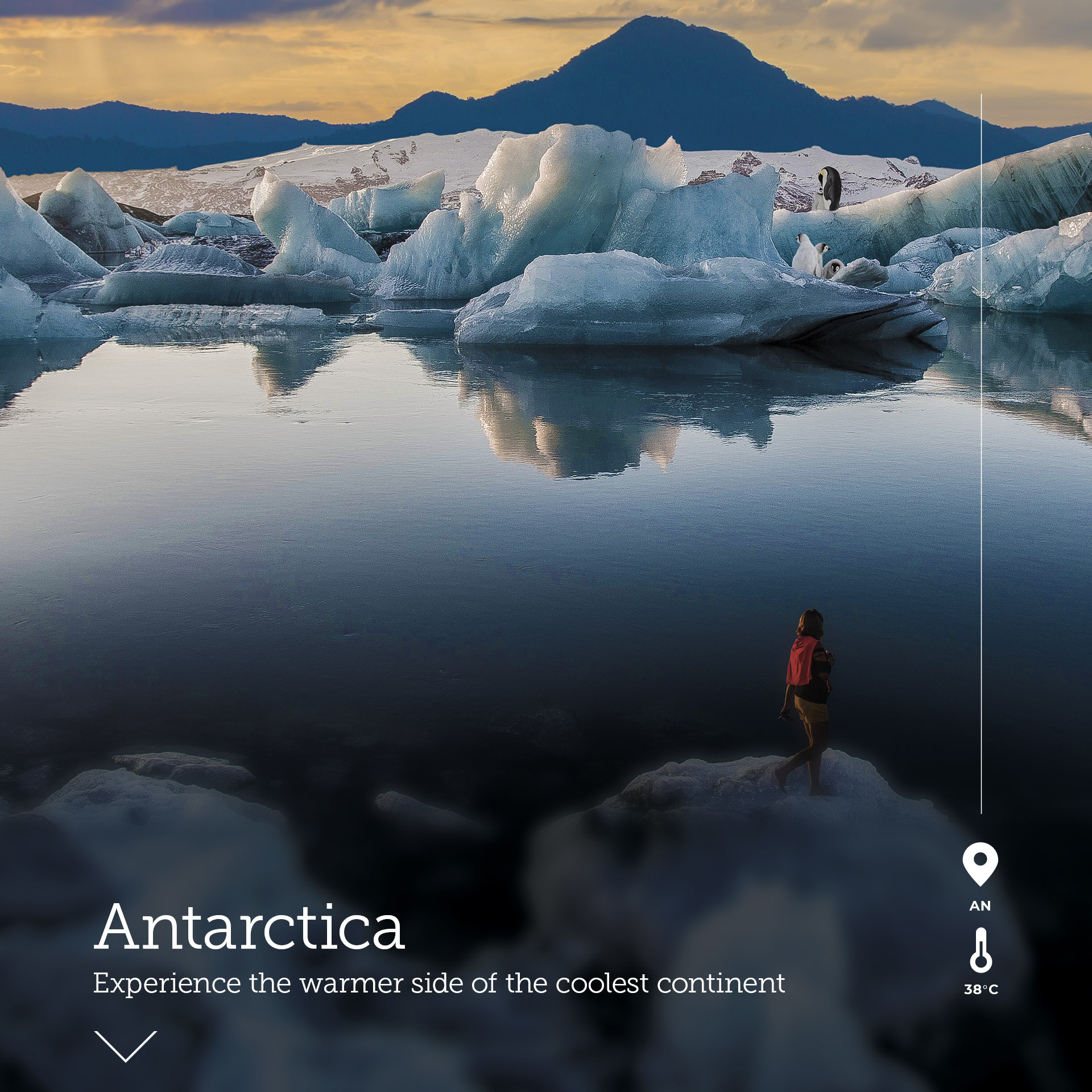
Chill out in the new and improved Antarctica, now with less ice and even fewer penguins!

Leave the bulky parkas and cumbersome snow boots at home: Antarctica is warming up to tourists in a whole new way. Welcome to the world’s most exclusive destination, now more accessible than ever. Long gone are the chilly receptions of the past — say hello to a warmer, more welcoming Antarctic adventure.

Antarctica is melting faster than ever, according to the World Economic Forum, losing 150 billion tons of glacier ice a year. Warmer ocean temperatures melt the ice sheet but also thin the floating ice shelves that hold the ice sheet on the land. As ice shelves lose strength, more ice flows into the sea, raising the sea level and accelerating ice loss. Compared to 2016, the sea ice surrounding Antarctica in 2023 was missing an area the size of Libya.

In March 2022, the most extreme heatwave ever recorded on Earth hit East Antarctica: Temperatures were 38C higher than “normal.” This came as no surprise to Edward Blanchard-Wrigglesworth, part of the research team investigating this event: “The heatwave was skillfully forecast, resulting from a highly unusual weather pattern which produced strong northerly winds and imported warm and moist air from Australia. Weather forecast models predicted the heatwave up to eight days in advance. We found that the heatwave was made 2C warmer by climate change, and we expect future end-of-century heatwaves to be 5 to 6C warmer.”

Sunny days and comfortable nights bring barefoot strolls along the newly formed beaches of the Antarctic coast, where the only ice you’ll find is in your drink. Enjoy the surreal experience of sunbathing where once only penguins dared to tread.

Speaking of penguins, capture the perfect, unobstructed landscape shots in our penguin-less paradise. With these pesky crowds on the decline, you’ll have uninterrupted views of Antarctica’s stunning, changing landscapes.

In 2023, record sea ice loss caused a mass die-off of emperor penguin chicks, prompting concerns the world’s largest penguin species could soon be extinct.

Emperor penguins breed on sea ice rather than on the land. In 2023, the sea ice broke up much earlier than expected, and the fledgling penguin chicks did not have enough time to grow the black waterproof feathers and muscles needed to swim. They fell into the water and drowned or froze: Four out of five colonies suffered a total breeding failure, says British Antarctic Survey’s Peter Fretwell.

“Emperor penguins are an iconic symbol of Antarctica threatened by climate change,” Fretwell says. “Recent efforts to predict emperor penguin population trends from forecasts of sea ice loss have painted a bleak picture, showing that if present rates of warming persist, over 90 percent of emperor colonies will be quasi-extinct by the end of this century. Climate change is considered the only major driver of their long-term population change.”

So grab your swimsuits and prepare to enjoy the new Antarctica with more comfortable temperatures and no pesky penguins underfoot. One dip in the world’s largest outdoor heated pool and you’ll soon forget you’re in the once frozen wilderness.

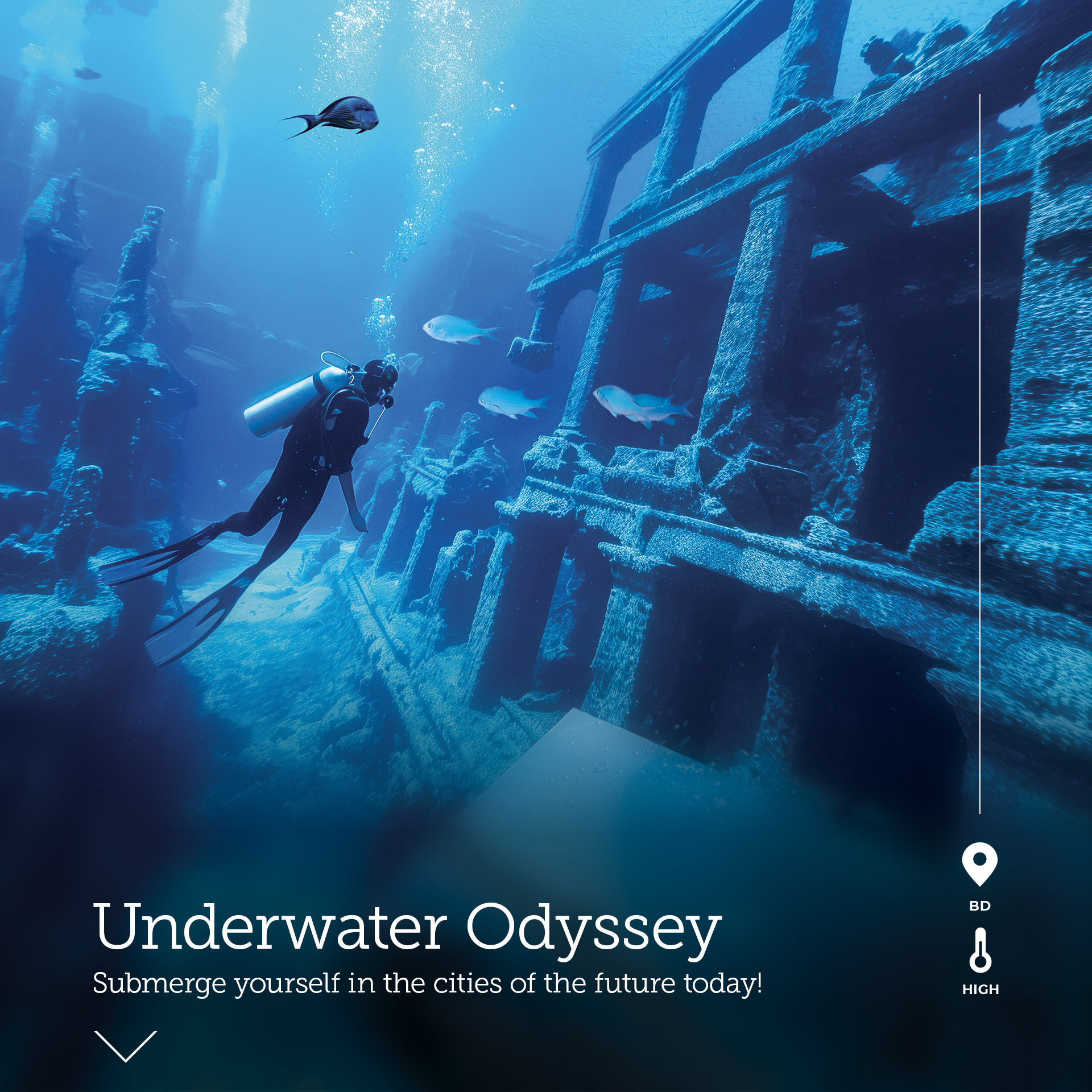
Embark on an unparalleled diving adventure where the treasures of civilization meet the mysteries of the deep. Our exclusive Underwater Odyssey takes you on a submerged journey to the splendors of Bangladesh and Vanuatu in a world tour unlike any other. These destinations are reimagined for a world post-sea-level rise. Strap on your scuba gear and dive into history, culture and the stark reality of our drowning planet.

One of the more dramatic potential outcomes in a warming world is the collapse of the Greenland ice sheet, which could be triggered by a 1.5C rise, and would cause a 7-meter rise in global sea levels. Chad Green, California Institute of Technology, found nearly every glacier in Greenland has thinned or retreated over the past few decades at a rate of 30 million tons of ice per hour. All that water has to go somewhere and that includes the tropical island nation of Vanuatu.

Formerly home to some 260,000 residents, the 82 volcanic islands now sit beneath the waves, creating an 800-mile diver’s paradise. Discover the vibrant coral gardens that have overtaken the once-idyllic archipelago, navigate underwater bungalows and submerged villages, where the fusion of culture and coral creates a breathtaking underwater maze. For the more adventurous, dive into the depths to witness submerged volcanic landscapes, where the fire now dances with the ocean in a steamy, ethereal ballet. The warmth of thermal vents attracts an array of marine life, creating a vivid tapestry of color against the ghostly backdrop of lost lands — perfect for the aspiring underwater photographer!

Sensitive to sea water? Our stop in Bangladesh offers river-water dives through sunken mangrove forests and the drowned streets of Dhaka, where the hustle and bustle of the city have been replaced by the serene silence of the deep. As monsoons intensified and glacial meltwater rushed down from the mountains, severe flood events became more common, hitting the world’s eighth-most populous country. Voyage into the heart of the country that used to sit on the largest river delta in the world, at the confluence of the Ganges, Jamuna and Meghna rivers, and is now a must-visit for fans of ornate architecture home to schools of weaving fish.

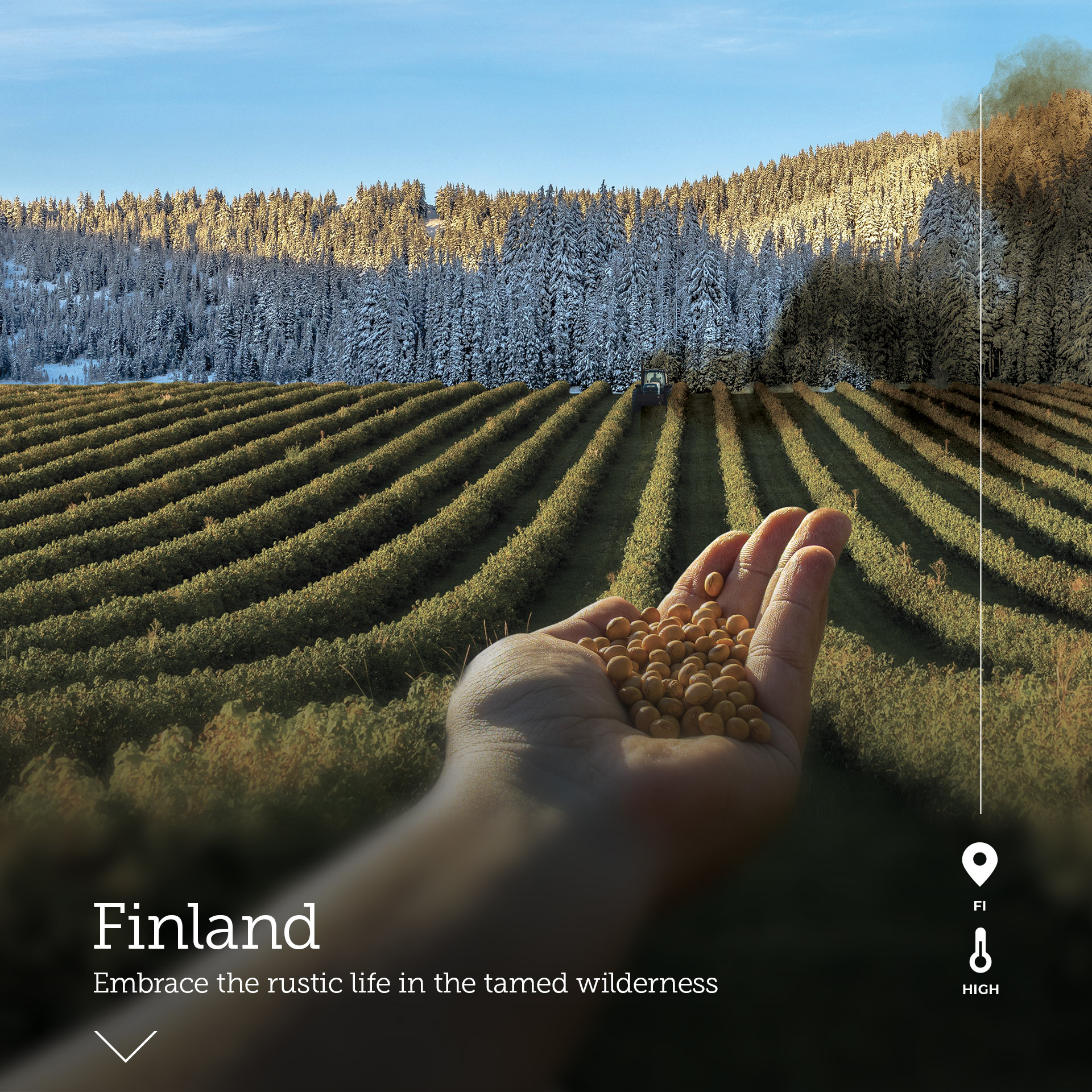
If you want to give back, cultivate change in the land of the midnight sun at this unique Finnish voluntourism farmstay opportunity.
As the world shifts, so too does the landscape of Finland. Once known for its endless forests and frozen tundra, climate change is reshaping parts of this Nordic wonderland into burgeoning farmlands. Dive hands-first into the heart of Finland’s emerging agricultural scene.

Alexandra Gardner, University of Exeter, says as the climate warms, crop production will increasingly shift into wilderness areas: “2.7 million square kilometers of wilderness will become suitable for agriculture within 40 years, equivalent to 7 percent of the total wilderness area outside Antarctica. The increase in potentially cultivable land in wilderness areas is particularly acute at higher latitudes in the northern hemisphere, where 76.3 percent of newly suitable land is currently wilderness. ”

While Gardner’s results don’t account for whether our current crops could be grown in these new areas, you can give it a go as you experience the Finnish countryside like never before. Partake in the cultivation of crops from hearty root vegetables to more exotic produce and witness the green revolution in real-time. Don’t worry about any biodiversity loss or natural habitat destruction: Your farming efforts can only contribute to a greener, more productive farm ecosystem. This isn’t just a holiday: It’s a hands-on contribution to a global challenge.

As climate change redraws the map of what’s possible, your efforts in Finland will help sow the seeds of change.

What are you waiting for?Global climate change isn’t hanging around. With the 1.5C temperature goal slipping out of reach, take the opportunity now to plan your trip to a warmer world. Our carefully curated trips aren’t just adventures; they’re wake-up calls wrapped in an unforgettable holiday package.

Return with not just memories and souvenirs, but with a renewed commitment to protecting what we have left.

More like this: High seas

FLOOD INSURANCE

Storms are becoming stronger, wetter and deadlier. You can thank a warmer, moister atmosphere and heating oceans as the extreme storms they feed produce more rain, stronger winds and heavier flooding. In 2024 alone, hurricanes Helene and Milton left hundreds of billions of dollars in damages while flooding in Afghanistan and Pakistan was blamed for more than a thousand deaths.

Watch video on sponge cities here.

Cities, in particular, may be feeling the effects of these killer storms more intensely than the countryside.

For one thing, urban areas draw more rain: Skyscrapers often slow storms, letting them drop more precipitation in a relatively small area. Pollution like auto exhaust also seeds clouds. And heat rising from pavement and concrete creates convectional rainfall.

IMAGE: ABJAD DESIGN
Protection from heat too

Sponge cities don’t just protect residents from flooding. They also provide relief from extreme heat, says the University of Adelaide’s Scott Hawken. “In cities like Adelaide, heat waves are even more deadly than flooding. They kill a lot of people: the vulnerable, the young and the old. We need to think about how to keep our cities cooler during these extreme events and design parks and gardens to generate cool airflows and bring the surface temperature down,” he says. Read more›››

The best way to do that is to use well-watered and irrigated vegetation to set up cool airflows throughout the city, Hawken says. “It’s not just having a park here. It’s strategic, like a natural air conditioner. We need to think of these larger park systems woven in amongst our cities. These parks need to be well-watered, but that shouldn’t be a problem if resources are used wisely, he says. “Most of the time there is plenty of water in our cities, but we just don’t use it carefully,” he says.

“Many cities around the world are running out of water, but those cities often don’t take care of their water. It’s only when the drought kicks in that the penny drops. But by then it’s too late. We don’t have the systems in place.”  Urban oases in Abu Dhabi helped cool surrounding temperatures by up to 2.2 degrees Celsius, according to a study by Mohamed bin Zayed University of Artificial Intelligence and the tech giant IBM.

Artificial intelligence-enabled technology helped analyze decades of satellite data and provided insights on how vegetation and water bodies make a significant impact on heat islands in the city.   Masdar Park in the Masdar City neighborhood had a 2.2-degree cooling effect in that area, the researchers found. Umm Al Emarat Park, one of the largest and oldest parks in the city, brought down the surrounding temperature by 1 degree.

The researchers suggest the technology can enable sustainable design and help urban planners identify other areas that could benefit from green spaces.  ‹‹‹ Read less

A study published in the Proceedings of the National Academy of Sciences says the effect has become more pronounced over the past two decades.

Listen to the story here

“This is everywhere,” Dev Niyogi, a professor at the University of Texas at Austin and paper co-author, tells the Washington Post. “The magnitude of the impact will vary. But just the way we treat urban heat islands, we should start treating urban rainfall effect as a feature associated with urbanization.”

And some cities that have not previously been associated with flooding are finding that the changing climate may require a different kind of urban planning.

Exhibit A: Abu Dhabi, where record-breaking April 2024 storms brought a year’s worth of rain to the Gulf city in just a day. 

FROM THE GROUND UP

Chinese landscape architect Kongjian Yu has been thinking about that different kind of urban planning for decades.

He won the Cornelia Hahn Oberlander International Landscape Architecture Prize (“Oberlander Prize”) in 2023 for his concept of “sponge cities,” which has inspired projects not only in China, but France, Russia, Indonesia, Thailand and the United States. Yu’s company Turenscape has contributed to more than 600 projects in 200 cities.

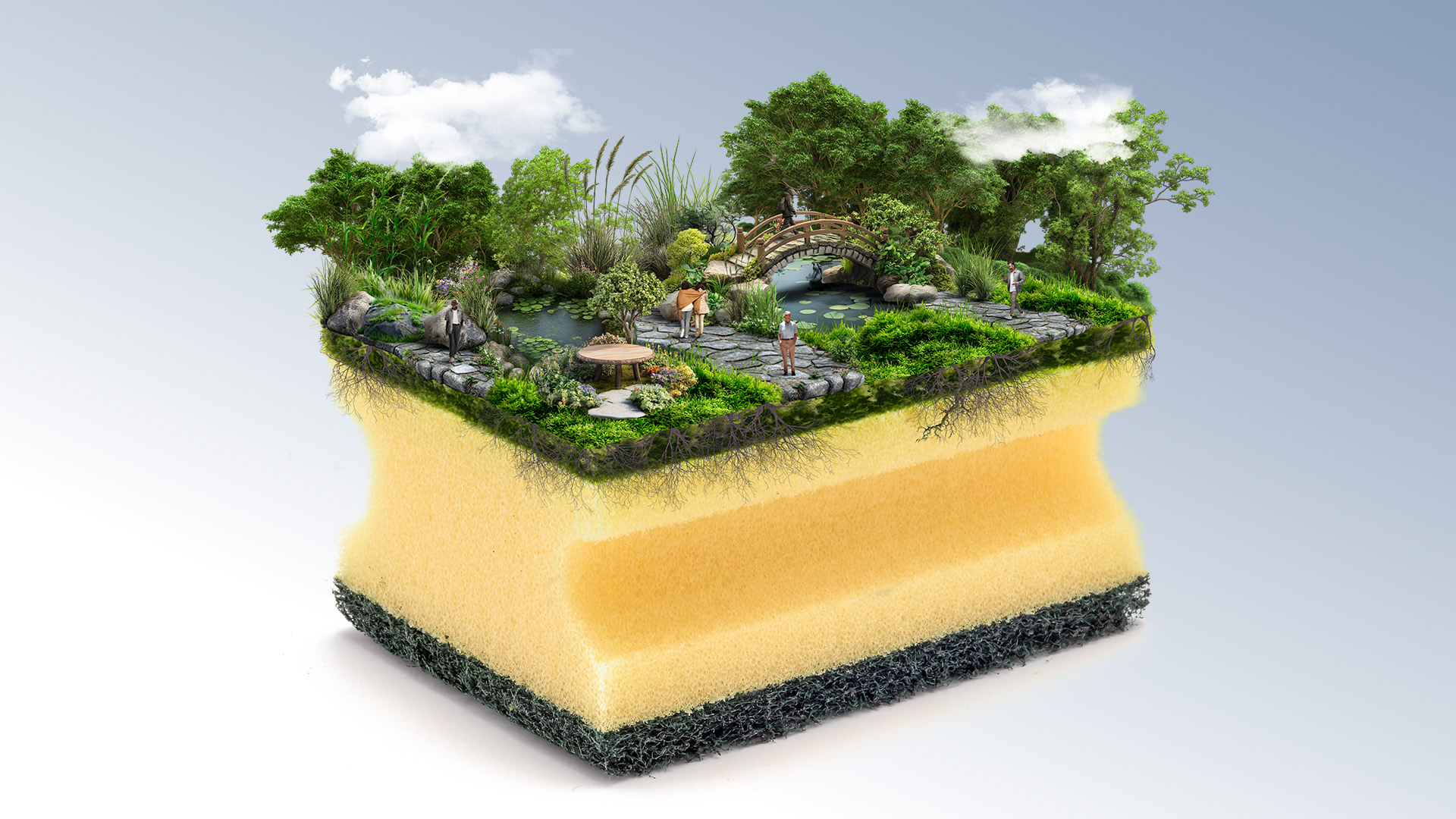
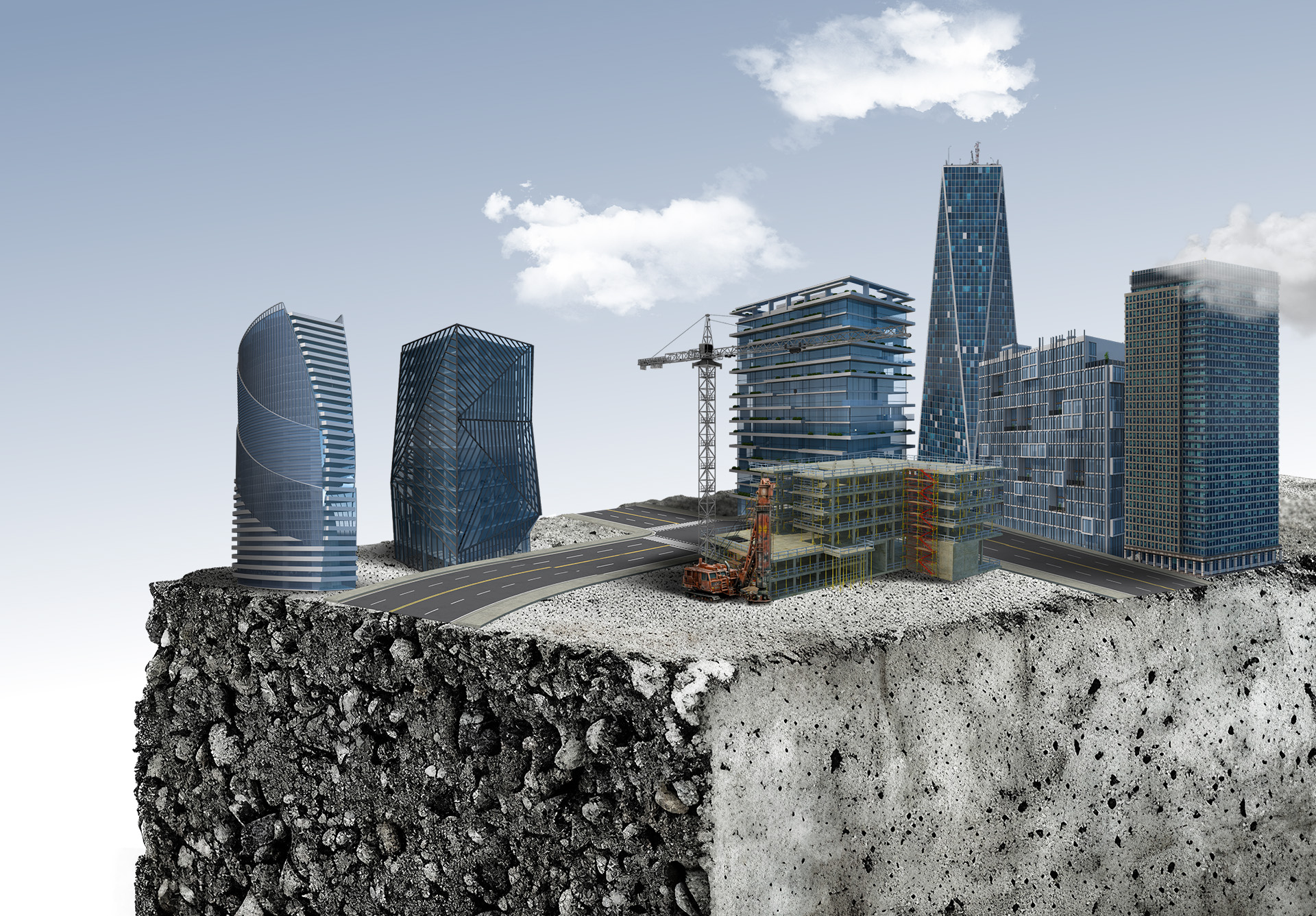
The concept relies on nature – through trees, parks and ponds – and good design to protect cities from flood waters. In essence, rather than rely on concrete drainage systems and flood walls, it makes the city itself a “sponge” to better absorb rainfall.

“There’s a misconception that if we can build a flood wall higher and higher, or if we build the dams higher and stronger, (then) we can protect a city from flooding,” Yu tells CNN. “(We think) we can control the water … that is a mistake.”

Watch: Climate Change, the Classroom Crisis

The stakes are high. An Intergovernmental Panel on Climate Change report says 700 million people live in areas where rainfall extremes have risen. This number is expected to grow as global temperatures increase.

CELEBRATING THE WATER

Scott Hawken, director of the Landscape Architecture and Urban Design program at the University of Adelaide’s School of Architecture and Civil Engineering, uses sponge city principles in his work. It’s about celebrating the water on site, he says.

“This development of the sponge city is about the necessity to manage water in a more intelligent way. It allows water to infiltrate into the landscape and slow it down, to manage it on site rather than what has been done throughout most of the 20th century, which is to expel the water from the city rapidly,” he tells KUST Review.

As Hawken tells it, preparing urban areas to better withstand flooding isn’t just an issue with physical infrastructure, like swapping out concrete gutters for absorbent plants and sandier soils. It requires a change in social perspectives as well.

“The 20th century perspective (sees) water or flooding being a problem or a nuisance.

That’s one cultural perspective that inspired overengineered approaches which haven’t really valued water in the way that it should be valued.


Instead, Hawken suggests looking to communities that consider flooding a part of life, like the cities and settlements of Southeast Asia that have weathered monsoon climates for hundreds of years and longer.

“Floods there are not viewed as a risk. But in the Western context we really fear floods. They’re out of mind until they’re around us, and then we panic rather than thinking into the future and planning to live with floods and work with them on site.”

And where you can’t work with them?

“We’ve also built in a lot of areas which we shouldn’t, like on flood plains.”

MANAGING THE WATER

Hawken isn’t just concerned with creating a landscape that better absorbs water but cities that manage the rain wisely.

“The irony is often you have a very wet landscape that has a lot of water but also has to pipe water in because it’s not using water in a smart enough way. It isn’t recycled, filtered and reused.

“People have a resistance to that. But some of the traditional societies have been reusing and recycling water in intelligent ways for a long time. We need to get over that. The technology is certainly there.

“The filtered and recycled water is often much cleaner than the water that’s not,” Hawken says.

Singapore, he says, is an example of a city that is successfully reusing and recycling its water resources.

“A lot of the technology that was developed in Australia has been exported to places like Singapore. Now they’ve taken those ideas and run with them, probably doing a better job than anywhere else.”

DESERT SOLUTIONS

Dubai entrepreneur Chandra Dake has also been thinking about managing flood waters and collecting rain for reuse. His inspiration: the United Arab Emirates’ desert sands.

Dake and his company, Dake Rechsand, use the plentiful sand to create permeable materials that not only allow water to pass through but filter it on its way to underground honeycomb storage tanks. These tanks keep the water fresh without chemicals or electricity.

“Every nook and corner, every junction, can become a storage house of water,” he says. “That reduces the burden of centralized storm management, which is normally implemented in advanced cities across the globe.”

He points to a project in Beijing that used his technology to address chronic flooding problems that led to frequent traffic jams.

“This area that used to flood is now able to harvest every drop of water. The surface is now used for a recreational facility. All the rainwater goes underneath it. After implementing it for the last two, three years there’s no more flooding, not even one traffic jam. And the water? It’s literally like distilled water.”

Saving the water from just one storm would be a huge benefit for UAE cities that rely mostly on energy-hungry desalination technology, he says.

That record-breaking 2024 storm? The water could have been used for two or three months cleaning roads, improving irrigation and watering greenery, he says.

Instead, it went to waste. “All of that water was discarded. Not even one cubic meter was used.” Dake says his technology can easily be integrated into an existing infrastructure. “You can build a road. You can build paving. You can build anything. And these can be retrofitted as well.”

The materials are suitable for both hot and cold climates, Dake tells KUST Review. “And one important element is these materials are made from desert sand. Desert becomes a solution for global problems.

“We will see enormous social, environmental and economical benefits,” he predicts.

More like this: A river runs over it

Sands of change

Sand dunes form when wind blows sand into piles, creating shapes depending on the wind speed and direction. Sand blows up the windward side of a dune and slides down the leeward side. Like a game of leapfrog, the dune slowly moves.

This movement is glacial — incremental movements as small as a grain of sand each time — but over time these movements add up. And climate change could change their speed, shape and direction.

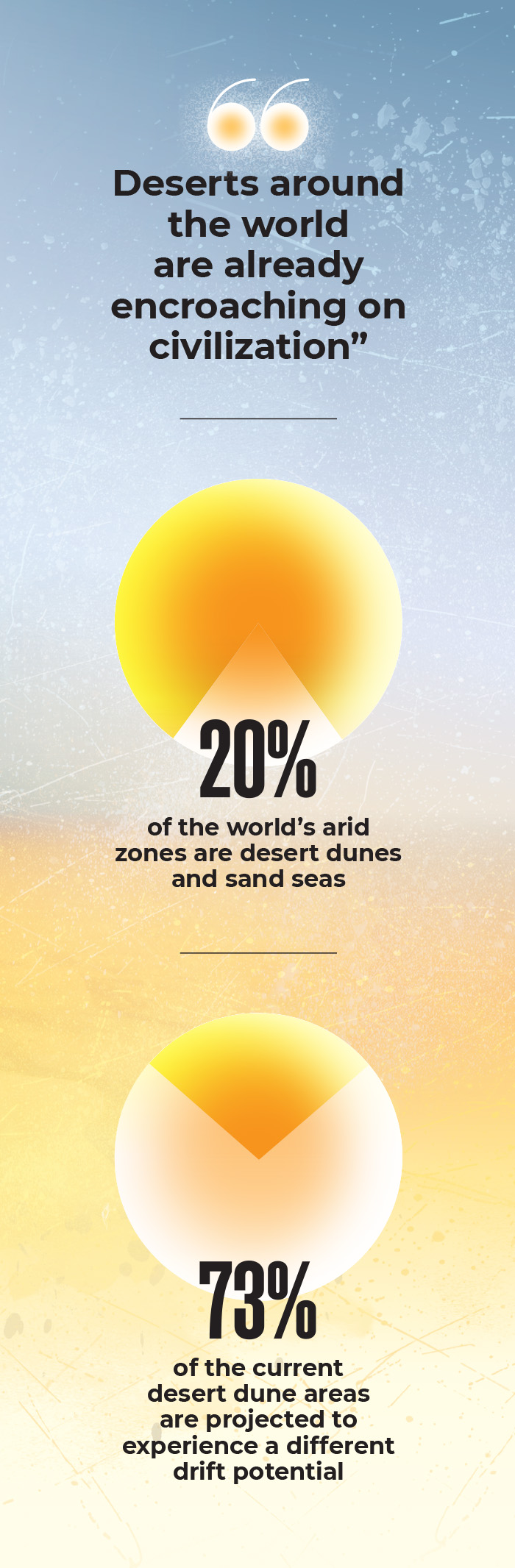
Deserts around the world are already encroaching on civilization, threatening farmland and infrastructure. The rate at which dunes move varies, depending on the velocity of the wind and the topography of the region.


“Sand dunes in arid regions are conspicuous mobile landforms that require adaptation and mitigation strategies to protect human infrastructure and economic assets from encroachment, and (they) play a substantial role in desertification and atmospheric dust emissions,” says Andreas Baas, professor of aeolian geomorphology at King’s College London. “Desert dunes and sand seas cover approximately 20 percent of the world’s arid zones, and their morphology and patterning are an important diagnostic of environmental surface conditions, not only on Earth, but also on other planetary bodies.”

Baas’ latest research focused squarely on terrestrial sand as he and King’s College London colleague Lucie Delobel investigated how the shape, migration speed and direction of mobile desert dunes are projected to change by 2100 around the world in direct response to changes in wind patterns. The researchers say a changing wind climate plays a key role in this — and climate change is in the driver’s seat.

“We were surprised to find many regionally significant future increases in potential sand drift and changes in wind regime, which can impact the migration and shape of desert dunes,” Baas tells KUST Review. “The general assumption previously was that global warming leads to smaller temperature differences around the world (because poleward regions are heating up more) and that these smaller temperature differences would lead to weaker winds. We found that the poleward expansion of monsoon systems in particular will have a major impact on dunes in places like Oman and Mauritania.”

Baas points out that while most dunes around the world are unlikely to change their shape due to changes in winds, around 10 percent will, and some dune fields are likely to change their direction of movement.

Watch: The Global Impact of Middle East Dust Storms

“We found that 73 percent of the current desert dune areas are projected to experience a significantly different drift potential,” Baas says. Drift potential is defined as the total amount of sand transportation by wind. “Around one-third of desert dune areas will see an increase, while the other two-thirds will see a decrease.”

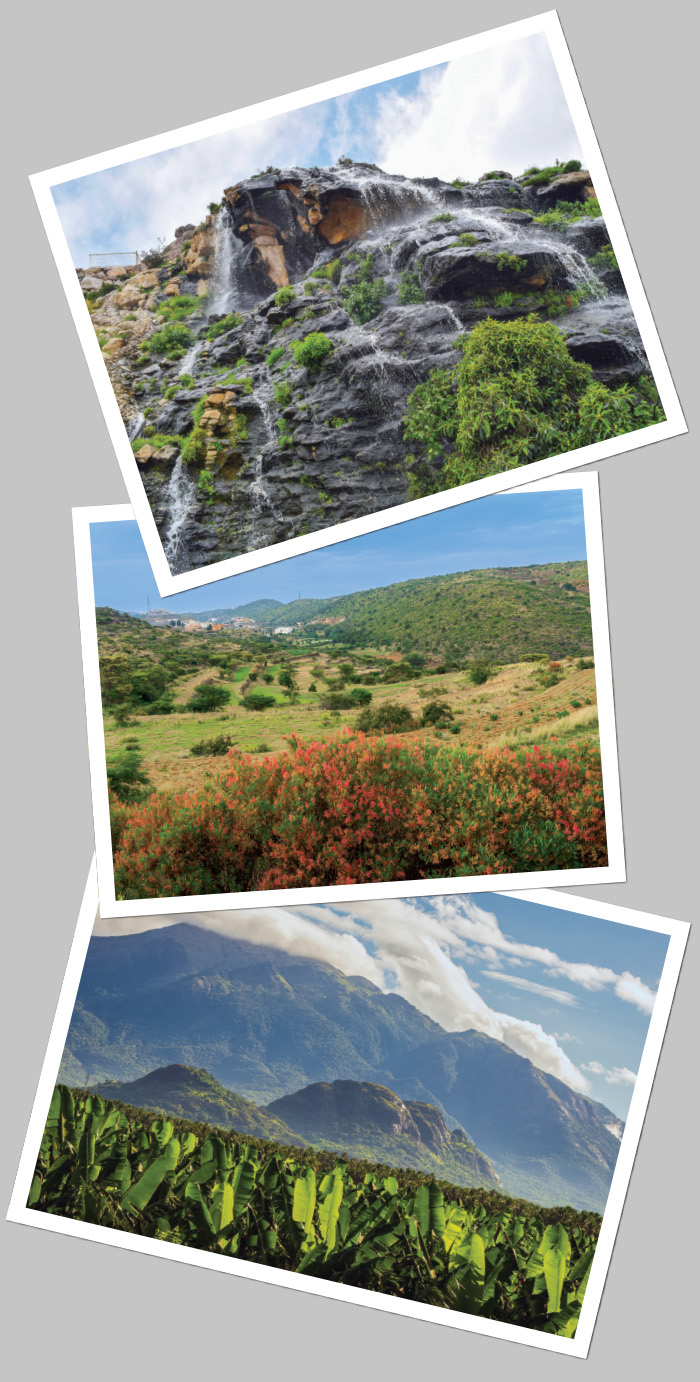
CAPTION: These photos are not of tropical forests in Brazil nor the country side of Italy, but of south of Saudi Arabia. IMAGE: Shutterstock
Longer springs, warmer nights

The arid and semi-arid regions in northern Africa and southwest Asia have been expanding, exacerbated by rapid population growth and climate warming, according to a study in Scientific Reports from Khalifa University’s Diana Francis and Ricardo Fonseca. Read more›››

The study investigates atmospheric circulation changes and their effects on clouds, moisture, dust and radiation across northern and equatorial Africa, southern Europe, the Middle East and southwest Asia.
The researchers note that daily nighttime temperatures are increasing faster than daytime temperatures, particularly in summer, due to higher atmospheric moisture and dust levels.

In winter, convective regions have shifted eastward in Africa, increasing low-level clouds in subtropical regions and shifting dusty areas southward. Future climate projections (2066-2100) suggest longer springs and shorter autumns.

The subtropical highs over North Africa and the Arabian Peninsula are projected to migrate poleward by 1.5 degrees in latitude, a trend statistically significant at 95 percent confidence level, in line with the projected expansion of the Hadley Cells. The Hadley Cells are the convective cells over the tropics. As they expand, the southern Arabian Peninsula (currently subtropics) may shift toward a tropical-like climate with increased rainfall frequency per year

The study highlights the importance of accurate, high-resolution climate models that account for dust and pollutants in the MENA region. Such models, the researchers note, are crucial for reliable climate projections and for supporting climate resilience and mitigation initiatives, including the transition to renewable energy sources.‹‹‹ Read less

Dune movement will still be very slow and incremental, but over time it could cause serious problems to infrastructure and the fragile ecosystems surrounding areas of sand.

“In many desert countries, the layout of settlements and infrastructure has been historically adapted to the local dune shapes and dynamics,” Baas says. “In the UAE, for example, there are many villages and infrastructure — even airports — that are built in between long seif dunes that run from west to east. If those seifs break up into smaller dunes, they may migrate towards a more southerly direction and those settlements will become buried by sand. In other places, such as Rajasthan, sand dunes may migrate faster and become a bigger problem to deal with where they’re overrunning agricultural fields.”

The researchers note that changes in dune behavior may need to be considered in planning and management efforts as mitigations designed for the current wind climate, such as sand fences and green belts, may become locally less effective — under a changing wind direction, for example — or even unnecessary, if dunes transform from a migrating to an elongating type. More precise models are needed for site-specific recommendations.

“The planet’s history has seen many vast changes in deserts and dune fields in its long history, but now is the first time that humans have come along and have built assets in between the dunes,” Baas says. “Our projections based on a global climate-change model suggest that potential sand drift in the UAE may decrease somewhat in the future, but these global models are not good at representing regionally important weather events like the shamal. And other studies predict that such extreme events will become stronger, in which case future shamal winds may kick up more dust and move more sand.”

More like this: Dust busters

A Hot Topic

Climate change is undeniably affecting the Earth. But how will those changes affect us and our neighbors near and far? We asked our experts: What are the anticipated implications of rising temperatures for human societies?

Rising oceans put lives and economies in peril
— Elizabeth Phillips

Today we can see that rising sea levels are negatively affecting coastal ecosystems and communities, ushering in a wave of unprecedented challenges.

Over the past century, sea levels around the world have risen on average 23 centimeters, and this number is increasing every year. Research published in February 2022 shows that sea level rise is accelerating and projected to rise by 30 centimeters by 2050.

Sea level is controlled by both water temperature (thermal expansion) and melting ice caps and glaciers. Due to climate change, the oceans as well as the atmosphere are getting warmer.

In the past century, the oceans have become about 0.1 degree Celsius warmer. This does not sound like a lot, but warmer, expanding oceans caused about half of the rise in sea level in the past century. The other half can be attributed to melting ice caps and glaciers.

Elizabeth Phillips

Elizabeth Phillips is an environmental Consultant with GHD Global Pty Ltd. with industry experience in Canada and consulting experience in South Africa. She holds a B.Sc. from the University of Calgary.

The global ocean covers close to three-quarters of the Earth’s surface, and around 40 percent of the world’s population lives within 100 kilometers of the coast. Densely populated cities like Shanghai, Jakarta and Hanoi are in danger of flooding from even a small rise in sea levels. If the flooding is too much, vulnerable populations may be displaced temporarily or permanently.

Higher sea levels are eroding coastlines, resulting in the loss of land and habitat for plants, animals and people. Coastal erosion also causes loss of infrastructure, including homes, roads, agricultural land, ports, airports and power plants or at least making them more susceptible to damage and disruption.

Some of the world’s most visited beaches are suffering coastal erosion. It happens faster when supercharged storms repetitively hit beaches, chipping away at the coastline. Over recent years, we have seen increased frequency and severity of storm surges during hurricanes and tropical storms, leading to more severe flooding in these coastal regions.

As sea levels rise, salt water will contaminate freshwater sources, the water we drink. It will also make things more difficult for farmers, plants and animals and will have a huge economic impact on coastal areas. Many ocean species are in decline because of pollution and warming seas. Coastal ecosystems, such as mangroves here in Abu Dhabi and coral reefs, suffer significantly due to submersion and habitat degradation.

The economic consequences and global implications are huge. Coastal economies, especially those dependent on tourism and fisheries, may suffer from the loss of infrastructure and the decline in natural resources.

Displaced people and disrupted economies can have global effects, influencing trade, food supply chains and international relations.

Addressing the multifaceted impacts of rising sea levels demands a comprehensive global response. Sustainable coastal development, adaptation measures and efforts to mitigate climate change are essential to helping our coastal communities and the planet.


Here’s how agriculture weathers new challenges
— Tarek Kapiel

Rising temperatures have a number of anticipated implications for human societies, but one of the most critical for the UAE and other Arab nations is their effect on food security.

The agricultural systems of Arab nations, with their arid and semi-arid climates, are vulnerable to disruption in several ways.

Changes in precipitation patterns: Rising temperatures can alter rainfall patterns. In some regions, this may result in more frequent and severe droughts, negatively impacting soil moisture levels and crop growth. In other cases, intense rainfall can cause soil erosion and waterlogging, further affecting agricultural productivity.

Tarek Kapiel

Tarek Kapiel is assistant professor of plant biotechnology, botany and microbiology at Cairo University.

Droughts: Higher temperatures can exacerbate drought conditions by increasing evaporation rates, reducing soil-moisture content and intensifying water scarcity. Droughts can lead to decreased crop yields, reduced livestock productivity and increased competition for water resources. Such disruptions in agricultural production can result in food shortages, price increases and economic instability, with potential implications for social unrest.

Increased pest activity: Insects, fungi and other pests thrive in warmer conditions, leading to increased infestations and crop damage. This can further reduce crop yields and necessitate the use of more pesticides, which may have environmental and health consequences.

The implications of rising temperatures for food security vary across the UAE and other Arab nations due to differences in climate, geography and agricultural practices.

In arid regions, such as the Arabian Peninsula, water scarcity is already a significant challenge, and rising temperatures can compound this issue. Coastal areas face additional risks due to the potential for sea-level rise and saltwater intrusion into agricultural lands.

Fortunately, there are potential solutions. These include:

  • Improving water-management practices, including increased water efficiency, desalination and wastewater reuse.
  • Promoting sustainable agricultural practices, such as precision farming, organic farming and agroforestry, to enhance resilience to climate change.
  • Investing in research and development to develop drought-resistant and heat-tolerant crop varieties suitable for the local climate.
  • Enhancing agricultural infrastructure, including irrigation systems, storage facilities and transportation networks, to reduce post-harvest losses and improve market access.

In the meantime, the implications of rising temperatures on food security have sparked ongoing policy debates in the UAE and other Arab nations.

These debates revolve around issues such as balancing agricultural development with environmental sustainability; promoting climate change adaptation and mitigation measures; encouraging international cooperation and knowledge sharing to address common challenges; and integrating traditional knowledge and local practices with modern technologies and innovations.

Understanding the regional variations, exploring potential solutions and engaging in ongoing policy debates are crucial for mitigating the adverse effects of climate change.

By adopting sustainable practices, investing in research and development and fostering international collaboration, the UAE and other Arab nations can enhance their resilience and ensure food security for their populations in the face of rising temperatures.


There’s a human cost to a warming world
— Maryam Saad

Throughout Earth’s history, only creatures capable of adapting to environmental shifts have survived. to enhance resilience to climate change. This principle presents a stark challenge as we face the escalating threat of global warming.

As the planet heats up, we must confront its myriad implications on human health.

Scientists have dedicated immense effort to studying these complexities, revealing a range of potential health risks. These include heat-related illnesses, compromised water and air quality, rising rates of vector-borne diseases, and threats to food safety and nutrition.

Maryam Saad

Maryam Saad holds an M.Sc. degree in biochemistry from Alexandria University, Egypt.

In global climate action at COP 27, parties renewed commitment to limiting global temperature rise to 1.5°C. The Intergovernmental Panel on Climate Change (IPCC) report assessed the impacts of a 1.5 – 2 degrees Celsius increase above pre-industrial levels and the potential consequences if we fall short of maintaining the global average temperature increase of less than 1.5°C.

One of the direct risks is increased heat-related illnesses and diseases, particularly to vulnerable populations like the elderly, pregnant women, children and urban residents.

Cardiovascular diseases top the list of heatwave-related fatalities, followed by dehydration, hypertension and respiratory and cerebrovascular issues. A chilling estimate suggests that a 2 degrees Celsius increase could make heatwaves, such as the one that struck Pakistan in 2015, frequent occurrences.

Another threat is an escalation of infection with vector-borne diseases, especially in tropical regions like Africa. Increased heat could lead to an increase in mosquito populations, thus escalating the risk of malaria, dengue and other vector-borne infections.

Warmer temperatures would also cause a shift in flowering time pollen initiation in allergenic plant species, and continuous exposure can worsen allergic responses in predisposed individuals. Those health risks will exert extra pressure on the health-care system.

Embracing climate mitigation and adaptation strategies is crucial to protect human health. Transitioning to a low-carbon future presents an opportunity for both sustainability and economic growth. By acknowledging the threats and taking decisive action, we can forge a healthier, more secure future for all.

More like this: Feeding tomorrow