The United Arab Emirates is a popular tourist destination, with much of the draw attributed to its impressive megastructures: the Burj Khalifa and the Future Museum in Dubai, Abu Dhabi’s Emirates Palace and Qasr al Watan, the Louvre and, of course, Sheikh Zayed Mosque.
There is over U.S. $710 billion invested in ongoing construction projects aimed at fostering economic growth and development. At the same time, architectural marvels and rapid urbanization often come at the cost of environmental sustainability.
Listen to the Deep Dive:
Shadeedha Saradara is a Ph.D. student at Khalifa University. With KU professor Malik Khalfan, she examined the sustainability initiatives surrounding construction efforts in the UAE, evaluating their effectiveness and drawing comparisons with regional and international standards.
The UAE government is unequivocally committed to attaining its sustainable development goals.
– Shadeedha Saradara, Khalifa University
Saradara says the built environment is a major contributor to global environmental challenges, responsible for over 50 percent of the annual global extraction of materials and a significant portion of greenhouse gas emissions.
“In 2015, the same year members of the U.N. signed the Paris Agreement to substantially reduce global greenhouse gas emissions, the construction industry was responsible for 38 percent of the total world carbon dioxide emissions,” Saradara says. “It’s imperative that we quickly and substantially reduce these emissions in the building sector on a worldwide scale if we want to achieve the objectives outlined in the Paris Agreement.”
However, the journey to sustainable construction is fraught with obstacles. The UAE, a nation synonymous with rapid development and constant construction, serves as a case study for this challenge.
“The UAE’s transformation from a modest economy to a global hub has been meteoric,” Saradara says.
IMAGE: Unsplash
“But this comes with a hefty carbon footprint. The construction sector here must now pivot toward a circular approach that emphasizes reuse and minimizes waste. This isn’t just an environmental imperative, it can also have economic benefits, reducing the long-term costs associated with material consumption and waste management,” she adds.
Saradara notes the UAE’s commitment to sustainable development is evident in its policies and practices. Despite its reliance on fossil fuels and the environmental pressures of air-conditioning and desalination, the country is striving to reduce its carbon emissions and enhance its sustainability credentials.
“The construction sector stands as a cornerstone of the UAE’s economy, but this comes with a set of environmental responsibilities,” she says. “There are new green building standards and certifications which are augmented by existing global certifications, and efforts to reduce emissions from the construction industry and construction and demolition waste are all backed up with Emirate-level programs and policies.”
More legislation and initiatives are still needed to address the challenge of sustainable construction, but Saradara says the UAE is definitely heading in the right direction: “The UAE government is unequivocally committed to attaining its sustainable development goals, showcasing its dedication to ensuring a sustainable future for its population and natural resources.”
In June 2023, Rowan Atkinson – the versatile English actor, comedian and writer – authored an opinion piece for the Guardian casting doubt on the environmental benefits of electric vehicles (EVs) powered by lithium-ion batteries.
Listen to the Deep Dive:
While the arguments and studies he based his arguments on have been debunked, he rightly argued for more focus on hydrogen-powered vehicles.
It, however, is too early for hydrogen vehicles since there currently are just 72,000 hydrogen-fueled vehicles on the planet. In comparison to the 14 million EVs sold the previous year alone, the hydrogen-vehicle numbers pale. It, however, is indisputable that hydrogen-fuelled vehicles will be one of the major players in the times to come.
Intelligent Energy, a start-up in Leicestershire, U.K., has started to roll off the hydrogen fuel cell units capable of powering cars, trucks and buses. BMW is heavily invested in hydrogen-powered vehicles and has started delivering its iX5 hydrogen vehicles to select partners in Europe, the U.S. and Asia. While the hydrogen-vehicle future is already here, there has been a keen interest in hydrogen as a fuel for the aviation industry.
The aviation industry is a vital part of global transportation and economic growth but its heavy dependence on fossil fuels and thereby greenhouse gas emissions is a severe problem.
Mudasir A. Yatoo, Ph.D.
—Research associate in the Materials Department at Imperial College London and freelance consultant at Outsmart Insight.
In order to tackle these challenges, hydrogen as a fuel is emerging as a promising solution.
One of the primary motivations for exploring hydrogen as an aviation fuel is its potential to reduce carbon emissions. When combusted, hydrogen produces only water vapor as a by-product, presenting a pathway to mitigate the aviation industry’s carbon footprint.
Hydrogen for aviation comes with benefits including environmental sustainability; energy efficiency; versatility in terms of production and scalability; and synergy with other renewable energy sources such as wind and solar energy.
Fuel cells and hydrogen storage systems are two such technologies that have the potential to provide the necessary energy density and power output for commercial aviation.
The ability to store significant energy in a small space is vital for long-range flights and heavy payloads. The energy content per unit mass of hydrogen is 120 MJ/kg, the highest, but its volumetric energy density is very low because of its exceptionally low density at ordinary temperature and pressure conditions.
Although hydrogen’s energy density per unit volume is lower than traditional jet fuels, advancements in fuel cell and storage technologies are making it increasingly feasible for commercial aviation.
However, major challenges in infrastructure, technological advancement and safety remain. Establishing a strong hydrogen infrastructure including the availability of hydrogen at airports worldwide is one such key challenge.
Developing and integrating hydrogen storage, transportation and refueling infrastructure into existing airports are crucial.
Hydrogen is highly flammable and requires careful handling to ensure safety. Adequate safety measures and regulations and learning lessons from existing hydrogen applications, such as fuel cell vehicles appear to be the way forward.
Therefore addressing safety concerns and public perception surrounding hydrogen in aviation should be prioritized.
Furthermore, a concerted effort is required: Collaboration among government bodies, industry stakeholders and research institutions is necessary.
The road to the hydrogen-based aviation industry is long, but world governments’ policy support and funding with a clear focus on emissions-reduction targets could very well catalyze the transition sooner than later.
Mudasir A. Yatoo, Ph.D., is a research associate in the Materials Department at Imperial College London and freelance consultant at Outsmart Insight.
“Space exploration is a material-science saga, because independent of the electronics and so forth, materials are the enabling technology for the challenges that exist in space.”
That’s according to Carlo Iorio, director of the Center for Research and Engineering in Space Technologies at the University of Brussels. And the game-changers he’s most excited about: graphene and other 2D materials. “2D materials can be used and embedded for solving (many) different problems,” he tells the KUST Review.
Listen to the Deep Dive
IMAGE: Anas Al Bounni/KUST Review
Graphene might be the granddaddy of 2D materials, but it is relatively new, discovered in 2004, winning Andre Geim and Konstantin Novoselov a Nobel Prize in 2010 for its isolation. The material is a single layer of carbon atoms in a hexagonal pattern. It is tough, flexible, light and offers high resistance.
“The properties of graphene are exceptional in many ways,” says Yarjan Abdul Samad, who earned his Ph.D. at Khalifa University, studied the properties of 2D materials as a postdoc at Cambridge University, and has recently returned to Khalifa as an assistant professor in aerospace engineering.
Samad says the discovery of graphene launched a tidal wave of 2D material research: “There are thousands of new 2D materials now under investigation because of the discovery of graphene. It’s as if a new periodic table has erupted,” he says.
“Every property can be utilized for an application not possible for traditional materials. That keeps me intrigued. For me, especially when I look at the challenges of space, whether it’s thermal management or radiation protection or long journeys, there are so many issues that need unconventional solutions. 2D materials are versatile and tunable to solve many problems,” Samad says.
Here’s a look at some of the issues of space travel and settlement Iorio and Samad say 2D materials might address:
Radiation protection
Space radiation is often considered the top limiting factor of long-term space travel, with astronauts likely facing risks of cardiovascular and degenerative disease and cancer.
“I may be biased on this, but top of the list (of 2D applications) is radiation protection. Everyone is concerned about radiation and there have been many radiation-related incidents. So, how can we protect against radiation?” Samad asks. “It’s a very complex phenomenon, and conventional materials won’t work against galactic cosmic radiation. We need to come up with an approach where we can have selective protection.”
Graphene and hybrid solutions might be the answer, he suggests.
Space radiation is also on the top of Iorio’s list of 2D applications for space – “first and foremost,” he says.
Space shields will allow human exploration over long distances, he says. “At present it’s fairly challenging to settle on Mars.”
Samad worked with the UAE’s Mohammed Bin Rashid Space Center on the Rashid Rover project that was presumed lost when its lander apparently crashed in April 2023.
IMAGE: Anas Al Bounni/KUST Review
But plans are underway for Rashid 2, and Samad says studying radiation’s effects on 2D materials is under discussion. “(This) is one of the most pressing challenges, in my opinion,” he says.
Suits and habitats
Advanced materials are required for making temperature-resistant suits and structures for people to use on Mars or the moon, Iorio says. 2D material molybdenum disulfide will play a role in this specific challenge, he adds. 2D materials could also be useful in other construction applications.
Khalifa University is exploring rubber-based components with graphene to not only withstand the extreme temperatures but help the infrastructure sustain moonquakes, Iorio notes. “If it’s rigid (the structure) will break. Imagine if the cracks allowed the O2 out.”
Transporting materials from Earth into space is expensive. But 2D materials are light. And Samad sees potential for them to turn matter found on the moon or other worlds into building blocks for settlements. “There could be composites or hybrid materials,” he says. “There are many approaches that can be taken.”
IMAGE: Anas Al Bounni/KUST Review
And once the habitat is built, keeping it a healthy environment for human residents could also fall on 2D materials.
“Graphene and graphene oxide can play a role in materials that can prevent the spread of bacteria and foreign biological elements,” Iorio says. “Imagine in a sealed human base if an epidemic is spread. We’re at the level of a sci-fi scenario.”
Thermal regulation
“How can we stand the lunar nights and what kinds of materials can help with that?” Samad asks.
2D materials show promise: Not only can they resist the extreme temperatures of space, they are excellent candidates to transfer the heat from, for example, a sun-facing side of a craft to the side facing away, where the temperatures could vary by 200 Celsius. And because 2D materials are, well, 2D, they require little space, freeing up room for bigger habitats.
“In space you have a lot of heat that is lost. So (2D) materials like MXenes have been used because they have a low infrared signature,” Iorio says.
Propulsion systems
“Another application is the propulsion system for a rocket. 2D materials can easily be functionalized,” Iorio says.One possibility: sails made from graphene membranes powered by light from the sun or lasers, freeing spacecraft to travel farther and longer without having to carry fuel on board. The craft would also be lighter, nimbler and easier to launch. The European Space Agency says graphene has passed initial tests that show it is a viable candidate.
IMAGE: Anas Al Bounni/KUST Review
Earthside applications
What we learn from our space exploration attempts can be quite useful for us at home too, here on Earth. The problems graphene and other 2D materials solve in space can easily be transferred to Earthbound issues, Iorio says. “The problem of scarcity that we solve in space will be used to solve the problem of rising scarcity anywhere,” he says.
Filters and membranes developed for recycling water on a moon base, for example, can help conserve resources on Earth.
“The technology that we develop for space is capable of exploiting every single drop of water, which is the same goal of a sustainable economy,” Iorio says. “There is also a scarcity of power. That means that the concepts we develop for space are to use the least energy. Regardless of how far we get in space, this will possibly be used on the ground to reduce energy consumption.”
Samad sees advances in radiation protection eventually protecting data centers on Earth whose systems are vulnerable to cosmic radiation. Additionally, thermal management in spacecraft could eventually improve technology for trains and transportation in general.
“In the Emirates there is a growing interest in sustainability,” Iorio says. “Despite the luxury of the lifestyle, there is more attention to sustainability, reducing the carbon footprint and so forth. I have been in developing countries but one of the things that strictly relates space exploration with sustainable development is they share the need to tackle the scarcity of resources.”
As the world looks to a renewable-energy future, storage becomes a concern because with renewables, supply and demand aren’t always in balance.
Renewable energy sources such as wind and the sun aren’t always “on” when consumers need energy, and excess power that can’t be used immediately is wasted unless it’s stored.
Storing energy can be expensive, however, so some utilities use plants that burn fossil fuels to make up the difference during times of peak demand. Those plants operate most efficiently when at full power, however, and using these plants to redistribute power can lead to more pollution.
Chemical batteries are useful for electric vehicles but they may not be the best option for utility companies. Chemical batteries’ life cycles can also be short. Lithium ion batteries, for example, last about five to 10 years. They’re expensive. And the metals used to make them raise issues of geopolitics and human rights.
Looking at other materials seems to be a good idea.
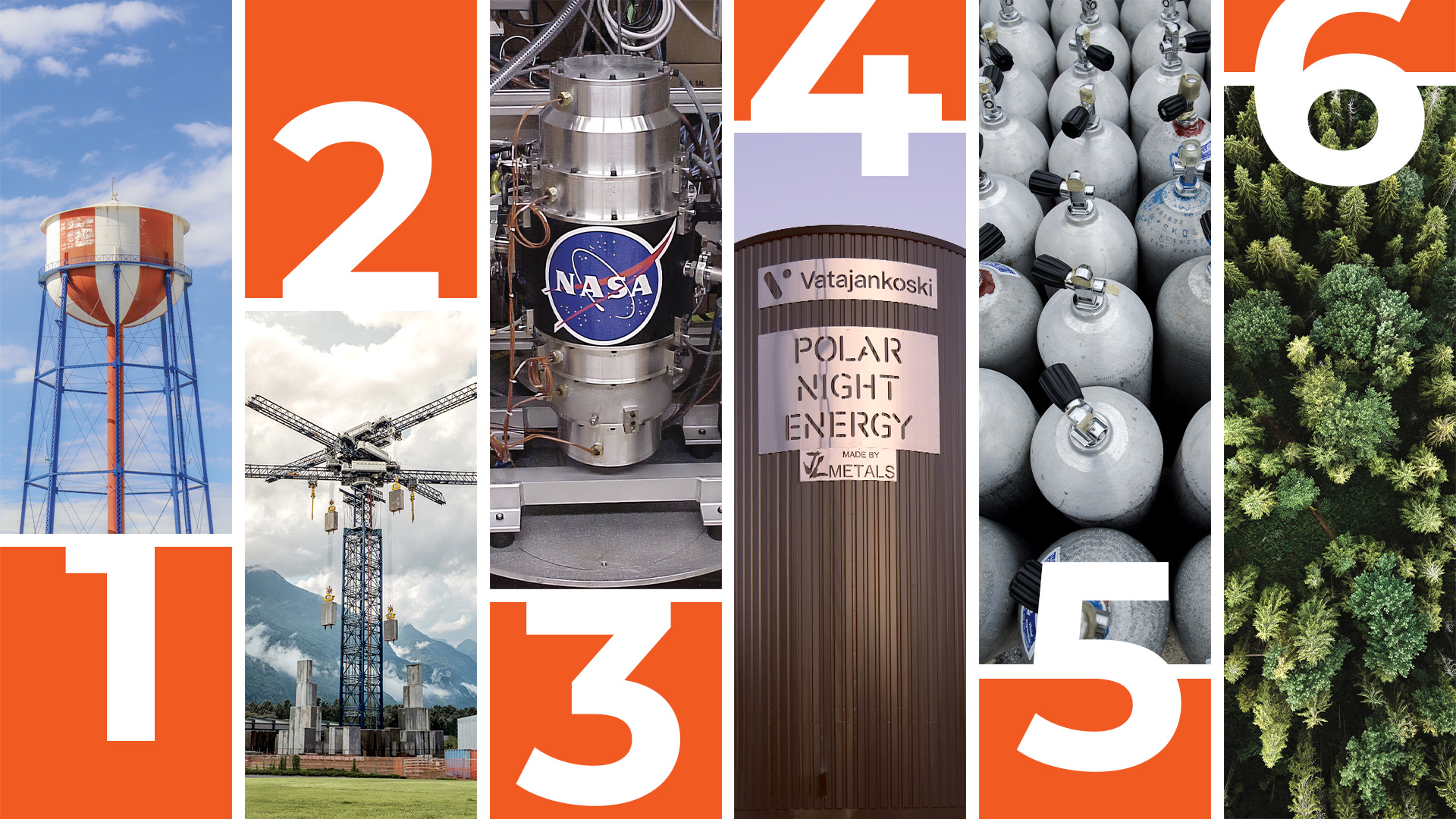
Here are six innovative materials and methods we might use instead:
PUMP STORAGE WITH WATER
This isn’t a new idea: People have been using pump storage since the early 20th century. Early pump storage used fossil fuels to move water from a lower reservoir to a higher one during off-peak hours, when that energy was cheapest. Then when the energy was needed, gravity returned the water to the lower reservoir, turning turbines as it flowed. Such systems today can substitute renewable energy for power from fossil fuels. This is the most popular method of storing electricity today and accounts for 93 percent of utility-scale energy storage in the United States.
GRAVITY BATTERIES
As with the pump-storage system, this uses renewable energy to raise an object from a lower level to a higher one. But instead of water, it’s a heavy mass that generates gravitational potential energy. When the energy is needed, the mass is slowly dropped. The motor that raised it in the first place switches to generator mode and energy is sent off to the consumer. How much energy is produced and how long it is generated depends on the height and weight of the lift. One company working with the technology, Gravitricity in Scotland, is investigating the use of deep decommissioned mines for gravity energy storage. The company estimates that some 14,000 mines around the world could be repurposed for energy storage.
FLYWHEELS
A flywheel can be as simple as the power system in a child’s friction toy or as complex as NASA’s G2 system for energy storage in a spacecraft. The flywheel is essentially a mechanical battery with a heavy weight that rotates around an axis. Energy gets the wheel spinning. And if it spins fast enough, it can store energy. The limiting factors are friction and how much force the wheel can take before it breaks.
SAND BATTERIES
The sand battery uses sand or a sandlike substance heated to temperatures well above the boiling point of water – about 500 degrees C. Cool air blown through pipes in the storage facility picks up the heat and can be used, for example, to convert water into process steam. The first commercial sand battery in Finland uses about 100 tons of low-grade sand to warm homes, offices and a municipal swimming pool year-round, and its developers say the sand can hold its heat for months.
THERMODYNAMIC STORAGE USING COMPRESSED AIR
This system uses electrical energy to create high-pressure compressed air, which can be released later to drive a turbine generator. Utility-scale versions of these systems are generally located in caverns. A variant of this storage system is underwater compressed air energy storage, which benefits from the constant water pressure and could be useful for coastal locations.
WOOD BATTERIES
About 30 percent of a tree – depending on species – is lignin, the glue that holds its cellulose fibers together. The polymer lignin also contains carbon, which as it turns out is a great material for a battery part called an anode.
Finland’s Stora Enso happens to have lots of trees: It calls itself the one of the largest owners of private forest in the world. And according to the BBC, the company’s engineers say they can extract the lignin they need from waste pulp the company is already producing.
Stora Enso has entered into a partnership with Swedish company Northvolt to create batteries sourced sustainably in Nordic countries. They expect to be in production as early as 2025.
According to data from the U.S. Census Bureau, the average house requires a span of seven months to materialize. This includes a cascade of developmental stages: the foundation is laid, the framing is erected, insulation is packed, drywall is hung, the plumbing installed, and the electrical grid established. This calls for a broad array of experts. Now, the construction industry is pivoting toward adopting 3D printing technologies to respond more nimbly, sustainably and affordably to the dynamic demands of modern homebuyers.
Japan, for example, has demonstrated the speed, building a house in 24 hours. While the resulting build serves as an office space now, its swift construction proves its potential for future home-building on a time crunch. Japan further showcased this by fabricating a spacious villa in 45 days.
Time may be money and this axiom resonates well in the world of 3D printed structures. Data from 3D print technology company, COBOD, suggests an economic advantage, with the cost of 3D homes approximately 45 percent lower than traditional construction methods. Personalization is also an option.
3D printers for home construction are essentially giant robots, capable of rendering virtually any design specifications a homeowner might dream up. Want a home shaped like a sphere? With 3D printing, such whimsical abodes could be actualized. Plus, these printed homes come with integrated reinforcement, which means no precast or additional reinforcements are required, making it a greener option.
In 2022, ICON, construction tech development company, and the Lennar Corporation, one of the leading home building companies in the U.S., announced a plan to 3D print an entire neighborhood of 100 homes. These solar-powered homes, ranging in size from 1,524 to 2112 square feet, offer a vision of a sustainable future community.
Projects like these pave the way for solving global issues, from the pervasive shortage of housing and scarcity of skilled labor, to the rehabilitation of regions hit by natural disasters. Swift and cost-effective structures could offer near-immediate shelter to communities affected by natural disasters or to the ubiquitous problem of homelessness. A 2022 report from Urbanet, highlights that over 1.8 million people globally lack adequate housing.
“There are far too many homeless people. Working-class people can’t afford basic housing in regular old American cities. Construction’s too wasteful. Houses aren’t energy-efficient enough. At the suburb scale, it’s dystopian, almost, what we’re getting, right? We’re supposed to be the most advanced version of humanity that’s ever existed and we can’t even meet this basic need properly,” Jason Ballard, CEO of ICON told The New Yorker.
The scope of 3D printing extends beyond the residential. As the 3D home-building market grows, other regions are exploring 3D printed structures for office buildings, bus stops and religious centers.
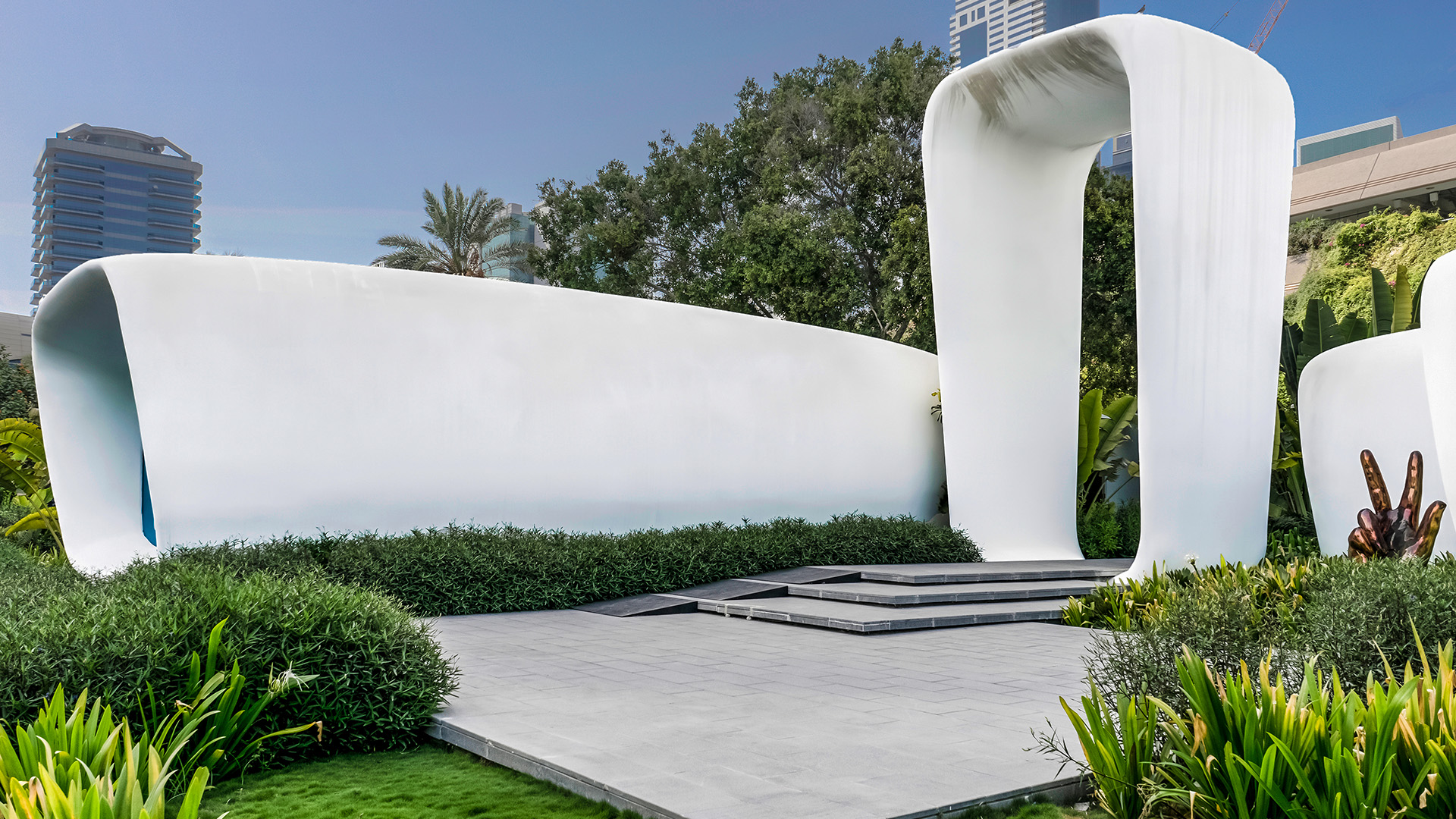
In 2020, the UAE was awarded the Guinness World Record for the first 3D-printed commercial building which served as the headquarters for the Dubai Future Foundation. After a swift 17-day print, followed by interior outfitting, it stands as a testament to rapid, efficient construction, offering up to 60 percent less waste.
The UAE is also home to the world’s largest 3D-printed building and plans to inaugurate the first 3D-printed, fully-functioning mosque by 2025.
Join our mailing list
Get the latest articles, news and other updates from Khalifa University Science and Tech Review magazine



 IMAGE: Unsplash