FLOOD INSURANCE

Storms are becoming stronger, wetter and deadlier. You can thank a warmer, moister atmosphere and heating oceans as the extreme storms they feed produce more rain, stronger winds and heavier flooding. In 2024 alone, hurricanes Helene and Milton left hundreds of billions of dollars in damages while flooding in Afghanistan and Pakistan was blamed for more than a thousand deaths.

Watch video on sponge cities here.

Cities, in particular, may be feeling the effects of these killer storms more intensely than the countryside.

For one thing, urban areas draw more rain: Skyscrapers often slow storms, letting them drop more precipitation in a relatively small area. Pollution like auto exhaust also seeds clouds. And heat rising from pavement and concrete creates convectional rainfall.

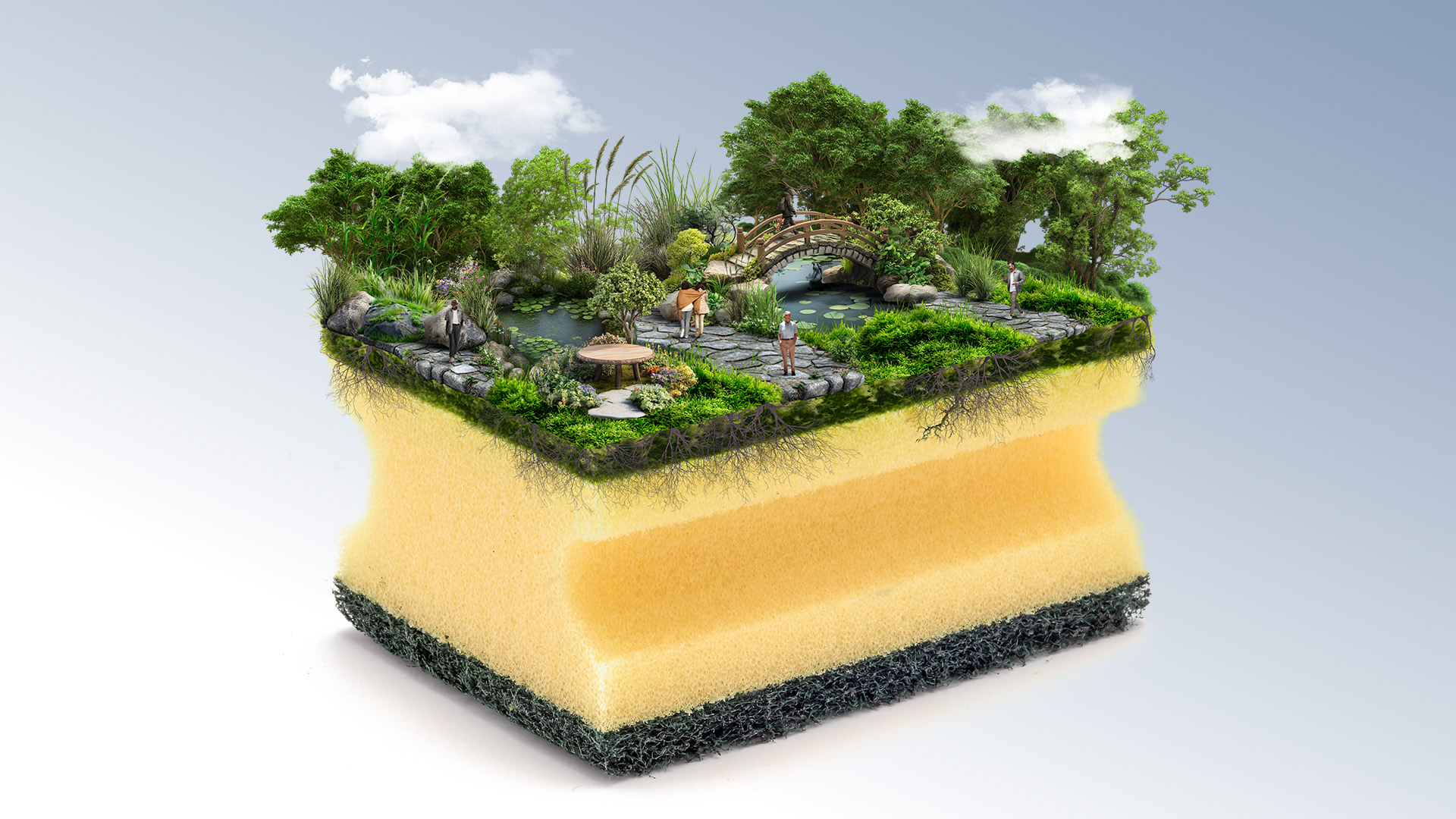
IMAGE: ABJAD DESIGN
Protection from heat too

Sponge cities don’t just protect residents from flooding. They also provide relief from extreme heat, says the University of Adelaide’s Scott Hawken. “In cities like Adelaide, heat waves are even more deadly than flooding. They kill a lot of people: the vulnerable, the young and the old. We need to think about how to keep our cities cooler during these extreme events and design parks and gardens to generate cool airflows and bring the surface temperature down,” he says. Read more›››

The best way to do that is to use well-watered and irrigated vegetation to set up cool airflows throughout the city, Hawken says. “It’s not just having a park here. It’s strategic, like a natural air conditioner. We need to think of these larger park systems woven in amongst our cities. These parks need to be well-watered, but that shouldn’t be a problem if resources are used wisely, he says. “Most of the time there is plenty of water in our cities, but we just don’t use it carefully,” he says.

“Many cities around the world are running out of water, but those cities often don’t take care of their water. It’s only when the drought kicks in that the penny drops. But by then it’s too late. We don’t have the systems in place.”  Urban oases in Abu Dhabi helped cool surrounding temperatures by up to 2.2 degrees Celsius, according to a study by Mohamed bin Zayed University of Artificial Intelligence and the tech giant IBM.

Artificial intelligence-enabled technology helped analyze decades of satellite data and provided insights on how vegetation and water bodies make a significant impact on heat islands in the city.   Masdar Park in the Masdar City neighborhood had a 2.2-degree cooling effect in that area, the researchers found. Umm Al Emarat Park, one of the largest and oldest parks in the city, brought down the surrounding temperature by 1 degree.

The researchers suggest the technology can enable sustainable design and help urban planners identify other areas that could benefit from green spaces.  ‹‹‹ Read less

A study published in the Proceedings of the National Academy of Sciences says the effect has become more pronounced over the past two decades.

Listen to the story here

“This is everywhere,” Dev Niyogi, a professor at the University of Texas at Austin and paper co-author, tells the Washington Post. “The magnitude of the impact will vary. But just the way we treat urban heat islands, we should start treating urban rainfall effect as a feature associated with urbanization.”

And some cities that have not previously been associated with flooding are finding that the changing climate may require a different kind of urban planning.

Exhibit A: Abu Dhabi, where record-breaking April 2024 storms brought a year’s worth of rain to the Gulf city in just a day. 

FROM THE GROUND UP

Chinese landscape architect Kongjian Yu has been thinking about that different kind of urban planning for decades.

He won the Cornelia Hahn Oberlander International Landscape Architecture Prize (“Oberlander Prize”) in 2023 for his concept of “sponge cities,” which has inspired projects not only in China, but France, Russia, Indonesia, Thailand and the United States. Yu’s company Turenscape has contributed to more than 600 projects in 200 cities.

The concept relies on nature – through trees, parks and ponds – and good design to protect cities from flood waters. In essence, rather than rely on concrete drainage systems and flood walls, it makes the city itself a “sponge” to better absorb rainfall.

“There’s a misconception that if we can build a flood wall higher and higher, or if we build the dams higher and stronger, (then) we can protect a city from flooding,” Yu tells CNN. “(We think) we can control the water … that is a mistake.”

Watch: Climate Change, the Classroom Crisis

The stakes are high. An Intergovernmental Panel on Climate Change report says 700 million people live in areas where rainfall extremes have risen. This number is expected to grow as global temperatures increase.

CELEBRATING THE WATER

Scott Hawken, director of the Landscape Architecture and Urban Design program at the University of Adelaide’s School of Architecture and Civil Engineering, uses sponge city principles in his work. It’s about celebrating the water on site, he says.

“This development of the sponge city is about the necessity to manage water in a more intelligent way. It allows water to infiltrate into the landscape and slow it down, to manage it on site rather than what has been done throughout most of the 20th century, which is to expel the water from the city rapidly,” he tells KUST Review.

As Hawken tells it, preparing urban areas to better withstand flooding isn’t just an issue with physical infrastructure, like swapping out concrete gutters for absorbent plants and sandier soils. It requires a change in social perspectives as well.

“The 20th century perspective (sees) water or flooding being a problem or a nuisance.

That’s one cultural perspective that inspired overengineered approaches which haven’t really valued water in the way that it should be valued.


Instead, Hawken suggests looking to communities that consider flooding a part of life, like the cities and settlements of Southeast Asia that have weathered monsoon climates for hundreds of years and longer.

“Floods there are not viewed as a risk. But in the Western context we really fear floods. They’re out of mind until they’re around us, and then we panic rather than thinking into the future and planning to live with floods and work with them on site.”

And where you can’t work with them?

“We’ve also built in a lot of areas which we shouldn’t, like on flood plains.”

MANAGING THE WATER

Hawken isn’t just concerned with creating a landscape that better absorbs water but cities that manage the rain wisely.

“The irony is often you have a very wet landscape that has a lot of water but also has to pipe water in because it’s not using water in a smart enough way. It isn’t recycled, filtered and reused.

“People have a resistance to that. But some of the traditional societies have been reusing and recycling water in intelligent ways for a long time. We need to get over that. The technology is certainly there.

“The filtered and recycled water is often much cleaner than the water that’s not,” Hawken says.

Singapore, he says, is an example of a city that is successfully reusing and recycling its water resources.

“A lot of the technology that was developed in Australia has been exported to places like Singapore. Now they’ve taken those ideas and run with them, probably doing a better job than anywhere else.”

DESERT SOLUTIONS

Dubai entrepreneur Chandra Dake has also been thinking about managing flood waters and collecting rain for reuse. His inspiration: the United Arab Emirates’ desert sands.

Dake and his company, Dake Rechsand, use the plentiful sand to create permeable materials that not only allow water to pass through but filter it on its way to underground honeycomb storage tanks. These tanks keep the water fresh without chemicals or electricity.

“Every nook and corner, every junction, can become a storage house of water,” he says. “That reduces the burden of centralized storm management, which is normally implemented in advanced cities across the globe.”

He points to a project in Beijing that used his technology to address chronic flooding problems that led to frequent traffic jams.

“This area that used to flood is now able to harvest every drop of water. The surface is now used for a recreational facility. All the rainwater goes underneath it. After implementing it for the last two, three years there’s no more flooding, not even one traffic jam. And the water? It’s literally like distilled water.”

Saving the water from just one storm would be a huge benefit for UAE cities that rely mostly on energy-hungry desalination technology, he says.

That record-breaking 2024 storm? The water could have been used for two or three months cleaning roads, improving irrigation and watering greenery, he says.

Instead, it went to waste. “All of that water was discarded. Not even one cubic meter was used.” Dake says his technology can easily be integrated into an existing infrastructure. “You can build a road. You can build paving. You can build anything. And these can be retrofitted as well.”

The materials are suitable for both hot and cold climates, Dake tells KUST Review. “And one important element is these materials are made from desert sand. Desert becomes a solution for global problems.

“We will see enormous social, environmental and economical benefits,” he predicts.

More like this: A river runs over it
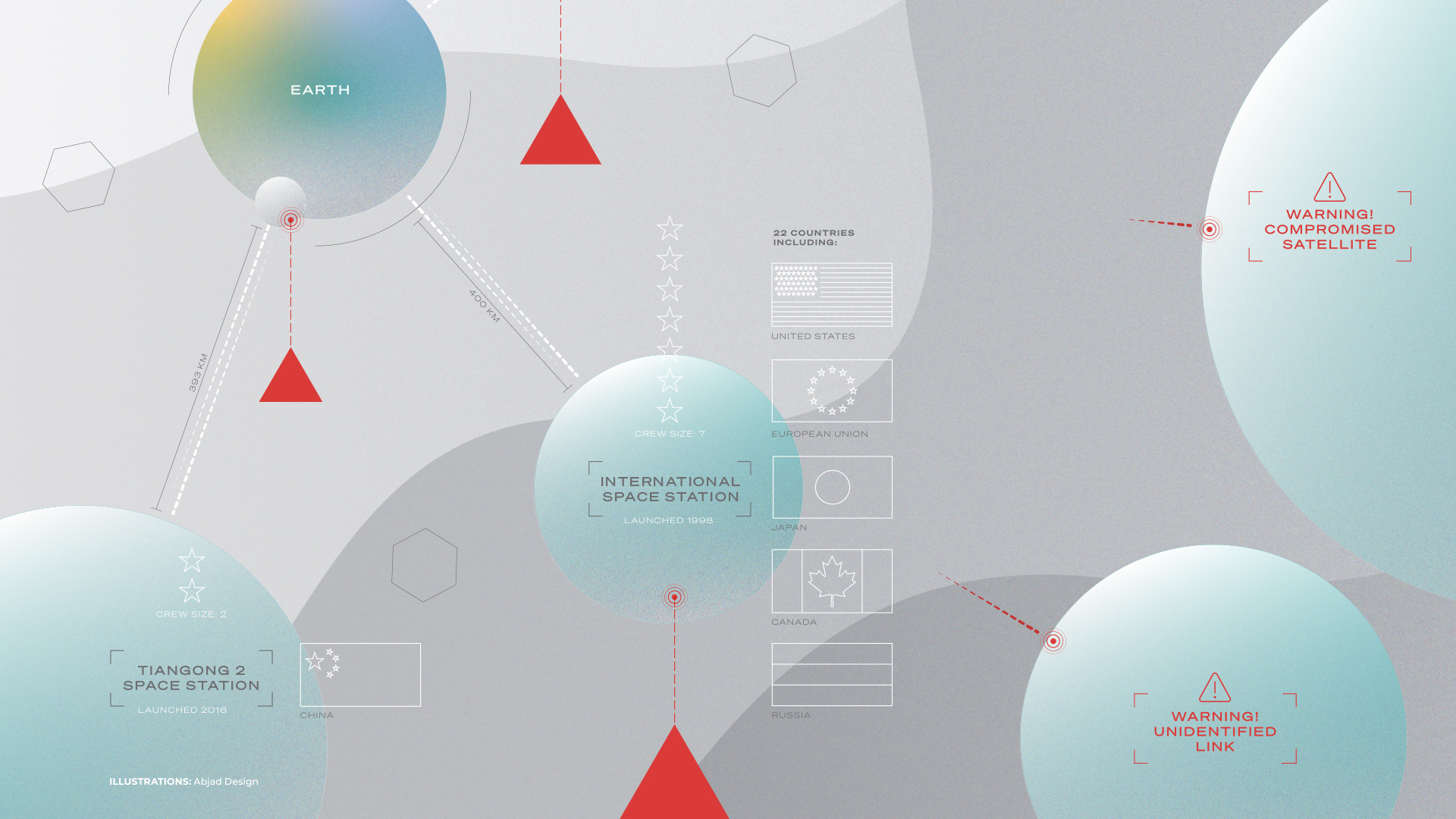
Space invaders

Space was once a domain largely associated with government actions. Sovereign states were solely responsible for sending probes, satellites and crewed missions to Earth’s orbit, the moon and beyond. The technology was similarly segregated: Terrestrial and space systems were generally isolated from each other, creating a kind of “security by obscurity.”

In recent years, however, private industry has launched into space, providing satellite services for telecommunications to the Earthbound that are projected to become a U.S.$1.4 trillion market by 2030. These systems in space talk to the systems on the ground, and the scope is only growing. Cellphone users of tomorrow, for example, may be able to tap into satellites to seamlessly send messages when there is no terrestrial connectivity. Elon Musk’s Starlink is a good, live example.

Listen to the Deep Dive


The World Economic Forum also points out that modern systems establish interfaces across “traditional trust boundaries,” such as partners and customers. And more complex systems have more potentially exploitable attack surfaces.

With such growth and Earth-space network interconnectivity amid such other sectors as the military, aviation, emergency services and utilities, however, comes risk from those who might use those connections to steal, extort, sow chaos or wage war.

Real-world examples

A series of cyberattacks in 2022, for example, targeted three wind farms operated by Germany-based companies. A ransomware group supporting the Russian government said it was responsible for one of the attacks.

Christoph Zipf, a spokesman for WindEurope, a Brussels-based industry group, sees links to the Russia-Ukraine war.

Matthias Brandt, director of Deutsche Windtechnik, which maintains wind turbines and was one of the companies hacked, tells the Wall Street Journal that the renewable-energy sector will become an even more attractive target.

“We need high IT security standards,” he says.

Earlier the same year as the conflict unfolded, another attack linked to hostilities in the region targeted satellite modems, knocking out internet service in Ukraine and other parts of Europe for tens of thousands.

Ukrainian cyber official Victor Zhora called the hack “a really huge loss in communications in the very beginning of the war,” CNN reports.

In response, SpaceX, which created the Starlink network of 3,335 active satellites, shipped truckloads of Starlink terminals to Ukraine in April 2022, providing hospitals, banks and families with internet access. The military also used the network, prompting Starlink to curb the country’s use of the satellites for offensive drones.

By April 2023, the Washington Post was reporting on classified U.S. intelligence that concluded Russia was far more advanced in its plans to target the Starlink network than previously thought.

Additionally: “Starlink usage in Ukraine has been associated with Starlink users’ uplink transmissions becoming beacons for airstrike,” says Christina Pöpper, a professor of computer science at New York University-Abu Dhabi who focuses on information and communications security.

Space, it seems, has become an active theater in Earth conflicts. And the cyberattacks in this conflict could be a harbinger of many more such attacks to come.

Even nations not involved in war have reason to be wary of cyberattacks in space, Pöpper tells KUST Review. “(They) can have far-reaching implications, affecting various aspects of the lives of everyday people from communication and navigation to personal privacy, safety, economic stability and national security.”

3 kinds of attacks

Governments or rogue elements could target satellite systems in a number of ways.

They can target services, rather than the satellites themselves, by hacking and GPS spoofing, as seen in the Ukraine conflict, denying millions access to essential services.

They could also use anti-satellite weapons (ASATs) to target satellites in orbit.

Juliana Suess is a research analyst and policy lead for space security at the Royal United Services Institute, a defense and security think tank with headquarters in London.

“ASAT attack consequences range from temporary and reversible to permanent and non-reversible,” she tells KUST Review.

“The potential consequences are numerous. It needs to be borne in mind that a space system is made up of three basic elements — the satellite in space, the ground station on Earth and the links in between. All three are potentially vulnerable to attack.”

“For example, an adversary may take control (permanently or temporarily) of a satellite through hacking,” Suess says. “They may also disrupt (jam) or spoof the signal reaching or emanating from the satellite with temporary effect. A counterspace measure may also be to prevent a satellite from collecting information — for example by dazzling the sensors onboard of an Earth Observation satellite.”

China, India and Russia have been criticized for testing physically destructive ASAT weapons on their own satellites. But such tactics are expensive, don’t guarantee success and can add to the growing problem of space debris.

The United Nations has approved a non-binding resolution calling for a halt to testing one type of such weapons, the debris-generating direct-ascent ASATs. It cited environmental issues and a desire to prevent an arms race in space. By April 2023, 13 countries, including the United States, Japan and Germany, had pledged to ban the tests.

“Space is difficult,” say Oxford University researchers in a paper published in IEEE. “A launch program alone does not guarantee the resources and precision required to operate a meaningful ASAT capability.”

And then there are cyber-ASATs.

These, the Oxford researchers say, “threaten the foundations of space’s longstanding stability due to their high accessibility, low attributability and low risk of collateral damage.”

In other words: They’re easy to use, hard to pin on the offender and probably won’t damage nearby satellites.

Without firing a rocket, the researchers say, belligerents could alter debris-collision forecasts to cause direct harm to space systems.
“Cyber-ASATs are not merely a distant theoretical threat, but a real and present danger to the balance of power in space.”

Multiple threat vectors

Threats, however, can be hybrid, warns NYU-AD’s Pöpper.

“In reality, multiple threat vectors are often combined,” she tells KUST Review. “Hacking and spoofing are part of cyber anti-satellite weapons. We are dealing with whole infrastructures, so while spoofing satellite (GPS or other) signals typically happens during communication, hacking targets the satellites and satellite operation software, and cyber ASATs also encompass attacks (e.g., exploiting vulnerabilities) on ground control systems.

“Successful attacks can disrupt satellite communications, compromise control systems, manipulate data, and even disable satellites, potentially leading to loss of control, compromised missions, and significant disruptions to various sectors relying on satellite services.”

A good defense

So what are governments and businesses doing about the threat?

“There are a few defenses that can protect satellites — ranging from ‘bodyguard’ satellites (currently in the planning stage) that could accompany sensitive assets to simpler measures such as cyber defenses against hacking,” says space-security expert Suess.

Pöpper, meanwhile, sees three tracks of interest:

Develop and deploy secured space systems: “Recognize that space security is a real problem and thus support the development and deployment of secure space infrastructure, secure communication channels, integrity of satellite firmware and software, and satellite system hardening. There are many open research questions in this domain as well,” she says.

Collaborate and share information: “Share threat intelligence, best practices and lessons learned from previous cyber incidents to enhance the overall security of satellite systems.”

International cooperation and regulations: “Governments should collaborate internationally to establish common cybersecurity standards and regulations for space systems, promoting consistent security practices and enabling a coordinated response to cyber threats. I am aware that this can be a tricky ask beyond national boundaries, but the space industry in general has a long history of multi-national collaborations.”

His Excellency Dr. Mohamed Al Kuwaiti, head of cybersecurity for the UAE, also sees the need for governments to work with businesses and other stakeholders.

“Cybersecurity is teamwork,” he tells KUST Review, “and we have to involve everyone including government entities, industrial partners, academia and the community. That should be done at national and international levels.”

The solar cradle

In the past few decades there has been a substantial leap in our understanding of how our solar system formed and how the planets came to be in the positions we see today.

Indeed, a bird’s eye view of our solar system reveals a number of defining characteristics that intrigue scientists. The inner part of our solar system is dominated by small “rocky” planets including Earth. As we move out we encounter the gas and ice giants. Jupiter and Saturn are mainly composed of hydrogen and helium (similar to the sun’s average composition), while the ice giants Uranus and Neptune show a high concentration of ices, or what scientists tend to call “volatiles.”

Nearly 4.6 billion years ago, a rotating nebula started to gravitationally collapse on itself, leading to concentration of materials in the center.

When seen from above, all planets orbit around the sun in a counter-clockwise orientation and in nearly circular orbits. Furthermore, almost all planets rotate around themselves from west to east, in what we call “prograde” rotation. Any valid scientific theory or a model for the formation of our solar system needs to address these collective properties of our planetary system. Planets also host a vast collection of moons: Small planets have few or no moons while larger planets have tens of moons on average. However, there are more pieces to the puzzle of our solar system!

As we move beyond Mars to Jupiter, we encounter small bodies that similarly orbit the sun, called the asteroid belt. And if we continue farther out beyond Neptune, we encounter an even larger collection of small bodies in what is called the Kuiper belt.

Scientists have built a solid model for how our solar system formed from a cloud of gas and cosmic dust called a nebula. Nearly 4.6 billion years ago, a rotating nebula started to gravitationally collapse on itself, leading to concentration of materials in the center. As gravity led to an increase in matter toward the center of the nebula, more grains and solid materials in that area collided and temperatures rose in the center of the nebula.

The International Astronomical Union has named an asteroid after Mohammed Ramy El-Maarry, director of Khalifa University’s Space and Planetary Science Center. Earlier known as 2002 CZ, it is now (357148) El-Maarry.


The hot center is where our sun was born. Furthermore, as mass concentrated in the center, the rotating nebula started to spin much faster, leading to a shift from a somewhat spherical cloud to a structure that would eventually become the “protoplanetary disk.”

In this disk, materials continued to merge with each other, forming larger blocks. The variations in temperature within the rotating disk are the main reason planets have different compositions. In particular, the inner part of the disk was too hot for ices and other volatiles to condense from a gaseous state into a solid state, so planets in the inner system are relatively devoid of such volatiles. We also know now that the planets orbit around the sun in the same direction because this was the direction of the original nebula’s rotation.

Small bodies are the remnants of this complex process. They are the spare “LEGO” parts of our solar system. When we study the asteroids, we gain more information about the physical and chemical conditions of the inner solar system, including Earth. Similarly, when we study ice-rich small bodies in the Kuiper belt and beyond, we gain more information about the conditions at the outer edges of the early nebula. The great thing about small bodies is that rather than travel long distances to study them, we can rely on them coming close to Earth’s backyard. But how does this happen?

Large planets, particularly Jupiter, have a massive gravity that occasionally pushes small bodies in the asteroid belt toward the inner solar system.

This creates the family of near-Earth asteroids that have been visited by numerous space missions. Such bodies may even penetrate our atmosphere and land on Earth as meteorites.

Small bodies can also offer viable economic prospects in the near future given the vast wealth of precious metals and ores they contain.

Neptune has a similar, yet weaker, effect and can attract bodies from the Kuiper belt, shifting their orbits inward till they get captured by the outer planets as moons, or upon encountering Jupiter in their journey inward undergo a shift in their orbit allowing them to visit the inner solar system as comets. These ice-rich bodies allow us to study the outer solar system without needing to go there. When these comets enter the inner solar system, their near-surface ice may turn from a solid to a gas state, lifting surface dust along the way and forming a bright “coma” around the body that can aid in its viewing. Scientists can use remote sensing techniques to measure the composition of the ices.

Small bodies are essential parts of the puzzle to help us better understand our solar system. Small bodies can also offer viable economic prospects in the near future given the vast wealth of precious metals and ores they contain. Near-Earth objects can also pose threats to human civilization if they are large enough and their orbits put them in a collision course with Earth. As such they are a target of planetary defense programs and constant monitoring by Earth-based telescopes. So don’t expect our interest in small bodies to dwindle any time soon.

Mohamed Ramy El-Maarry received his Ph.D. from Goettingen University in Germany. He is an associate professor of planetary geology at Khalifa University’s Department of Earth Sciences and the director of KU’s Space & Planetary Science Center.

Seeing space in 2D

“Space exploration is a material-science saga, because independent of the electronics and so forth, materials are the enabling technology for the challenges that exist in space.”

That’s according to Carlo Iorio, director of the Center for Research and Engineering in Space Technologies at the University of Brussels. And the game-changers he’s most excited about: graphene and other 2D materials. “2D materials can be used and embedded for solving (many) different problems,” he tells the KUST Review.

Listen to the Deep Dive

IMAGE: Anas Al Bounni/KUST Review

Graphene might be the granddaddy of 2D materials, but it is relatively new, discovered in 2004, winning Andre Geim and Konstantin Novoselov a Nobel Prize in 2010 for its isolation. The material is a single layer of carbon atoms in a hexagonal pattern. It is tough, flexible, light and offers high resistance.

“The properties of graphene are exceptional in many ways,” says Yarjan Abdul Samad, who earned his Ph.D. at Khalifa University, studied the properties of 2D materials as a postdoc at Cambridge University, and has recently returned to Khalifa as an assistant professor in aerospace engineering.

Samad says the discovery of graphene launched a tidal wave of 2D material research: “There are thousands of new 2D materials now under investigation because of the discovery of graphene. It’s as if a new periodic table has erupted,” he says.

“Every property can be utilized for an application not possible for traditional materials. That keeps me intrigued. For me, especially when I look at the challenges of space, whether it’s thermal management or radiation protection or long journeys, there are so many issues that need unconventional solutions. 2D materials are versatile and tunable to solve many problems,” Samad says.

Here’s a look at some of the issues of space travel and settlement Iorio and Samad say 2D materials might address:


Radiation protection

Space radiation is often considered the top limiting factor of long-term space travel, with astronauts likely facing risks of cardiovascular and degenerative disease and cancer.

“I may be biased on this, but top of the list (of 2D applications) is radiation protection. Everyone is concerned about radiation and there have been many radiation-related incidents. So, how can we protect against radiation?” Samad asks. “It’s a very complex phenomenon, and conventional materials won’t work against galactic cosmic radiation. We need to come up with an approach where we can have selective protection.”

Graphene and hybrid solutions might be the answer, he suggests.

Space radiation is also on the top of Iorio’s list of 2D applications for space – “first and foremost,” he says.

Space shields will allow human exploration over long distances, he says. “At present it’s fairly challenging to settle on Mars.”

Samad worked with the UAE’s Mohammed Bin Rashid Space Center on the Rashid Rover project that was presumed lost when its lander apparently crashed in April 2023.

IMAGE: Anas Al Bounni/KUST Review

But plans are underway for Rashid 2, and Samad says studying radiation’s effects on 2D materials is under discussion. “(This) is one of the most pressing challenges, in my opinion,” he says.


Suits and habitats

Advanced materials are required for making temperature-resistant suits and structures for people to use on Mars or the moon, Iorio says. 2D material molybdenum disulfide will play a role in this specific challenge, he adds. 2D materials could also be useful in other construction applications.

Khalifa University is exploring rubber-based components with graphene to not only withstand the extreme temperatures but help the infrastructure sustain moonquakes, Iorio notes. “If it’s rigid (the structure) will break. Imagine if the cracks allowed the O2 out.”

Transporting materials from Earth into space is expensive. But 2D materials are light. And Samad sees potential for them to turn matter found on the moon or other worlds into building blocks for settlements. “There could be composites or hybrid materials,” he says. “There are many approaches that can be taken.”

IMAGE: Anas Al Bounni/KUST Review

And once the habitat is built, keeping it a healthy environment for human residents could also fall on 2D materials.

“Graphene and graphene oxide can play a role in materials that can prevent the spread of bacteria and foreign biological elements,” Iorio says. “Imagine in a sealed human base if an epidemic is spread. We’re at the level of a sci-fi scenario.”


Thermal regulation

“How can we stand the lunar nights and what kinds of materials can help with that?” Samad asks.

2D materials show promise: Not only can they resist the extreme temperatures of space, they are excellent candidates to transfer the heat from, for example, a sun-facing side of a craft to the side facing away, where the temperatures could vary by 200 Celsius. And because 2D materials are, well, 2D, they require little space, freeing up room for bigger habitats.

“In space you have a lot of heat that is lost. So (2D) materials like MXenes have been used because they have a low infrared signature,” Iorio says.


Propulsion systems

“Another application is the propulsion system for a rocket. 2D materials can easily be functionalized,” Iorio says.One possibility: sails made from graphene membranes powered by light from the sun or lasers, freeing spacecraft to travel farther and longer without having to carry fuel on board. The craft would also be lighter, nimbler and easier to launch. The European Space Agency says graphene has passed initial tests that show it is a viable candidate.

IMAGE: Anas Al Bounni/KUST Review

Earthside applications

What we learn from our space exploration attempts can be quite useful for us at home too, here on Earth. The problems graphene and other 2D materials solve in space can easily be transferred to Earthbound issues, Iorio says. “The problem of scarcity that we solve in space will be used to solve the problem of rising scarcity anywhere,” he says.

Filters and membranes developed for recycling water on a moon base, for example, can help conserve resources on Earth.

“The technology that we develop for space is capable of exploiting every single drop of water, which is the same goal of a sustainable economy,” Iorio says. “There is also a scarcity of power. That means that the concepts we develop for space are to use the least energy. Regardless of how far we get in space, this will possibly be used on the ground to reduce energy consumption.”

Samad sees advances in radiation protection eventually protecting data centers on Earth whose systems are vulnerable to cosmic radiation. Additionally, thermal management in spacecraft could eventually improve technology for trains and transportation in general.

“In the Emirates there is a growing interest in sustainability,” Iorio says. “Despite the luxury of the lifestyle, there is more attention to sustainability, reducing the carbon footprint and so forth. I have been in developing countries but one of the things that strictly relates space exploration with sustainable development is they share the need to tackle the scarcity of resources.”

Lifting off

In 2021, the UAE’s Hope probe arrived on Mars, just one of many missions launched by governments and private businesses in recent years looking to increase our understanding of our solar system and beyond. With all of this interest in space exploration, we asked our experts: What should be our first priority? Here’s what they said.

WORKING TOGETHER BENEFITS ALL OF EARTH’S PEOPLE

Hamad Al Marzooqi

Hamad Al Marzooqi was the project manager for the Emirates Lunar Mission and oversaw the computer and the imaging systems of the Rashid rover.

Space exploration has always been human-centric in nature. It has been the case in the past, it is what fuels the current space-exploration program, and it will continue to be in the future.

There were different drivers of space-exploration programs including political, economic and national defense in the past, and they will continue to be.

However, such drivers come and go, and what remains is the curiosity in all of us to explore the unknown and expand our knowledge.

What distinguishes us as humans is our persistence in asking questions from our childhood until adulthood, and such questions are the drivers of all scientific space-exploration programs.

Our ancestors looked at the moon, planets and the stars with awe and inspiration. Today, through our persistence in asking questions, we have become space explorers by sending spacecraft and rovers to the moon, Mars and other planets, eventually reaching the edge of our solar system.

Soon, we will be a space-faring species, and we will create our permanent presence on the moon and Mars.

The “we” in the previous statements is not privileged to a nation, country, political region, ethnicity or religion. It includes all humans living on Planet Earth, and that is what should be the first priority in space exploration.

CAPTION: The UAE’s Sultan Al-Neyadi looks on as Tom Marshburn signs on for the first day of exams at Star City, Russia. IMAGE: NASA

Space exploration is a challenging task, and it will not be feasible without working together as one species through international collaboration.

The International Space Station sets an excellent example of what can be achieved by setting our differences aside and working together. We need to take this example further and expand our international-collaboration efforts in future space-exploration programs.


We need to take advantage of the substantial advancements that are being made through different space programs and find solutions that are human-centric to improve the livelihood of humans living on this planet through technologies, knowledge, education and empowerment of underdeveloped and developing nations.

Our international space-exploration program should focus on advancing human knowledge, finding solutions for existing problems (global warming, inequality, poverty and global health system) and providing a brighter future for the next generation on Earth and other planets.

AVOIDING THE FATE OF THE DINOSAURS

Ettore Perozzi

Ettore Perozzi is senior scientist at the Italian Space Agency (ASI) with a long-standing expertise in celestial mechanics, planetary science, space flight dynamics, education and public outreach. Asteroid (10027) bears his name. Read more›››

The long and winding roads that connect the neighborhood of the Earth to the outer regions of the solar system (and beyond) are well known in celestial mechanics. It is also well established that asteroids and comets, often following chaotic orbital paths, are key to understanding the early phases of planetary formation – where we all come from.

Their dynamical mobility – leading to impacting the planets, falling into the sun or escaping to interstellar space – and their diversity in physical properties make them extremely interesting for planetary science as well as threatening objects in case of collision. They also present an opportunity for extraterrestrial mining.

Therefore, exploring asteroids and comets allows us to address at once three fundamental issues: unveiling the origin and evolution of the solar system, opening a potential new market for commercial space applications and providing vital information for civil protection.

Knowing the chemical composition and internal structure of a small celestial body en route to colliding with the Earth would allow us to develop a robust and reliable deflection strategy, thus helping humans avoid the fate of the dinosaurs.

CAPTION: Knowing more about small celestial bodies could help us deflect them. IMAGE: NASA, Freepik, Shutterstock

When the body poses no danger, its pristine composition could provide precious reservoirs of extraterrestrial resources to compensate for the feared lack of key elemental abundances on our planet.

To date many successful space missions (Giotto, NEAR, Dawn, Rosetta, Hayabusa 2, Dart/LICIAcube, to name a few) have reached asteroids and comets. More are to come.

But in addition to the previous points, these celestial bodies represent ideal locations for the in-situ production of fuel and basic consumables, thus enabling routine long-range space exploration and, in the long run, sustaining the much-awaited human expansion in the solar system.

EXPLORING NEAR EARTH ORBITS WILL AFFECT LIFE ON EARTH

Anton B. Ivanov

Anton B. Ivanov is executive director for Beyond Space Exploration at the Technology Innovation Institute in Abu Dhabi, UAE.

We can distinguish two important priorities for the future in space exploration: Near Earth orbits (LEO, MEO and GEO) and study of the solar system.

Safe exploration of near Earth orbits (NEO) is important for a couple of reasons. These orbits are home to Earth observation communication and GNSS satellites. These assets play crucial roles in our everyday life, even though we don’t notice their impact.

In the recent decade, we are seeing a big push toward creating large constellations, which will enable new applications, yet popular orbits will become very congested.

The number of active satellites and debris in orbit is rapidly increasing. This presents a significant safety risk to both human and robotic missions in LEO, and proper measures must be taken to mitigate these risks.

Exploration of the solar system, particularly Mars and the moon, is important for a number of reasons.

CAPTION: NASA IMAGE: The Jupiter spacecraft captured this image of Jupiter’s swirling clouds. This sort of exploration will continue to help humans understand more about the universe.

Many governments and private companies are investing in missions to the moon, Mars and asteroid belt. In addition to technology advancement, we learn about the history of the solar system.

In conjunction with the growing number of discovered exoplanets, we can better understand whether life, as we know it, can exist outside the solar system.

Exploration of Mars and the moon can also serve as a stepping stone for human exploration of deeper space and inspire technologies that will find their place here on Earth.

Humanity has a natural curiosity to explore new places. Mars and the moon present great interest for establishing permanent future settlements.

It is unlikely that these settlements will solve problems, such as overpopulation and climate change. However, they will have a positive impact on human culture and society, promoting a sense of wonder and awe, fostering international cooperation and inspiring innovation.