
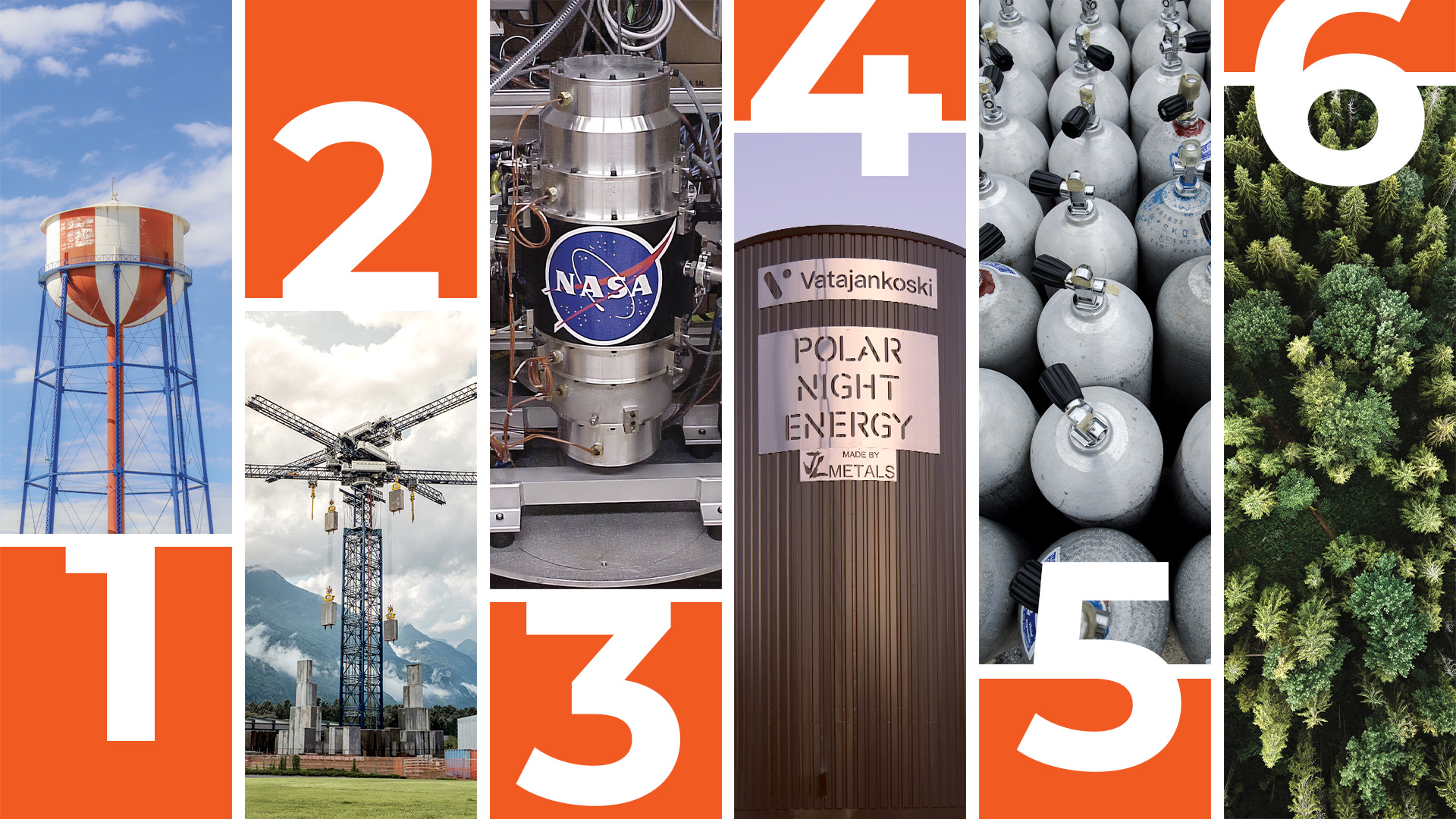
6 innovative ways to store energy

As the world looks to a renewable-energy future, storage becomes a concern because with renewables, supply and demand aren’t always in balance.

Renewable energy sources such as wind and the sun aren’t always “on” when consumers need energy, and excess power that can’t be used immediately is wasted unless it’s stored.

Storing energy can be expensive, however, so some utilities use plants that burn fossil fuels to make up the difference during times of peak demand. Those plants operate most efficiently when at full power, however, and using these plants to redistribute power can lead to more pollution.

Chemical batteries are useful for electric vehicles but they may not be the best option for utility companies. Chemical batteries’ life cycles can also be short. Lithium ion batteries, for example, last about five to 10 years. They’re expensive. And the metals used to make them raise issues of geopolitics and human rights.

Looking at other materials seems to be a good idea.

Here are six innovative materials and methods we might use instead:

PUMP STORAGE WITH WATER

This isn’t a new idea: People have been using pump storage since the early 20th century. Early pump storage used fossil fuels to move water from a lower reservoir to a higher one during off-peak hours, when that energy was cheapest. Then when the energy was needed, gravity returned the water to the lower reservoir, turning turbines as it flowed. Such systems today can substitute renewable energy for power from fossil fuels. This is the most popular method of storing electricity today and accounts for 93 percent of utility-scale energy storage in the United States.

GRAVITY BATTERIES

As with the pump-storage system, this uses renewable energy to raise an object from a lower level to a higher one. But instead of water, it’s a heavy mass that generates gravitational potential energy. When the energy is needed, the mass is slowly dropped. The motor that raised it in the first place switches to generator mode and energy is sent off to the consumer. How much energy is produced and how long it is generated depends on the height and weight of the lift. One company working with the technology, Gravitricity in Scotland, is investigating the use of deep decommissioned mines for gravity energy storage. The company estimates that some 14,000 mines around the world could be repurposed for energy storage.

FLYWHEELS

A flywheel can be as simple as the power system in a child’s friction toy or as complex as NASA’s G2 system for energy storage in a spacecraft. The flywheel is essentially a mechanical battery with a heavy weight that rotates around an axis. Energy gets the wheel spinning. And if it spins fast enough, it can store energy. The limiting factors are friction and how much force the wheel can take before it breaks.

SAND BATTERIES

The sand battery uses sand or a sandlike substance heated to temperatures well above the boiling point of water – about 500 degrees C. Cool air blown through pipes in the storage facility picks up the heat and can be used, for example, to convert water into process steam. The first commercial sand battery in Finland uses about 100 tons of low-grade sand to warm homes, offices and a municipal swimming pool year-round, and its developers say the sand can hold its heat for months.

THERMODYNAMIC STORAGE USING COMPRESSED AIR

This system uses electrical energy to create high-pressure compressed air, which can be released later to drive a turbine generator. Utility-scale versions of these systems are generally located in caverns. A variant of this storage system is underwater compressed air energy storage, which benefits from the constant water pressure and could be useful for coastal locations.

WOOD BATTERIES

About 30 percent of a tree – depending on species – is lignin, the glue that holds its cellulose fibers together. The polymer lignin also contains carbon, which as it turns out is a great material for a battery part called an anode.

Finland’s Stora Enso happens to have lots of trees: It calls itself the one of the largest owners of private forest in the world. And according to the BBC, the company’s engineers say they can extract the lignin they need from waste pulp the company is already producing.

Stora Enso has entered into a partnership with Swedish company Northvolt to create batteries sourced sustainably in Nordic countries. They expect to be in production as early as 2025.

Building blocks of sustainability

Since their discovery in the early 20th century, polymeric materials have revolutionized many aspects of our lives. Perhaps the most recognizable polymers in our daily lives are plastics.

Despite their enormous value, we produce more plastic than we recycle, and this is becoming a major environmental challenge. The figures are staggering: Just 9 percent of the global supply of plastic is recycled. Most plastic produced is incinerated or placed in landfills, leading to pollution. A significant amount of plastic waste is also found in the seas, creating not just an eyesore but damage to aquatic life and marine ecosystems.

At Khalifa University, Sharmarke Mohamed and his team at the Advanced Materials Chemistry Center (AMCC) are developing a new method for recycling post-consumer plastic waste that uses a combination of mechanical force (as part of mechanochemistry), light and catalysts.

The value of this technology is that it uses no corrosive or harmful chemicals.

Sharmarke Mohamed, Khalifa University

While mechanical methods are common as a means for reducing the size of plastics prior to recycling, it is not possible to apply this for the depolymerization of most plastic waste. Instead, the researchers are looking for ways to perform low-cost recycling using a range of stimuli.


“Despite the enormous environmental challenge posed by plastic waste, we felt a sense of duty to develop these new mechanochemical tools. Most researchers around the world are exploring mechanical force as a means to build new chemicals. In other words, building complexity from simple structures. We decided to use the same principles and use mechanical force as well as light and catalysts to break down complex polymer waste materials into smaller building blocks that can then either be recycled or upcycled,” he says.

“Solar energy is responsible for the photodegradation of plastics in the environment, particularly in the UV region of the electromagnetic spectrum. We also know that some biological catalysts (e.g. enzymes) are adapted to using organic macromolecules such as plastics as fuel sources. So in essence, we are learning from nature as we try to develop a lab-scale protocol that uses these tried-and-tested methods for turning plastic waste into high-value chemicals,” Mohamed says.

“As the UAE declares 2023 to be the Year of Sustainability, our research group is very much leading this effort in a challenging area. But we are motivated by solving the environmental challenges posed by plastic waste,” Mohamed says.

About 380 million metric tons of plastic are produced each year. Of that, only about 9 percent is recycled, Mohamed tells the KUST Review. Some plastics are treated with harsh chemicals, like acid. But most plastic is incinerated, he says.

“But the problem (with incineration) is that it releases carbon dioxide and adds to the global carbon footprint. The other problem is that if you burn the plastic you can’t reuse it. Our group is trying to take the end-user plastic and come up with new low-cost mechanical methods that are able to break down these polymers into their constituent parts.”

Those constituent parts might then be reused to make new plastic products or chemicals for other uses.

Mohamed’s team is working on a three-year project to investigate a three-part process for recycling plastics. This research is supported by AMCC and funded by ASPIRE, the technology program management pillar of Abu Dhabi’s Advanced Technology Research Council (ATRC), via the ASPIRE Award for Research Excellence.

The first part involves mechanochemistry: using mechanical energy to induce the chemical depolymerization of the plastic waste.

“Mainly we use ball mills to grind the polymers in the presence of proprietary chemicals we are developing in our lab. This leads to the polymer essentially breaking down and releasing its constituent building blocks, known as the monomers. Preliminary results in our lab suggest this process can be done under ambient conditions in the solid-state with yields of up to about 70 percent or higher,” he says.

We are trying to think outside the box and look at the problem from a non-conventional perspective using a mechanocatalytic approach.

Zeinab Mohamed Saeed, Khalifa University


The value of this technology is that it uses no corrosive or harmful chemicals, which is important as it makes the entire process much more environmentally friendly than incineration or land-filling the plastic waste.

The next step is to examine the influence of light on the process, followed by experiments with inorganic catalysts (i.e. metal salts) or enzymes to break down the plastics.

“Once we understand each of these processes on their own, we can see how they can be stitched up together to create what we refer to as a photolytic and mechanoenzymatic degradation (PMED) protocol. We envisage the PMED process will be implemented serially as part of a batch process, much like a conveyor belt in a factory. Our long-term goal is to take post-consumer plastic waste and to efficiently produce the chemical building blocks of the plastic waste via our PMED process.”

Different forms of plastic break down in different ways under mechanical force, complicating the process, Mohamed says. But he says the initial work is promising.

Zeinab Mohamed Saeed, a Ph.D. candidate working on the project, says she’s excited by the non-conventional approach to a long-standing problem.

“The field of polymer degradation was there for decades,” she says. “People have been trying to come up with different ways to tackle the issue using their expertise, and now we are trying to think outside the box and look at the problem from a non-conventional perspective using a mechanocatalytic approach. I find this research challenging but exciting, and can’t wait to see what kind of results we will end up with.”

Among the challenges, however, is creating vessels that can hold the material but also allow in light of a certain wavelength. And the enzymes known to break down plastics are expensive.

The hope, however, is to scale up the technology to levels required by industry. That’s still some time off, however.

“Now we can do up to a gram or two. This is fine for feasibility and patenting,” Mohamed says.

The Advanced Materials Chemistry Center (AMCC) was formed in 2022 and combines expertise from different disciplines to tackle major environmental problems. Its methods for treating plastic waste “align with the UAE’s ambitions to transition to a green circular economy and achieve its net-zero targets” Mohamed says.

2 promising approaches to
treating wastewater

Wastewater treatment protects human as well as environmental health. And it conserves water. Abu Dhabi researchers offer promising approaches using innovative membranes:

Filtering out nutrients

High levels of nutrients sounds like a benefit to an ecosystem, but when an environment sees too many, otherwise known as eutrophication, algal blooms and waters with too little oxygen can kill fish and seagrass, setting off a chain reaction in the ecosystem.

Large amounts of carbon dioxide from the decomposing matter acidify the water, slowing the growth of fish and shellfish. Eutrophication is an economic threat as well — smaller harvests mean more expensive seafood.

“We need to control the levels of nutrients and develop innovative technologies to treat water and remove excess nutrients,” says Shadi Hasan, director of the Khalifa University Center for Membranes and Advanced Water Technology (CMAT), whose team published its research in npj Clean Water.

The KU team developed a composite polylactic acid (PLA) and nanomaterial membrane to remove nutrients from wastewater.

The membrane works via adsorption, the process by which a solid holds molecules, in this case liquid, as a thin film. The team used a functionalized positively charged multi-walled carbon nanotube/graphene oxide hybrid nanomaterial to remove nitrogen (as ammonia) and phosphorus from wastewater while enhancing water permeability. The nutrients are collected in the pores of the nanotubes at the surface of the membrane.

Removing oil from water

Wastewater can be difficult to treat, especially when trying to remove fine oil droplets.

“The large volume of industrial oily wastewater is difficult to treat due to its emulsified fine oil droplet content,” says Linda Zou, a Khalifa University professor. “Conventional membranes experience low separation efficiency and oil fouling issues, which we wanted to overcome.”

Zou and other researchers incorporated molybdenum disulfide (MOS2) nanospheres into a cellulose acetate matrix. MOS2 nanospheres repel water but attract oil — that is, they are oleophilic — whereas the cellulose acetate polymer has high water affinity and is hydrophilic. The membrane is designed to be amphiphilic, meaning it can target and capture oil droplets in a large volume of water. This is important for separation because the membrane has components that attract the oil droplets but can also facilitate the passage of water.

The membrane’s amphiphilic nature also eliminates fouling caused by oil droplets.

The team found the membrane had a high separation efficiency in tests, with greater than 90 percent removal of oil from the diluted oil-in-water mixture. The membrane also had good stability and durability, meaning it could be used repeatedly without losing performance, which makes it a promising material for industrial application.

The bugs that eat plastic

By some estimates there are more than 8.3 billion tons of plastic on the planet – more than 6.3 billion tons of that is waste. Recycling isn’t an option for all of it. But scientists around the world are looking at organic solutions in the form of hungry bugs and the enzymes and bacteria they produce.

Among them: Dr. Chris Rinke and a team of researchers at Australia’s University of Queensland in 2022 published a study in Microbial Genomics about their work with the larvae of the darkling beetle Zophobas morio.

It found that the so-called “superworms,” which normally feed on such decaying material as dead leaves and animal carcasses, could survive on polystyrene alone. Most are able to complete their transition to adult beetles on just a diet of the synthetic resin commonly used for such items as disposable cups and surfboards.

“Our understanding is that superworms mechanically shred the polystyrene, ingest it, and then the bacteria in the worm’s gut further degrade the plastic. We found several encoded enzymes associated with polystyrene degradation in the gut bacteria,” Rinke tells KUST Review, adding that the team is also looking into the degradation of such other thermoplastics as polyethylene and polypropylene.

And, sure, your local waste-reclamation facility might set up a giant worm farm to decompose unwanted polystyrene, but Rinke tells NPR it  would be cheaper and easier to reproduce the enzymes that allow the larvae to digest, say, old dishwasher parts and packing material. A synthetic “enzyme cocktail” could be sprinkled over shredded waste. Add microbes to the material and you could create useful and more sustainable bioplastics.

Rinke cautions that it will take a while before the enzymes are available for industrial use.

“It will take sufficient research funding and several years of research to characterize the enzymes involved in polystyrene degradation, but once we have found the most efficient enzymes, we can offer a biological solution to degrade plastic waste,” he says.

In the meantime, he encourages consumers to avoid plastic, “especially single-use plastic packaging, whenever possible,” he tells KUST Review.

“If plastic needs to be used and eventually becomes waste, then one should recycle plastic waste as much as possible. Last but not least, it’s also important to ask local councils to increase the amount of plastic recycling,” he says.

ANOTHER HUNGRY, HUNGRY CATERPILLER

But the Zophobos morio isn’t the only insect bellying up to the plastics buffet.

Researchers in Poland published their results on a study of Tenebrio molitor in the journal Polymers.

The researchers fed the insect – commonly called a yellow mealworm and another species of darkling beetle – a diet of polystyrene foam (PS), two types of polyurethane (PU1 and PU2, like kitchen sponges and commercial insulation foam) and polyethylene foam (PE, commonly used in packing materials).

The researchers concluded that genetic variances among mealworm populations could account for different rates of consumption, but say 1 kilogram of PS, PU1, PU2 and PE could be consumed over 58 days by 40.5 kg, 46.0 kg, 36.5 kg and 30.9 kg of Z. morio, respectively.

FROM PEST TO PROMISE

The Polish researchers mention other plastivore species, including Galleria mellonella, a wax moth whose palate for plastics was discovered accidentally when a researcher put the caterpillars in a plastic bag and found later that they had eaten holes in it. The information that resulted was featured in a recent study from Brandon University in Canada.

The moth caterpillar larvae, which normally invade beehives and eat wax, can digest polyethylene – the kind of plastic found in shopping bags – and excrete ethylene glycol, a form of alcohol that can be used as antifreeze.

In the study, 60 waxworms consumed 30 square centimeters of the plastic in less than a week. The researchers published their results in Current Biology.

Although the waxworms can consume the plastics on their own, researchers also isolated an intestinal bacteria from the larvae that was able to survive on polyethylene as its sole source of nutrition for a year. Working together, the waxworms and the bacteria accelerate plastic biodegradation. Researchers caution, however, that the waxworms and their bacteria aren’t a solution to the plastics problem but point to possible future directions for waste management.

ENTER MICROBES

Different kinds of bugs – not insects but microbes – are also emerging as potential solutions to the world’s plastics-waste problem.

Researchers in 2016 discovered a bacterium in a Japanese garbage dump that had evolved naturally to eat plastic, and when they tweaked a promising enzyme to see how it evolved, they accidentally made the molecule even better at breaking down polyethylene terephthalate, the plastic used in soft-drink bottles.

But more recently, a group of scientists in Sweden has found that microbes around the world are evolving to eat the plastic trash that has found its way into mountain peaks, ocean depths and remote tropical beaches. They published the results of their study, the first to assess the global potential of plastic-eating microbes in mBio.

Scanning 200 million genes, the researchers found 30,000 enzymes that could degrade 10 kinds of plastics.

The number and type of enzymes they found corresponded to the amount and type of plastics in their locations. One in four organisms examined carried an enzyme that could break down plastics.

“We did not expect to find such a large number of enzymes across so many different microbes and environmental habitats. This is a surprising discovery that really illustrates the scale of the issue,” Chalmers University researcher Jan Zrimec says in the Guardian.

The remarkable thing about these microbes and insects is that plastics are man-made and, in evolutionary terms, quite recent, says Khalifa University’s David Sheehan. “Yet microbes clearly have evolved enzymes that can degrade them in a short period of evolutionary time. If we can identify a panel of these enzymes, we could use enzyme engineering approaches to improve their activity and substrate range and produce these commercially much as we do with biological detergents.”

Reports of nuclear’s death are
exaggerated

As nations battle rising energy costs and world temperatures, nuclear looks to remain an important part of the clean-energy mix, even in countries that had previously stopped investing in the technology.

Japan, for example, turned against nuclear after the 2011 Fukushima disaster, when a tsunami and earthquake struck, leading to power loss and the failure of cooling systems in three reactors. But the country in 2022 announced that it would restart old plants. extend the life of plants past the 60-year limit and build next-generation reactors.

We need more electricity production, we need clean electricity and we need a stable energy system.

Elisabeth Svantesson, Swedish finance minister

Other countries are also reinvesting. Many U.S. states with the most vigorous climate goals are putting millions of dollars into nuclear power.

“We are moving expeditiously toward a clean energy mix, but that is going to take a while,” Joe Fiordaliso, president of the New Jersey Board of Public Utilities, says in an article for Pewtrusts.org. “We can’t build renewables fast enough, and people still need energy. Nukes are an important interim part of the mix.”

The U.S.’ first new reactor in 40 years came on line in Georgia in 2023.

Sweden’s parliament in June green-lit plans to build new nuclear reactors. The country plans to build 10 in the next 20 years as part of a target to reach net-zero emissions by 2045. The country 40 years ago voted to phase out nuclear power.

“This creates the conditions for nuclear power,” Finance Minister Elisabeth Svantesson said in parliament per Reuters. “We need more electricity production, we need clean electricity and we need a stable energy system.”

As of May 2022, there were 439 nuclear plants operating in about 30 countries. The United States had the most, with 92.

One of the newest of the world’s plants, however, is the UAE’s Barakah facility, which opened in 2020 and began operating commercially in 2021. Three reactors at the plant are in operation with the fourth expected to go online in 2024.

“Nuclear is really important in the energy portfolio. For the UAE to embark on the nuclear program is important for the country’s energy security mix as well as to reduce carbon emissions,” says Saeed Al Ameri, a professor in Khalifa University’s Department of Mechanical and Nuclear Engineering.

It is … crucial to use cost-effective and proven solutions to provide secure access to 24/7 low-carbon electricity to support socioeconomic development for everyone.

Henry Preston, World Nuclear Association


Mohamed Ibrahim Al Hammadi, president of the World Association of Nuclear Operators, was also keen on the technology’s future in the UAE when he spoke in 2022 at the opening of the Barakah plant’s third reactor. “The Barakah plant is spearheading the decarbonisation of the power sector, sustainably generating abundant electricity to meet growing demand and power growth,” he said.

Other countries in the MENA region, including Saudi Arabia and Egypt, are also investing in nuclear, KU’s Al Ameri adds. Egypt began construction on its El Dabaa site on the Mediterranean coast in 2022.

Meanwhile in France, President Emmanuel Macron in 2022 announced six new reactors to come online by 2050.

That year is important, says Henry Preston of the World Nuclear Association.

“Demand for electricity is set to increase at least 50 percent by 2050, with the global population, electrification and access to electricity all projected to increase,” he tells KUST Review. “It is therefore crucial to use cost-effective and proven solutions to provide secure access to 24/7 low-carbon electricity to support socioeconomic development for everyone.”

LOW-CARBON BACKBONE

The International Energy Agency, an intergovernmental organization based in Paris, in a 2019 report called nuclear, along with hydropower, “the backbone of low-carbon energy generation,” providing 75 percent of global low-carbon energy generation.

This has reduced CO2 emissions by more than 70 gigatons over 50 years, Preston says. To put that into perspective, a single gigaton is equivalent to about twice the mass of all humans on Earth. Seventy gigatons also equals nearly two years of global energy-related emissions, Preston says.

We know that nuclear is clean. Operation cost is not expensive. And it continuously supplies energy to the grid.

Saeed Al Ameri, Khalifa University

And as the U.S. Office of Nuclear Energy points out, reactors have small physical footprints, needing little more than a square mile to operate. The Nuclear Energy Institute says a wind farm producing about the same amount of electricity needs 360 times more land area. Solar farms are slightly more compact, needing about 75 times more space to produce the same amount of electricity.

Land use is one of the issues addressed in Simon Friederich and Maarten Boudry’s 2022 paper in Philosophy & Technology on the ethics of nuclear energy in times of climate change. They conclude that even considering such issues as waste disposal and diminishing uranium reserves, “From the point of view of climate-change mitigation, investments in nuclear energy as part of a broader energy portfolio will be ethically required to minimize the risks of decarbonization failure.”

LOOKING AHEAD

The 2019 International Energy Agency report foresaw risks of steep declines in nuclear’s use in advanced economies. And there are drawbacks to the technology, to be sure: It’s expensive to build and slow to roll out. The power it produces is also expensive, rising 40 percent per kilowatt since 2011 while solar’s price is falling. And what to do with the waste remains an issue. But the World Nuclear Association’s Preston remains enthusiastic.

“Reactors online today can expect to operate for 60-80 years, so I think there is also a growing appreciation that nuclear power plant construction and operation generates thousands of long-term, high-quality jobs, along with substantial socioeconomic benefits into the local, regional and national economies,” Preston says.

KU’s Al Ameri is similarly enthusiastic. “In terms of the technology itself, we know that nuclear is clean. Operation cost is not expensive. And it continuously supplies energy to the grid.”