Sea, salt and sun:
Desalination’s brighter future

If you’re ever lost in a desert, finding a water supply is key to your survival. Understandably, this is difficult in a desert as there is neither enough rainfall nor open-water sources, such as rivers or lakes, to reliably support the people inhabiting these areas. What many desert regions do have, however, are coastlines with access to plenty of salty seawater.

Enter desalination.

Desalination is a brilliant way to make fresh water. Seventy percent of the world is covered with water, but only 1 percent of that is potable. The solution? Take the salt out of the sea.

In the United Arab Emirates, even the groundwater is saline, in some cases up to eight times as salty as the surrounding seawater. Although this brackish groundwater can be used in irrigating salt-tolerant plants like date palms, everything else needs that water to be desalinated.

IMAGE: Anas Albounni, KUST Review
A harsh legacy of waste

“Historically, water availability has always been considered fundamental for human civilizations to evolve and flourish, from the early Mesopotamian age to the current rapidly growing cities in the Middle East. Read more›››

“Over time, wasteful water use, mismanagement and significant environmental challenges have triggered severe depletion and degradation of the available freshwater resources, with adverse effects on human health, living conditions, and social and economic prosperity.”

Tom Pankratz, Global Water Intelligence‹‹‹ Read less

In many ways, the Middle East is on the cutting edge of sustainability because the governments there were forced to confront water scarcity from the get-go. The evolution of water conservation and sustainability in this region is a result of a multi-pronged approach, involving rethinking city planning, efficient water use and innovative solutions to providing clean water.

A PERFECT FIT

Desalination plants are found in abundance in the Middle East: The U.S. Geological Survey says 70 percent of the world’s desalination plants are located in this area, found mostly in Saudi Arabia, the UAE, Kuwait and Bahrain. This makes sense: These countries are water-strapped but oil-rich. An energy-intensive clean-water-production technique is a perfect fit.

This oil won’t last forever, though. And the world is already feeling the effects of global warming and climate change thanks to rampant use of fossil fuels in applications including desalinating water for desert populations. The solution? “Renewabilize” it. And luckily, the Middle East also has plenty of renewable energy to spare: sunshine.

RELATED: Desalination has social benefits – and costs, too

But first, how does desalination work?

The most popular method is reverse osmosis, where large quantities of seawater are pushed through a semipermeable membrane to remove the salt from the water. Think of this membrane as a very fine sieve that catches salt and other impurities.

Although this is an effective means to desalinate seawater, it is driven by very high hydraulic pressure and requires robust pumping and expensive pretreatment. In Saudi Arabia’s Eastern Region, for example, the seawater first needs to be filtered for oils, greases and jellyfish.

IMAGE: Shutterstock
What to do
with the brine?

Brine is a high-concentration solution of salt in water and is a byproduct of many industrial processes, including desalination. The simplest way to dispose of brine is to return it to the ocean, but high localized brine concentrations raise seawater salinity and alkalinity, creating an environmental risk. Read more›››

Another common way to dispose of brine is to use evaporation ponds, where the water is evaporated and the salt is collected for use in other processes. Unfortunately, neither method is a fully environmentally friendly approach, and untreated brine can be corrosive and toxic if disposed of improperly.

A collaborative work between King Abdullah University of Science and Technology, Saudi Arabia, and Khalifa University of Science and Technology, UAE, saw the design of a solar crystallizer that uses solar energy as the main energy source to heat and evaporate the brine. This follows the same concept as an evaporation pond, except the condensate from the evaporated brine is collected as fresh water.

This sounds like an obvious solution to reducing the water loss, but the amount of salt in the water can affect the performance of the materials in the crystallizer, so the team needed to design a new device in which the water-evaporation surface and the light-absorption surface are separated by an aluminum sheet with high thermal conductivity. The bottom and inner walls absorb the solar energy, while the outer wall performs the evaporation and crystallization parts of the process.

The research team says the high thermal conductivity of the aluminum separator conducts the heat generated at the bottom of the device to the walls for water evaporation, resulting in a “high solar-to-vapor performance.” They believe this is a simple but promising strategy to provide a low-cost and sustainable solution for treating industrial brine, especially in small- to medium-size applications.‹‹‹ Read less

SEAWATER: SEE WATER

Desalination is an energy-hungry process. According to Richard Muller, professor of physics at the University of California, Berkeley, it will always take one kilowatt hour or more of energy to desalinate a cubic meter of seawater.

RELATED: Khalifa University is a hub for desalination research

But Corrado Sommariva, founder and CEO of the Middle-East-based Sustainable Water and Power Consultants, says the desalination sector has been experiencing a revolution in the past five years and believes the process can be powered by renewable energy, particularly solar.

The cost of desalination from reverse osmosis has fallen dramatically in recent years, with much of this decrease in price stemming from streamlining processes and cheaper electricity, he notes, and as solar power looks set to become the cheapest form of electricity, moving to a renewable-power supply seems inevitable.

Tom Pankratz, editor of the US Water Desalination Report, confirms: “Desalination is more energy-intensive than other water-treatment processes, so there’s a growing interest in using renewable energy to reduce a plant’s operating costs and its environmental footprint. In many places, especially in the Middle East where desalination is the primary source of water, renewable energy is often much less expensive – even with the abundance of fossil fuels in the region.

”In theory,” he says, “any form of renewable energy could power desalination, but solar power is generating the most attention. Helpfully, the arid regions that need desalination the most are also the ones blessed with abundant sunshine.

IMAGE: Anas Albounni, KUST Review
Solar stills:
A classic solution

Sometimes the old ways are the best ways. Read more›››

The oldest desalination technology is the solar still, a simple device that uses sunlight to purify water.

Salt water is placed in the still and an angled piece of glass or plastic is placed above. The sunshine evaporates the water, which then condenses on the surface above before running down the surface to collect in a separate trough.

The impurities and salt remain in the bottom of the still and the water in the trough is clean, pure drinking water.

If you do find yourself lost without a clean water supply, you can make a solar still from a sheet of plastic lining a hole in the ground, a mug to collect the clean water, and another plastic sheet on top anchored with a rock to create the angled surface.‹‹‹ Read less

“Solar farms are sprouting up in more and more areas in the Middle East, and their power generation gets priority to feed into the grid,” Sommariva says. “For at least six hours a day, power tariffs as low as 1 U.S. cent per kilowatt hour are available to utilities from photovoltaic plants as the amount of electricity being generated by these plants will shortly outstrip grid demand during certain hours of the day. Photovoltaic power offers the chance to both operate desalination plants as potable-water generators and grid-energy absorbers and buffers.”

A TOUGH BALANCE

The journey of electricity from the power plant to our homes and businesses is not always a smooth one. Grid operators are faced with the complex task of balancing the amount of electricity fed into the grid against the amount of electricity consumed to keep the power system stable. But as more intermittent renewable-energy sources of electricity, like solar and wind, are fed into the grid, this balancing act becomes even more challenging.

Pankratz notes that it’s no coincidence renewable-energy desalination plants are being implemented in Saudi Arabia and the UAE, where some of the largest solar photovoltaic power plants are also being built.

“For larger plants, it is often infeasible to locate a large wind- or solar-energy power plant near a coastal seawater desalination plant. In these cases, it is usually more practical and cost-effective to build the wind or power plant farther inland, and feed the energy into an electrical grid that can be distributed to the desalination plant and other facilities,” Pankratz says.

“This approach not only ensures that the desalination plant and energy plants are located where they are most cost-effective, but it also eliminates, or lessens, the need for large batteries to store the energy during the night or low-wind conditions.”

AN INGENIOUS BATTERY

Sommariva believes solar-power-driven desalination plants could also act as an electricity-storage system, using the excess electricity produced by photovoltaic plants, rather than continuously running fossil-fuel plants, to desalinate water. Connecting the desalination plant to the renewable-power grid could be the solution to two problems facing the region: renewable-energy storage and drinking-water shortage.

In theory, any form of renewable energy could power desalination, but solar power is generating the most attention.

Tom Pankratz, editor of US Water Desalination Report

“If the industry could simply move away from the traditional concept of steady water generation mainly dictated by a lack of storage, we could imagine a desalination plant able to operate in a sustainable and flexible manner: producing when excess power is available in the grid from photovoltaic production and curtailing desalination when the grid is in peak mode,” Sommariva says.

Additionally, producing water when excess power is available from solar power and curtailing production when the grid is in peak mode does not require any dramatic changes to infrastructure, except an increase in storage capacity for the resultant potable water. As Sommariva points out, additional water-storage capacity is part of the strategic development in the region anyway.

“If the industry could simply move away from the traditional concept of steady water generation mainly dictated by a lack of storage, we could imagine a desalination plant able to operate in a sustainable and flexible manner: producing when excess power is available in the grid from photovoltaic production and curtailing desalination when the grid is in peak mode,” Sommariva says. Additionally, producing water when excess power is available from solar power and curtailing production when the grid is in peak mode does not require any dramatic changes to infrastructure, except an increase in storage capacity for the resultant potable water. As Sommariva points out, additional water-storage capacity is part of the strategic development in the region anyway.

CAPTION: Solar power-driven desalination plants could also act as an electricity-storage system. IMAGE: Anas Albounni, KUST Review

“It is necessary that policy makers start seeing desalination not only as a water producer but also a potential energy buffer and indirect storage system,” he says, adding that all of the desalination plants in the Gulf region and worldwide have the opportunity to smart retrofit and develop a net-zero-energy operational process.

CONTINUED IMPROVEMENTS

The potential use of renewable energy for desalination is hardly a new idea. Reported since the mid-1990s, a few conventional water-treatment plants in the United States have integrated solar power for water treatment, including a Massachusetts plant in 2009.

IMAGE: Anas Albounni, KUST Review
Managing
the resources

Previous poor water management and unsustainable agriculture practices in the Middle East have exacerbated desertification, and water scarcity is becoming severe in countries including Jordan and Yemen. Read more›››

Agriculture, industry, urbanization and population growth are all fueling the demand for more water, while climate change decreases supply day by day.

As the UN Food and Agriculture Organization points out, for every 1 degree Celsius of global warming, 7 percent of the world could see 20 percent of renewable water resources dry up. More frequent and severe droughts, combined with crops needing more water in higher temperatures, will put further pressure on dwindling water supplies.

According to the Water Project, other concerns with the future of desalination plants in the Middle East focus on the improper dependency they will cause, instead of encouraging alternate forms of water and energy to be explored and conservation of fresh water.‹‹‹ Read less

New renewable-energy technologies are becoming available for desalination applications as well. For example, an Australian pilot project utilizing wave-power technology for seawater desalination using submerged buoys began operating in 2015.

Despite the challenges, many researchers are working to improve desalination so it can reach more people and address climate change without contributing to it. The Global Clean Water Desalination Alliance has set a goal for 20 percent of new desalination plants to be powered by renewables between 2020 and 2025. Currently, the global share of renewable energy used in desalination is just 1 percent.

Sommariva does point out that the main challenge in pivoting to renewable-energy-powered desalination is retiring or converting traditional thermal-desalination assets.

“These plants have a residual economic life of several decades,” he explains. “Not to mention they are substantially energy-intensive. But desalination is a technology that is fast developing.”

There haven’t been any major recent breakthroughs in the technology, he adds, but the process is seeing a steady rate of improvements that are fine-tuning the process for ever-increasing efficiency.

A GROWING APPROACH

Already, stakeholders in the desalination industry are beginning to turn to renewables.

Dubai Electricity and Water Authority is planning to power its desalination plants with solar power by 2030, pushing for increased efficiency and large-scale integration of renewable energy in its water-production processes.

CAPTION: The desalination triangle: When the oil runs out, can the sunlight step in to power the process? IMAGE: Anas Albounni, KUST Review

In Port August, Australia, one desalination plant uses solar power to provide potable water for its tomato farm. In fact, in Western Australia, all new desalination plants must use renewable energy.

“All of the large Australian seawater desalination plant operators have contracts with renewable energy providers who supply energy into the local grid in an amount equal to that required by the desalination plant, in a cost-offset arrangement,” Pankratz adds.

Both the King Abdullah Economic City and the King Abdulaziz City for Science and Technology in Saudi Arabia are supplied by solar-powered seawater desalination plants, taking water from the Red Sea. Also in the United Arab Emirates, one Masdar plant in Ghantoot produces desalinated water using a solar-powered solution. The company behind this plant, Mascara Renewable Water, is now developing similar projects in Mauritius, Cape Verde, South Africa, Morocco and Vanuatu.

OTHER PROJECTS

There have also been several small-scale trials across the Middle East, Spain and India bringing together concentrated solar power and seawater desalination. Pankratzs says there are on-going research projects looking into using other forms of renewable energy too, including those from wave power, geothermal and biomass sources, and even from the energy contained within salinity, chemical and pressure gradients.

“There is absolutely a real future for this, and it’s happening now,” he says. “Renewable-powered desalination is proving itself in plants in the GCC and around the world. It’s happening on a local scale too, with hundreds of small, renewable-energy desalination plants under construction in island communities and off-grid locations in developing countries such as Kenya, Madagascar, Mozambique and Nigeria.”

As the planet faces an uncertain water future, desalination will continue pumping out freshwater for thirsty cities. And as renewables become increasingly mainstream and technology prices continue to fall, renewable energy will become an economically viable option as well as the environmentally friendly solution.

It’s not all bad though.

Renewable-powered desalination is proving itself in plants in the GCC and around the world.

Tom Pankratz

Desalination can provide sufficient quantities of water as and when needed, which can significantly enhance the water security of a nation, while also supporting regional stabilities by evading any conflict over water resources. This also means there are a plethora of opportunities for society to benefit from desalination technologies.

Local employment opportunities during the construction and operation of desalination plants are one such benefit, but easy access to cheap water also means more work and education opportunities for women, who otherwise typically bear the often expensive, time-consuming and physically taxing burden of collecting and carrying water in the poorest communities.

Out of thin air

On a desert planet in a galaxy far, far away, the land is hot, dry and devoid of any large bodies of surface water. It is a parched world, desolate in that way only a planet illuminated by a pair of binary stars can be. Fantastical, yes; a pop-culture icon, also yes.

Listen to the Deep Dive

But there are two reasons to start with a description of Tatooine, the desert planet that appears in the Star Wars franchise: The technology seen here has become a reality, and we can test it in the real-world places that inspired the fictional landscape.

We’re talking moisture farming.

The moisture vaporators, also known as vapor spires in the Star Wars lingo, are devices used on Tatooine moisture farms to capture water from the atmosphere. Tall and slender, they were stationed at ground level and used refrigerated condensers to pull water from the air around them. Captured water was then pumped or gravity-directed into a storage cistern. These devices could collect 1.5 liters of water every day, even when the relative humidity of the air was only 1.5 percent. An amazing idea, and now becoming real as new technologies and materials emerge to harvest previously untappable water from the atmosphere.

The basic concept is simple. If you take an ice-cold glass of water outside on a hot day, you’ll quickly notice water droplets forming on the outside of the glass. If you cool warm, humid air, it loses its capacity to maintain its water content and you can produce and collect condensation, whether it’s on the outside of your glass or in a moisture vaporator straight out of science-fiction.

Rather than waiting for the rain, bring the rain to you

When clean drinking water comes out of the tap at home, it’s easy to think that it will always be plentiful, but fresh water is actually incredibly rare. Only 3 percent of the world’s water is potable, and two-thirds of that is stored away, frozen in glaciers, or otherwise unavailable for our use.

IMAGE: AI; KUST Review
Do not eat this packet

Almost everyone has bought something and found a packet of silica gel beads placed inside to absorb moisture while items are waiting to make their way to the customer. Read more›››

Silica is commercially available, inexpensive and a highly effective desiccant.

Silica can also be also used in water production via the conventional condensation approach.

Silica gel is one of the most commonly used materials in moisture harvesting, and Lisa Klein, professor of materials science and engineering at Rutgers University, has investigated using patterns on silica gel to facilitate water-droplet formation.

She conducted a series of experiments to condense water vapor on the hydrophilic pattern of silica gels. Although the pattern was hydrophilic, the gel itself was hydrophobic so the water droplets slide down the surface and collect in a container rather than absorb into the gel. This represents another potential area of investigation for harvesting water from the atmosphere. ‹‹‹ Read less

As a result, more than 1 billion people worldwide lack access to clean water year-round. Global warming may be melting those glaciers, but as humans continue to pump carbon dioxide into the atmosphere, weather and water patterns will change, combining to make less water available for people around the world. By 2025, predicts the World Wildlife Fund, two-thirds of the world’s population may be facing water shortages.

Technologies such as filtration, desalination and solar purification have been developed to use seawater or wastewater. However, because they depend on terrestrial water sources, these technologies are feasible only in coastal areas. Atmospheric water, however, is present everywhere, and the global water cycle enables a sustainable supply of water to the air, providing a resource equivalent to about 10 percent of all the fresh waterin lakes on Earth.

At 100 percent humidity, the air at 40 degrees Celsius contains about 51 milliliters of water per cubic meter of air. For the same humidity at 10 degrees Celsius, the air contains only 9.3 milliliters. Bring that 40-degree air down to 10 degrees and you should be able to extract that water difference. Scale that up and you could produce an awful lot of water on one of those sticky, hot Arabian Peninsula days.

Technologies already exist to catch fog or collect dew that condenses overnight, but pulling water directly from the air, without consuming lots of electricity, is still under development. Still, Ruzhu Wang, professor at Shanghai Jiao Tong University, says atmospheric water harvesting is accessible everywhere and can be easily co-operated with a renewable energy source for local needs.

The problem, Wang writes in Joule, is that there are few commercial water-harvesting systems available.

But when those systems do become available?

“In general, any viable atmospheric water-harvesting technology must satisfy five primary criteria: It should be efficient, cheap, scalable, wide-band and stable enough to operate for a whole year or at least a monsoon season,” Wang writes.

None of the existing commercial atmospheric-water generators meets all five criteria. Wang says this is mainly due to the energy inefficiency of the process.

So, the ideal moisture harvester has a high water uptake, low-energy demand for water release, fast water capture/release cycling, high cycling stability and a low cost — a tall order but one that could be achieved with advances in material science.

Large-scale moisture farming is science-fiction today. But it may someday bring clean water to desert cities. CREDIT: AI; KUST Review

Living in a material world

Atmospheric water harvesting based on moisture harvesters captures vapor from the air via adsorption, where water molecules adhere to the surface of a material through chemical or physical interactions.

Researchers are looking at materials such as hydrogels and zeolites, as well as porous materials similar to this AI-generated image. IMAGE: AI; KUST Review

For chemical adsorption, the surface needs to adsorb water through strong chemical bonding; releasing the water requires a large energy supply.

Physical adsorption needs pores in the surface, where water molecules can pool and collect. Energy is still required to release the water, but at a significantly lower rate than chemical adsorption.

Porous materials capture the water from the atmosphere, but said pores need to be perfect; you can’t just place a sponge in the desert and expect water to collect.

Enter the metal-organic framework (MOF): a network of metal and organic materials that can easily trap water vapor, which is then released using energy captured from the sun.

Water load of options

But MOFs aren’t the only material vying for a slice of the water-harvesting pie: hydrogels and zeolites have also entered the ring.MOFs work great in areas with lower humidity, but they have a finite number of pores. Fill those, and your harvesting device stalls until they can be emptied.

CREDIT: AI; KUST Review
Combining the two: Fog and moisture farming

The United Arab Emirates has all the necessary ingredients for fog as dry desert conditions exist next to the warm seas of the Arabian Gulf, with moist air carried inland by the afternoon sea breeze cooled by the night desert surface. Read more›››

Tendrils of fog snake their way through the dunes in the early morning and could be captured by the fog-farming technologies already available. At the same time, the humidity that plagues the region during the hot months makes atmospheric-water generation viable.

Combining both approaches could reduce dependency on desalination and provide clean water for the many farms found far out in the desert.‹‹‹ Read less

Hydrogels, on the other hand, can expand to hold more water. The soft, pliable and thin material that makes up more than 90 percent of contact lenses prescribed in the United States is a hydrogel: a water-swollen polymeric material that maintains a 3D structure.

The 3D network of hydrophilic polymers can swell in water while maintaining its structure and is tunable, dynamic, biodegradable and, most importantly, capable of encapsulating huge amounts of water.

Let’s just use hydrogels, then. Well, they’re not the best in low-humidity areas — they like it muggy outside.

Although they may not be suited to the deserts of the Middle East, there are plenty of places with high humidity that are also water-stressed. Lima, Peru, is one such place.

Just south of Lima is the village of Bujama. Despite being in an area where air humidity reaches 98 percent, Bujama is almost a desert, and its people live in tough conditions with little access to clean water.

Researchers from the University of Engineering and Technology in Lima installed panels in advertising billboards that trap the humidity and transform it into drinking water for the people on the ground. These panels comprise filters and condensers and produced 96 liters of water a day in 2013.

People here may already have one solution to water scarcity, but that doesn’t mean hydrogels couldn’t also work in Bujama.

Zeolites are often considered “molecular sieves” as they can selectively sort molecules based primarily on a size-exclusive process. They are easy to manufacture and have a large internal surface area full of pores to adsorb the tiny quantities of water held in desert air — another contender for the low-humidity application.

Water is running out and we know that desalination is not the solution. It’s not just drinking water, it’s all the water used in industry, in agriculture.

Michael Rutman, co-CEO of Watergen

Desert countries especially would benefit from atmospheric water harvesting. CREDIT: AI; KUST Review

The zeolite can collect water vapor overnight, and heat from the sun can then be used to extract the water for use. However, compared to MOFs and hydrogels, the water capacity of zeolites is relatively low, and releasing the water requires a high energy consumption that, even when supplied by solar power, make zeolites a less efficient option.

In areas where water scarcity is a problem — and climate change is putting more areas at risk — it’s important to consider different technologies and approaches.

Condensing the problem

The billboard in Bujama is just one example of the condenser approach. Michael Rutman is co-CEO of Watergen, a company creating drinking water from air. Based in Israel, “which has a very similar climate to the UAE,” Watergen uses a system involving food-grade polymer condensers and filters to draw water out of the air around us.

“Adsorption can only generate so much water,” Rutman explains. “It also requires a much larger resource footprint than condensation, and much more energy. Metal-organic frameworks that don’t need quite so much energy input to draw the water out are under development, but the metal part of a MOF should also be a concern.”

Atmospheric water is everywhere. The trick is finding energy- and cost-efficient ways to tap it. IMAGE: AI; KUST Review

Rutman points out that an air conditioning unit does much the same thing as a Watergen condensing system: pull warm air out of the environment and cool it, producing water as a by-product. However, the heat exchanger material in an AC unit is usually made of metal, and that metal leeches into the resulting water.

“That’s why you don’t drink from your AC,” Rutman says, laughing. “An AC unit produces tons of water, but that water is contaminated with heavy metals. The Watergen systems use food-grade polymers in the heat-exchanger technology, so the water produced is immediately potable, but we also add minerals to further improve the quality.”

Watergen didn’t set out to save the world from its water problem; the company started by trying to make dehumidifiers more efficient and less power-hungry.

It was Michael Mirilashvili, an Israeli-Georgian businessman, who declared they were wasting this technology. Now president of Watergen, Mirilashvili realized these highly efficient polymers could be used to solve the world’s biggest problem and spent the past five years pivoting the company to producing water from the air for everyone.

Their system works, too. It works in areas of high humidity, such as Colombia and South Africa, but it also works in the driest of places, like Arizona in the U.S., where the average relative humidity is 38.5 percent.

Rutman says he believes mass use of atmospheric water generation is the future.

RELATED: Solar-powered plants could help achieve global water security 

“Water is running out and we know that desalination is not the solution. It’s not just drinking water, it’s all the water used in industry, in agriculture. It can take 160 liters of water to make a pair of jeans, and 60 liters for a loaf of bread. All this water can be replaced by water produced from the air. I believe we’re less than ten years away from this point. Our pilot technology works, and it’ll work everywhere.”

Perhaps a tabletop box like this will some day supply drinking water for an average home. CREDIT: AI; KUST Review

Speaking of everywhere, we should also start thinking about portability.

Conventional water supply starts with a large centralized plant that distributes water to the population, but if a device were small enough to incorporate into a home, gaps in water supply could be plugged.

Make them even smaller and they could travel to all sorts of now-uninhabitable regions: the middle of the desert, the polar extremes, Mars?

Back down to Earth

Understandably, research institutes in the Middle East are particularly invested in this new type of technology. Many of the projects showing promise in the U.S. were funded by Saudi Arabia’s King Abdulaziz City for Science and Technology, including projects designed by Omar Yaghi, pioneer in the MOF space, and his teams.

Similar technology is behind an industry-funded project at Masdar City, a hub for sustainability research and innovation in the MENA, with whom Khalifa University does research.

“As freshwater scarcity is becoming a global challenge, a promising route to overcoming water shortage is to extract water from air with innovative atmospheric water production (AWG) technologies,” says Samuel Mao, director of Masdar Institute at Khalifa University. “KU’s research team at Masdar Institute is performing comprehensive assessment of different AWG approaches, and developing advanced technologies to enable water extraction from air with better energy efficiency and lower cost.”

Almost half of all people on Earth live in water-threatened conditions, with demand growing drastically, while supply remains constant, according to the World Health Organization.

The United Nations recognizes that access to clean water and sanitation is at the core of sustainable development, and ensuring access requires innovation. Atmospheric water generation could be the solution, and it’s already here.

The next generation of face masks
might diagnose disease as well

People around the world wore masks in their daily lives during the pandemic to help prevent infection. Now, a new kind of mask might help diagnose illness.

Engineers from MIT and Harvard say their new prototype can produce a COVID-19 test result in 90 minutes.

The wearer breathes normally into the mask, and droplets produced by exhaling and coughing collect on a pad. The wearer then presses a button to activate the test. A small bit of water is released, flowing through the pad and rehydrating freeze-dried cells that react to the presence of coronavirus markers.

After about 90 minutes, a colored line indicates whether the result is positive or negative. It looks like a pregnancy test.

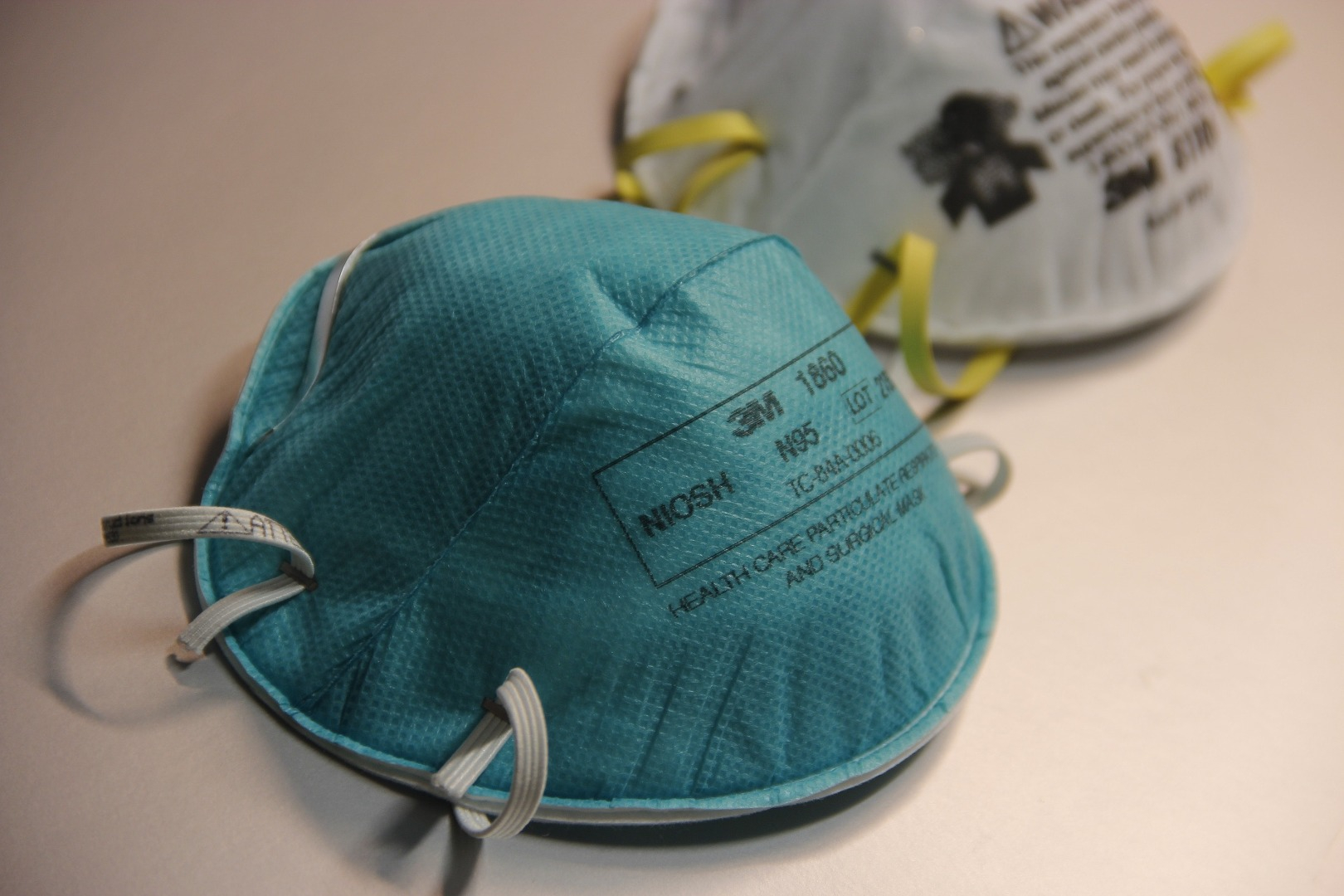
The team uses a typical N95 mask and the results were published in Nature Biotechnology. This technology had been developed to detect other viruses such as Ebola. The MIT and Harvard teams have further plans for the technology.

CAPTION: The team uses a typical N95 mask.

“We’ve demonstrated that we can freeze-dry a broad range of synthetic biology sensors to detect viral or bacterial nucleic acids, as well as toxic chemicals, including nerve toxins. We envision that this platform could enable next-generation wearable biosensors for first responders, health-care personnel and military personnel,” MIT researcher James Collins tells  MIT news

A non-fungible
token of good faith

The internet is full of funny images, including cartoon images of animals by digital artists from all over the world. The Bored Ape Yacht Club is one such group producing digital cartoons of apes in hats. They’re entertaining; they’re cute; and one sold for USD 3.4 million last year.

These monkey pictures are examples of NFTs: non-fungible tokens. To explain NFTs, let’s start with the concept of fungibility. Fungible assets are goods that can be readily interchanged for another of the same thing: a dollar bill is a dollar bill, regardless of its serial number.

That dollar bill is also four quarters or ten dimes, and so on. Its value remains the same. Stock operates in much the same way: One share of a company’s stock is worth the same as any other share of that same company. It doesn’t matter which one you personally own: The stocks are designed to be equivalent and interchangeable.

Go to any bookstore and buy a copy of any mass-market paperback. You now have a fungible copy of that text. But if you choose a first edition or a limited cover, things start to shift.

Now, you have something of a limited run, and its value often increases because of that. People may pay a premium to get that unique cover or the historical first edition: The book hasn’t actually got more to offer as a first edition. It’s generally the same text that you’d find in the mass-market paperback.

Bringing it back to art, you could purchase a print of one of Monet’s Water Lilies series for your wall; you could even print an image from the internet and hang that.

But an original Water Lilies piece costs so much more than a printer-paper copy or even the most skilled reproduction. You’re not just paying for the image, you’re paying for the history and the provenance, for the fact that it’s a Monet, an original.

Anything can be an NFT. The NFT isn’t a digital image itself, but the receipt that shows that you own it. A blockchain record verifies the purchase.

If you want your item to be valuable, you often want it to be non-fungible. For physical items, non-fungibility makes sense. Certain things hold greater value than others even if they are fundamentally the same thing. Digital media, however, is infinitely reproducible.

My eBook copy of the mass-market paperback is identical to your copy, right down to the ones and the zeros. How can you have a collector’s edition of those ones and zeros? How can you have something special when creating an exact copy is as simple as Ctrl+C?

ENTER THE BLOCKCHAIN

Blockchain is the technology that’ll be powering everything, that new system we’ve all heard of yet barely anyone actually understands. Blockchain offers an immutable and tamper-proof ledger, where each record created forms a block, and each block is confirmed by the community among which the platform is shared before it can be paired up with the previous entry in the chain.

The blockchain is a shared database, validated by a wider community rather than a central authority, making it a public ledger that cannot be easily tampered with, as no one person can go back and change things.
If you purchase an NFT, you are the sole owner, and this fact is protected by the blockchain. No one can modify the record of ownership, and no one can copy/paste a new one into existence.

Smart contracts assign ownership and manage the transfer of NFTs. When someone creates an NFT, they execute code stored in the smart contracts that conform to different standards, with this information added to the blockchain to be tamper-free forever.

It’s not hard to imagine a world where your Ethereum wallet becomes the key to your car or home.

Instead of a physical limited-edition copy of your favorite novel, your NFT is a token that says: “I bought one of only 500 limited-edition versions of this, and no matter how many times the piece is copied, there will only ever be 500 of these tokens.” It’s digital copyright; it’s digital bragging rights. Sure, you have a piece of work by Monet, but do you have a Monet? Sure, you have a piece of digital art, but do you have an NFT?

Think of an NFT as a template. Although 2021 saw digital art sweep the mainstream, anything can be an NFT. The NFT isn’t the asset itself, but a unit of data (or a digital asset) on the blockchain that confirms and represents ownership of the asset, whether that is digital or physical.

If you’re purchasing a piece of digital art that has been listed as an NFT, the NFT is the string of numbers on the blockchain that says, “Yes, you own this now.” It’s like a digital receipt that no one can argue with.

An NFT could represent digital art, from GIFs to videos, and real-world items such as the deeds to a house, legal documents, tickets to a real-life event and so on. As the Ethereum website says, “It’s not hard to imagine a world where your Ethereum wallet becomes the key to your car or home — your door being unlocked by the cryptographic proof of ownership.”

WHERE IS THE MONEY?

As with any good where only a limited number exist, you can often expect its value to increase over time. Bragging rights command a high price. The NFTs created by Bored Ape Yacht Club, a team of developers who created the 10,000 Bored Apes sitting in the digital repositories of such celebrities as Justin Bieber, Paris Hilton and Jimmy Fallon, also serve as tickets to an exclusive social club. And they’re all sold out.

At the same time, there’s money to be made anywhere people are willing to pay for something.

Some people want to support their favorite creators by buying a “premium” version of a piece. Some people just want to own a piece of digital art.

There’s also the concept of royalties, which is new to this marketplace, but powerful. Some NFTs have smart contracts that will automatically pay out royalties to their creators when they’re sold.

As their work is sold from person to person — as that NFT changes hands — creators can earn royalties automatically.

And the potential for those royalties could be rapidly growing. Andrea Baronchelli, reader of mathematics at City University of London, reports on what he describes as the “NFT revolution.”

Some NFTs have language built into the smart contract that automatically pays out royalties to the NFT creators when the asset is resold.

He investigated data concerning 6.1 million trades of 4.7 million NFTs between June 23, 2017, and April 27, 2021, and says the NFT market experienced a 150-fold growth in just eight months at the end of 2020 and into 2021.

“Following an initial rapid growth in late 2017, when the CryptoKitties collection gained worldwide popularity, the size of the NFT market remained substantially stable until mid 2020, with an average of around USD 60,000 traded daily,” Baronchelli says. “Starting in July 2020, the market experienced dramatic growth, with the total volume exchanged daily surpassing USD 10 million in March 2021.”

How valuable is an NFT, really? Usman Chohan, economist at the University of New South Wales, says an NFT is just “as valuable as people express a willingness to pay for it.”

Same as anything, then.

IT’S NOT PERFECT — YET

The blockchain itself is immutable; your information and your assets are safe when they’re on there. But with multiple NFT marketplaces and multiple individual blockchains, it’s feasible to screenshot an NFT from one platform and list it as something brand new and unique on a different platform.

Once it’s on that blockchain, have fun trying to delete it. Ultimately here, the fungibility applies to the specific blockchain instance of the thing, not the thing itself.

Chohan says this is part of what raises eyebrows among casual observers of NFT markets. “Anyone could, in theory, upload artwork onto an NFT, without proving that they are the original creator of the work,” he says. “This creates an evident real-world risk that fraudulent actors will upload NFTs to auction markets by posing as the original owners, or creators, of objects of value.”

“In theory,” he continues, “there can be multiple NFTs created over an asset, claiming to be the ‘true’ token representing an idea, image or object.”
There are contracts that can help mitigate this. If you want to buy an NFT, you can ask a smart contract to run a ”node,” a piece of software that checks everything on a blockchain for fakes. This contract needs to be smart enough to find fakes, but if it does, you’ll realize the NFT is a copy and you can pull out of the purchase.

The whole system works because blockchain technology is decentralized and secure, but this comes at a cost. It takes a lot of computing power to create new blocks in the blockchain, and blocks are created constantly to keep everything tamper-proof. Even if blocks aren’t storing new data, the more blocks, the more secure the chain.

The computing power to run NFT exchanges can be energy-intensive. Each new block in the blockchain required to prevent tampering with the record requires uninterrupted computer power.

However, this means that uninterrupted computing power is required and that is energy-intensive, to say the least. According to the New York Times, mining bitcoin uses more electricity than some countries.

“The process of creating bitcoin to spend or trade consumes around 91 terawatt-hours of electricity annually, more than is used by Finland,” the paper reports. Blockchain companies like Ethereum are committing to making the process greener, but it’s likely that blockchain technology’s energy consumption will remain volatile.

THE ‘ART’ IN FRAUD ARTIST

Nothing is immune from exploitation and NFTs are no different. For those looking to launder money, the art world has long been a draw: Art typically commands a high price, and the industry allows large cash deals.

Many valuable artworks are housed in ”freeports,” high-security storage spaces for safekeeping. They are auctioned and purchased using dirty money, then anonymously sold on without ever leaving their place in the freeport. The new buyer can retrieve their new artwork from the same freeport, and the original buyer, turned seller, has money from a seemingly legitimate business deal. NFTs could make this even easier.

There is nothing stopping you listing any asset as an NFT for huge amounts of money. An anonymous user who totally isn’t you then buys that NFT, and you receive some nice clean cryptocurrency. The anonymity of the whole affair is the key here: When your government wants to know where you got all your money, you can point to the transaction where an anonymous user paid for your NFT.

IT’S ALL A BIT TENUOUS

When you buy an NFT, you buy the certificate of authenticity that proves you own the NFT, not the thing itself, and a link pointing to that thing. That thing could be the original image, that Bored Ape you’ve wanted for so long.

But that link is only as good as the service keeping that link active. It’s all very fragile and maintains value only as long as the people using it insist it has value. But then, that’s how all money works, really.

As Baronchelli points out: “The NFT market is less than four years old. Overall, NFTs are a new tool that satisfies some of the needs of creators, users and collectors of a large class of digital and non-digital objects.

Have you bought THE Mona Lisa or A Mona Lisa? The value of your asset often depends on the exclusivity of the purchase.

As such, they are probably here to stay or, at least, they represent a first step towards new tools to deal with property and provenance of such assets.” Ultimately, NFTs are a way to emulate physical uniqueness for digital assets. Even if there are a million other identical copies out there, the NFT says that you own the original one.

This is all secured using blockchain technology, which is the same method that digital currencies use to ensure that you can’t make a million copies of your bitcoin.

There are countless copies of the Mona Lisa out there, but there’s only one Mona Lisa.

What’s chaining blockchain?

What’s chaining blockchain?

Blockchain might be the most hyped technology relatively few people understand or actively use.

Its earliest and perhaps most famous use – the cryptocurrency bitcoin – has become a household word, with other digital-currency companies such as Ethereum and Cardano gaining traction in the public consciousness and with investors.

Despite wild price volatility and scams that the United States’ Federal Trade Commission says cost 7,000 people more than US $80 million between October 2020 and March 31, 2021, the crypto economy keeps rolling along, with market capitalization topping $2.4 trillion in May 2021, up from around $200 billion in 2019. And according to a 2021 Fidelity study, seven in 10 institutional investors expect to buy or invest in digital assets in the future.

But financial applications are just part of the hyped potential for blockchain. Boosters of the technology point to other uses such as securing medical data, tracking supply chains, facilitating votes and protecting personal-identity security.

Blockchain, however, still faces hurdles before it can be the game-changer it’s been promising to be since the 2009 debut of bitcoin.

Terms you should know

Hash: The function that meets the encrypted demands needed to solve for a blockchain computation. Read more›››

Non-fungible token (NFT): A unique bit of data stored on a digital ledger that can be sold or traded. It can be a photo, a video or any kind of digital file. Companies such as Nike, Walt Disney, Warner Bros., the NBA and Coca-Cola are issuing NFTs.

Nodes: The computers that make up the blockchain network. They store and update records of each transaction in real time.

Smart contract: A signed, unalterable digital agreement stored on blockchain.

Token: Unit of value that can be acquired through blockchain.

Wallet: A digital wallet that lets users store or transfer digital currencies.

Central Bank Digital Currency (CBDC): A digital currency issued on a blockchain/distributed ledger technology (DLT). Governments across the globe are running pilot projects using CBDCs. A 2021 Banks for International Settlements survey found that 86 percent of the central banks worldwide are conducting research on CBDCs.‹‹‹ Read less

  But first: What is blockchain?

Blockchain is a platform to store and transfer information in a way that is virtually impossible to change without other users knowing. It is secure because it is decentralized and its content is hashed. Users issue transactions to a public ledger that is managed and verified by a network of computers (called miners) without a third party such as a government, bank or other institutional intermediary getting involved.

A group of verified transactions is called a block, and the blocks are linked by complex puzzles solved by computers(“miners”) which verify the transaction and are rewarded for their efforts. Any retroactive change to the log invalidates each block that follows. The result is a certified, transparent, decentralized, tamper-proof database or ledger.

  Do we really need it, though?

There are difficulties on the way to blockchain world domination, however.

Perhaps the first hurdle to the Age of Blockchain, as Jesse Frederik of the Correspondent asked in 2020, is whether blockchain is a solution in search of a problem. In other words, are the problems expected to be addressed by blockchain projects better suited to solutions we already have?

But hold up, says Dragan Boscovic, research professor and co-director of the School of Computing, Informatics and Decision Systems Engineering at Arizona State University. Blockchain may need to evolve and improve, but it’s viable, solves real-world problems and is on a well-trod path to large-scale adoption.

”It is rather a common technology evolution, the same way you would upgrade from your iPhone 11 to iPhone 12 or 13,” Boscovic tells KUST Review. “There are numerous examples of blockchain technology being deployed to solve practical problems: One example is the (IBM) Food Trust solution for the food-supply chain.” (See sidebar.)

Also, says Dr. Ramesh Ramadoss, co-chair of the Institute of Electrical and Electronic Engineers’ Blockchain Initiative, it’s important to note that “blockchain” isn’t a monolith. It refers to a collection of various distributed ledger architectures. “Different architectures are used in different applications,” he tells KUST Review, “so, it’s very challenging to make a general statement about the actual usage or maturity level of the field.”

  An energy glutton

Another issue is that blockchain can have a heavy carbon footprint.

According to the Harvard Business Review, Bitcoin alone consumes around 110 terawatt hours per year – 0.55 percent of the world’s energy production. Together, Ethereum and Bitcoin annually eat up the same amount of energy as the residents of Belgium and Thailand, respectively, Digiconomist’s Ethereum Energy Consumption Index reports.

And each Bitcoin transaction, regardless of how big or small, represents $176 in electricity to power the mining, according to UK financial site MoneySuperMarket.

SOURCE: Digiconomist, World Population Review. DESIGN: Anas Albounni, KUST Review

The technology needs the resources, but the industry is already beginning to correct itself, Boscovic says, noting “Ethereum 2.0,” which completed its long-awaited merge in September 2022. The initiative promises to reduce its energy usage by 99 percent and be “more scalable, more secure and more sustainable.”

And energy consumption for private blockchains, however, is generally not an issue, Ramadoss notes.

Still, “blockchain by its design needs to have access to a large pool of distributed resources,” ASU’s Boscovic adds. “It is from there that it is able to extract value by enabling independent validation and real-time auditing of the transactions enacted across these resources. Initial blockchain solutions made great strides in improving their scalability and throughput (e.g. speed of transaction) as well as energy efficiency. Cardano network is (another) example of new blockchain design that scales well and exhibits great energy efficiency.”

Most people think finance first when they consider the applications of blockchain. But here are seven examples of real-world uses you might not have expected. Read more›››

Food safety: The United Nations estimates that 1.4 billion tons of food are wasted every year because of supply-chain inefficiencies. The IBM Food Trust looks to change that – and control other issues, including food safety, sustainability and fraud – with its blockchain program to help supply-chain users better communicate

Avoiding spam calls: India’s telecom authority insisted that providers use digital ledger technology to solve the problem of spam calls and texts to its more than 500 million mobile-phone customers. The result? Tech Mahindra created Hyperledger Fabric, which works with all of the service providers in India to manage unwanted calls.

Entertainment: Mediachain, which was bought by Spotify in 2017, is another use of smart contracts, helping musicians agree to rates and get paid.

Health care: BurstIQ’s smart contracts help patients and doctors manage the transfer of sensitive identity information and data. Other blockchain-based systems for medical record-keeping and communication include Patientory, Immunity.Life and Medicalchain.

Marriage: Rebecca Rose and Peter Kacherginsky in April 2021 used Ethereum’s blockchain to get married. The couple, both employees of crypto-based exchange Coinbase, wrote a smart contract and exchanged “rings,” non-fungible tokens (NFTs) in the animated form of two circles merging into one.
The digital marriage was performed in conjunction with a traditional Jewish ceremony when the couple used their phones to exchange the tokens. The couple named their tokens Tabaat – the Hebrew word for ring.

Human rights: Coca-Cola, along with the US State Department and several crypto companies, is working on a plan to let workers use blockchain technology to report cases of forced labor. The initiative was announced after the Know the Chain study in 2019 found that many food and beverage companies failed to address the issue of labor abuses in their supply chains.

Tracking vaccines: With the Covid pandemic bringing vaccines and vaccine safety to the forefront of the world’s attention, IBM (again) is stepping up with a project aimed to make sure vaccines are trustworthy and distributed efficiently. IBM promises that its distribution network will ensure speed, transparency and accountability as well as the ability to monitor for adverse events and facilitate quick recalls, if needed.‹‹‹ Read less

  Out of the shadows

A feature for many users is blockchain’s anonymous transactions, which is fine if you just don’t want anyone to know you’re really into collecting rare My Little Pony figurines, but it becomes a problem when that anonymity is used to launder money or for other nefarious ends.

But just because you don’t have to show ID doesn’t mean transactions are really anonymous. Identities can be tracked if you care to look hard enough, Boscovic says: “Blockchain is a rich source of digital information. With the right digital forensic tools, it is relatively easy to link a specific person to their digital identity used to transact on the blockchain.”

The FBI followed that sort of forensic trail after cyber attackers hit the Colonial Pipeline in May 2021, shutting down the American oil-pipeline system and demanding a ransom of 75 bitcoin (about $2.8 million at the time), Boscovic notes. Most of the ransom (63.7 bitcoin) was recovered; the US government in November offered a $10 million bounty for information about DarkSide, the hacking group believed to be responsible.

Of course, as law enforcement becomes more tech-savvy, users will find new ways to cover their electronic trails. The IEEE’s Ramadoss points to blockchains such as Monero and Zcash that were designed with privacy in mind and are much more difficult to trace.

  Eyes on the future

So what does a blockchain future look like? International regulation might not be a part of the puzzle. Ramadoss thinks such agreements might be extremely difficult given the fragmented nature of the global regulatory landscape.

“Crypto regulation varies from country to country,” he says. “Some countries are favorable (Singapore, El Salvador, Ukraine, Malta), some countries are working on a new regulatory framework (European Commission), and some countries outright banned cryptocurrencies (China).”

And ASU’s Boscovic sees no need for international agreements in principle. “Blockchain solutions are international and borderless by their designs,” he says. “Rather, the national regulators will need to interpret and map international blockchain business opportunities onto local business ecosystems and help their economies be competitive in such a global environment.”

  Who’s in the lead?

The experts disagree, however, on which regions are leading the way to a blockchain future. Ramadoss is betting on China (for non-crypto technology), which has been piloting the blockchain-based Digital Yuan project, and the European Union, whose European Commission “is funding the European Blockchain Services Infrastructure (EBSI) to serve as a single platform for issuance of identity, diplomas management, notarization of documents and trusted data sharing among the EU member states.”

SOURCE: International Data Corporation. DEDISN: Anas Albounni, KUST Review

Boscovic, however, puts his money on North America. “It is primarily due to the entrepreneurial spirit of the young generation, its sharp focus on the global economy and easy access to the capital markets. Europe and Singapore are not far behind.”

But both agree that the confusing nature of the technology isn’t a problem at all. Just as most people don’t have to understand exactly why the internet works to use it, blockchain users will access the technology through user-friendly apps, they say. And the blockchain future? When will it finally arrive? “It’s already here,” Boscovic says.