Have you ever been in an area where it’s so crowded no one can move?
Robot swarms experience the same issue — when too many are trying to move in perfect order, they get jammed up and go nowhere. But there’s a solution.
There is a “sweet spot” between chaos and perfect order that leads to best performance. And it’s a simple fix.
A new study led by researchers at Harvard University reveals that throwing a little randomness into the mix can break up robot traffic jams and help bots get their jobs done quicker.
A smidge of capriciousness among robot movement lets them slip past each other and maintain flow. Not enough noise results in jams, too much noise and robots are off wandering aimlessly.
The “just right” area in the middle is where the magic happens.
Researchers tested using both computer models and real robots and discovered that at just the right level of randomness, traffic jams resolved, and test models reached their goals quicker. No central system instruction required.
Knowing that sometimes the best method of organization is to be a little less organized is meaningful not just for robots, but for such applications as warehouse logistics and crowd management.
Robots are becoming increasingly involved in our everyday lives, assisting everything from manufacturing and logistics to health care and housework. Yet they still face significant hurdles. Here are two ways teams at Khalifa University are improving the technology.
ENHANCED PERCEPTION
Accurately recognizing and dividing up objects in a robot’s environment is a task made challenging by occlusions blockages, complex shapes and ever-changing backgrounds. This stands in the way of robots fully grasping the world around them. The technical term for this daunting task is “panoptic segmentation” — dividing an image into foreground objects and background regions simultaneously. Improving a robot’s perception of its environment would enable them to handle complex tasks more efficiently.
Listen to the Deep Dive
However, this problem isn’t easy to solve. Cluttered scenes, object variability, objects that block vision, motion blur and the slow temporal resolution of traditional cameras all make it a tough nut to crack. Added to this, high latency — or delays — in processing sensor data can slow response times and reduce task accuracy.
Recent developments in object segmentation using cutting-edge graph neural networks have their own limitations: They add extra requirements as both panoptic segmentation and grasp planning must be done quickly and efficiently. More sophisticated algorithms and techniques that can grapple with the real world’s unpredictability are needed.
IMAGES: AI Generated DESIGNS & PROMPTS: Anas Albounni, KUST Review
Yahya Zweiri, director of the KU Advanced Research and Innovation Center, and his team developed a method to overcome these challenges using a graph mixer neural network (GMNN). Specifically designed for event-based panoptic segmentation, a GMNN preserves the asynchronous nature of event streams, making use of spatiotemporal correlations to make sense of the scene. The KU researchers developed their solution with researchers from London’s Kingston University.
Their results were showcased at the 2023 IEEE Conference on Computer Vision and Pattern Recognition, one of the most prestigious conferences in the field of computer vision. They were awarded best paper by a committee that included experts from Meta, Intel and leading U.S. universities.
“GMNN has proven its worth, achieving top performance on the ESD (event-based segmentation dataset), a collection of robotic grasping scenes captured with an event camera positioned next to a robotic arm’s gripper,” Zweiri says. “This data contained a wide range of conditions: variations in clutter size, arm speed, motion direction, distance between the object and camera, and lighting conditions. GMNN not only achieves superior results in terms of its mean intersection over union (a key metric for segmentation accuracy) and pixel accuracy, but it also marks significant strides in computational efficiency compared with existing methods.”
This model lays the groundwork for a future where robots can perceive and interact with their environment as efficiently as possible, opening up a world of potential applications across industries.
Drilling into greater precision
Robotic drilling systems play a crucial role in such industries as manufacturing, construction and resource extraction. Achieving precise positioning of these drilling systems is essential to ensure accuracy, efficiency and safety in drilling operations. To address this challenge, researchers have been exploring advanced control techniques that can improve the positioning accuracy of robotic drilling systems.
One such technique that has shown promising results is neuromorphic vision-based control. By leveraging the principles of neuromorphic engineering and incorporating vision-based sensing capabilities, this approach offers a novel solution for enhancing the precision of robotic drilling.
Zweiri and his team, along with Dewald Swart at Strata Manufacturing, developed a neuromorphic visual controller approach for precise robotic machining.
“The automation of cyber-physical manufacturing processes is a critical aspect of the fourth industrial revolution (4IR),” says Abdulla Ayyad, a researcher on the team. “Between 2008 and 2018, the number of industrial robots shipped annually more than tripled, and by 2024, more than 500,000 industrial robots are expected to ship each year.
The UAE specifically is aiming to become a global hub in 4IR technology and our work is aligned directly with this vision to support solutions for increased efficiency, productivity and safety.”
“The manufacturing industry is currently witnessing a paradigm shift with the unprecedented adoption of industrial robots, and machine vision is a key perception technology that enables these robots to perform precise operations in unstructured environments,” Dr. Zweiri says.
“Neuromorphic vision is a recent technology with the potential to address the challenges of conventional vision with its high temporal resolution, low latency and wide dynamic range. For the first time, we propose a novel neuromorphic vision-based controller for robotic machining applications to enable faster and more reliable operation, and present a complete robotic system capable of performing drilling tasks with sub-millimeter accuracy.”
Automating certain manufacturing processes means greater performance, productivity, efficacy and safety, with drilling one of the processes prime for automation. It is a widespread process, especially in the automotive and aerospace industries, where high-precision drilling is essential as the quality of drilling is correlated with the performance and fatigue life of the end products.
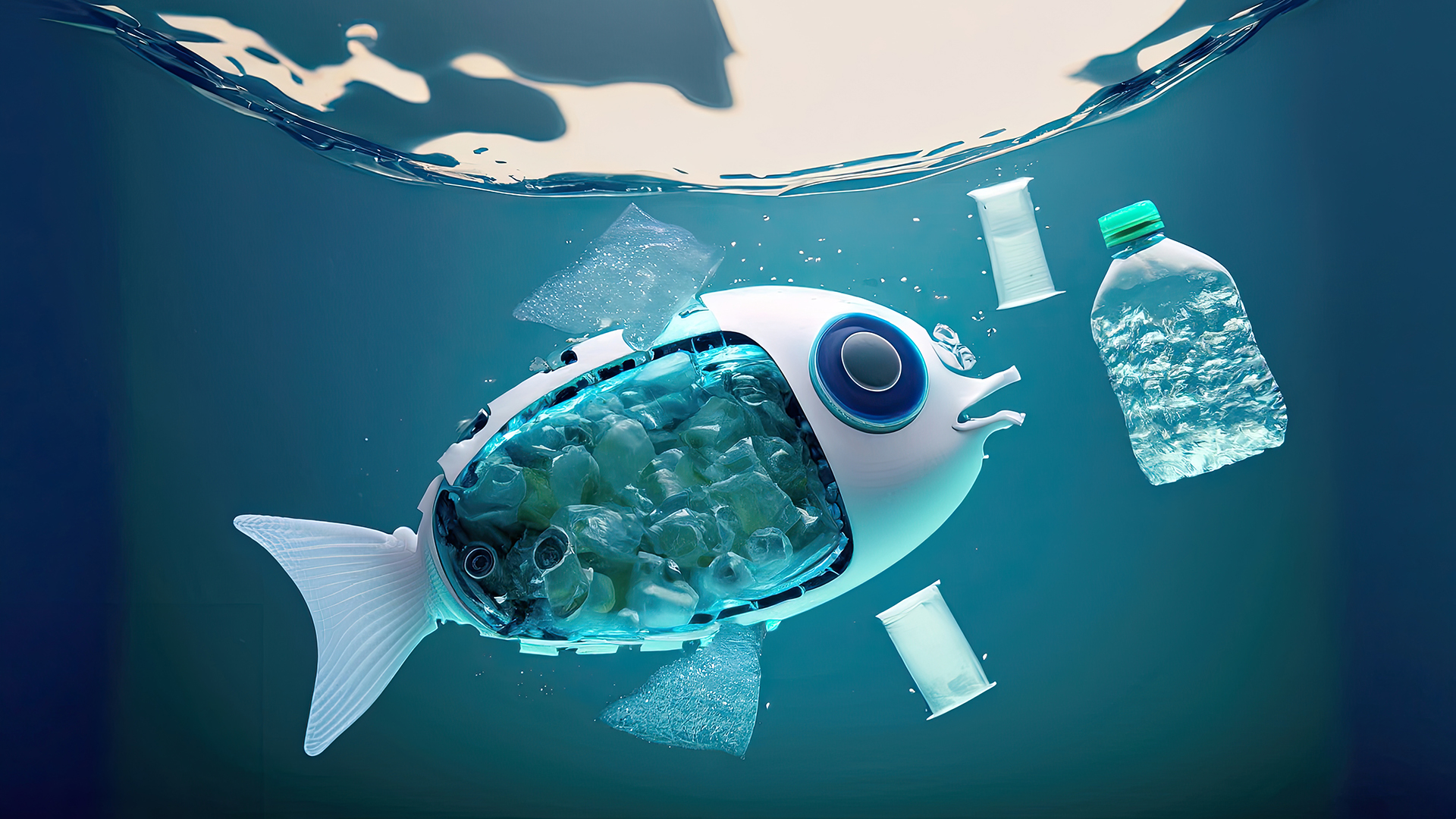
Scientists have developed a new generation of robot fish that can do more than just swim, it can also eat microplastics — providing a promising solution to the global problem of plastic ocean pollution.
The University of Surrey in the United Kingdom hosts a contest each year focused on developing robots that mimic things in nature. The 2022 winner, chemistry undergrad Eleanor Mackintosh, designed a robot that looks and acts like a fish and is skilled at filtering microplastics from water it sucks in through its gills. The robot is aptly named Gillbert.
Gillbert is 50 centimeters long and approximately the size of a full-grown pink salmon. It is shaped like a fish, and its movements mimic those of a fish. It moves through the water via remote control while its gills move in and out, drawing in water. Gillbert filters the microplastics — some as small as 2 millimeters — and stores them in an internal container.
Though Gillbert is operated by remote control, Robert Siddall, robotics lecturer at the University of Surrey and founder of the competition, hopes this robot fish inspires others to work toward gaining control of the plastic problem plaguing the world’s oceans.
But with an estimated 5.25 trillion pieces of plastic in the oceans, why focus on microplastics?
Ludovic Dumée, assistant professor of chemical engineering at Khalifa University, says although microplastics are small and difficult to see, they have an enormous impact.
“Microplastics, whose maximum dimension falls below 5 millimeters, are ultimately released into waterways and represent a major threat to global ecosystems, the entire food chain as well as many human industrial activities that rely on river or sea-water intake,” he says in a 2023 article in KUST Review.
Additionally, Dumée says human beings consume between 50,000 and 100,000 microplastics annually. This exposes humans to contaminants and increased cancer risks.
CAPTION: Plastic straws become microplastics IMAGE: Unsplash
Gillbert the fish is one possible solution to the microplastics problem, but more attention is required to solve this global issue.
The 2023 Natural Robotics Contest requires this year’s entries be inspired by the December 2022 UN Biodiversity Conference held in Montreal, Canada. The biodiversity conference addressed appropriation of a global biodiversity framework to deal with the main causes of nature loss. The 2023 contest is open for entries until July 1, and the winner is promised a working prototype based on their design.
A 3D print download of Gillbert is available for open access so others might improve upon the initial design.
Whether it’s adhesions that mimic gecko toes or robotic technology inspired by land animals like cheetahs, many developments in science are inspired by nature. A team of mechanical engineers at Rice University in the United States took inspiration one step further, creating a new field of study called necrobiotics turning a dead wolf spider into a robot.
Spiders use their legs to walk and jump, but unlike most animals, they do so with the force of pressure rather than muscle contraction and extension. Spiders don’t have the ability to extend muscles in their legs, so after flexing, they push blood into their legs like a hydraulic system, allowing for powerful movements like jumping. When the spider dies, the legs curl up because there is no pressure present.
The team reintroduced pressure into the spider’s legs via a needle in its back, adding pressure to extend the legs and removing pressure to flex them. This allowed the researchers to use the legs as an actuator gripper to pick up items. They demonstrated the spider’s ability to pick up oddly shaped and delicate items and lift objects up to 130 percent above its body mass.
Its ability to pick things up isn’t the only benefit of using bio material: Nature will take care of the waste.
The actuator can camouflage in natural surroundings and the material would eventually fully biodegrade — unlike bioinspired or biohybrid mechanisms that use synthetic materials. The actuators were used in 700 actuation cycles before decaying — only one of the limitations of working with dead organisms.
Seven hundred actuation cycles is a low number compared with non-bio actuator grippers. A synthetic gripper used in farming to pick up lightweight food like mushrooms or berries, for example, would complete between 263,000 and 700,000 cycles.
In addition to limited performance, there are variables to consider when working with bio material.
Not all wolf spiders are exactly the same size so will not have the same longevity. Additionally, variation in size could affect the strength of the gripper.
“The concept of necrobiotics could play a role in inspiring more sustainable fabrication of actuators to reduce the accumulation of technological waste,” the team says in Advanced Science. Though this is a new area of research, they will continue to explore other organisms with similar hydraulic- movement systems.
Up to 12.7 million tons of waste makes its way into the world’s oceans each year, forming massive “plastic islands” in oceanic gyres and devastating birds and marine life in the process.
Cleanup, in which plastics are currently collected at sea, stored and shipped to shore for disposal, is estimated to take from 50 to 130 years with annual costs expected by some at nearly US $37 million. In the meantime, the trash is degrading faster than it can be gathered, disintegrating into harmful and even more difficult to mitigate microscopic forms.
Listen to the Deep Dive
Now a team of researchers from Massachusetts in the United States is suggesting a new approach: self-powered cleanup vessels that turn the trash they harvest from the seas into the fuel they use for the job.
The researchers, representing Harvard University, the Woods Hole Oceanographic Institution and the Worcester Polytechnic Institute, suggest using high temperatures and high pressure in a process called hydrothermal liquefaction to depolymerize the plastics into a harnessable energy, creating self-powered cleanup that eliminates the need to refuel or unload plastic waste and potentially reduces total cleanup times.
Of course, it isn’t enough to clean up the oceans faster and with less fuel waste. The world needs to address the amount of garbage that makes it into the oceans in the first place, the researchers write. “Reducing or eliminating the amount of plastic waste generated is critically important, especially when the current loading may persist for years to even decades,” they say.
COVID’s toll on the oceans
Meanwhile, researchers from China’s School of Atmospheric Sciences at Nanjing University and the Scripps Institute of Oceanography at the University of California-San Diego say the COVID-19 pandemic is making an already bad situation in the oceans even worse.
Also writing in the Proceedings of the National Academy of Sciences of the United States of America, the scientists say that of the 8 million tons of plastic waste generated until recently in the fight against the virus, about 25,000 tons of medical waste, mostly from hospitals, has entered the world’s oceans. And more is expected to come, not only damaging marine species but potentially spreading contaminants including the COVID-19 virus.
The hospital trash, they say, dwarfs the amount of waste from discarded personal-protective equipment (PPEs) and plastic packaging produced by a surge of online shopping in the wake of the pandemic. For a little perspective, the authors cite another study estimating that 1.56 million face masks made it to the oceans in 2020.
Plastics that wash into the oceans are endangering wildlife. IMAGE: Shutterstock
Five of the top six rivers associated with medical-waste discharge are in Asia (Shatt al Arab, Indus, Yangtze,Ganges Brahmaputra and Amur). The other, the Danube, is in Europe.
The authors call for increased public awareness of plastics’ environmental impacts; better collection, treatment and recycling of plastic waste; and improved waste-management practices at pandemic epicenters, particularly in developing countries.
Microbots to the rescue?
A solution to microplastics in water might come in an equally small package: microbots.
The bacterium-size bots when added to water with a little hydrogen peroxide attach to microscopic bits of plastic and begin to break them down. The research was recently published in ACS Applied Materials & Interfaces.
“They can sweep a much larger area than you would be able to touch with stationary technology,” says study co-author Martin Pumera, a researcher at the University of Chemistry and Technology, Prague.
Pumera envisions setting the microbots loose in the oceans to collect microplastics, but Win Cowger, an expert in plastic pollution at the University of California, Riverside, who was not involved with the study, tells Scientific American that closed systems such as those for drinking-water or wastewater treatment would probably be better potential targets.
Join our mailing list
Get the latest articles, news and other updates from Khalifa University Science and Tech Review magazine



 UGH THEIR EYES