
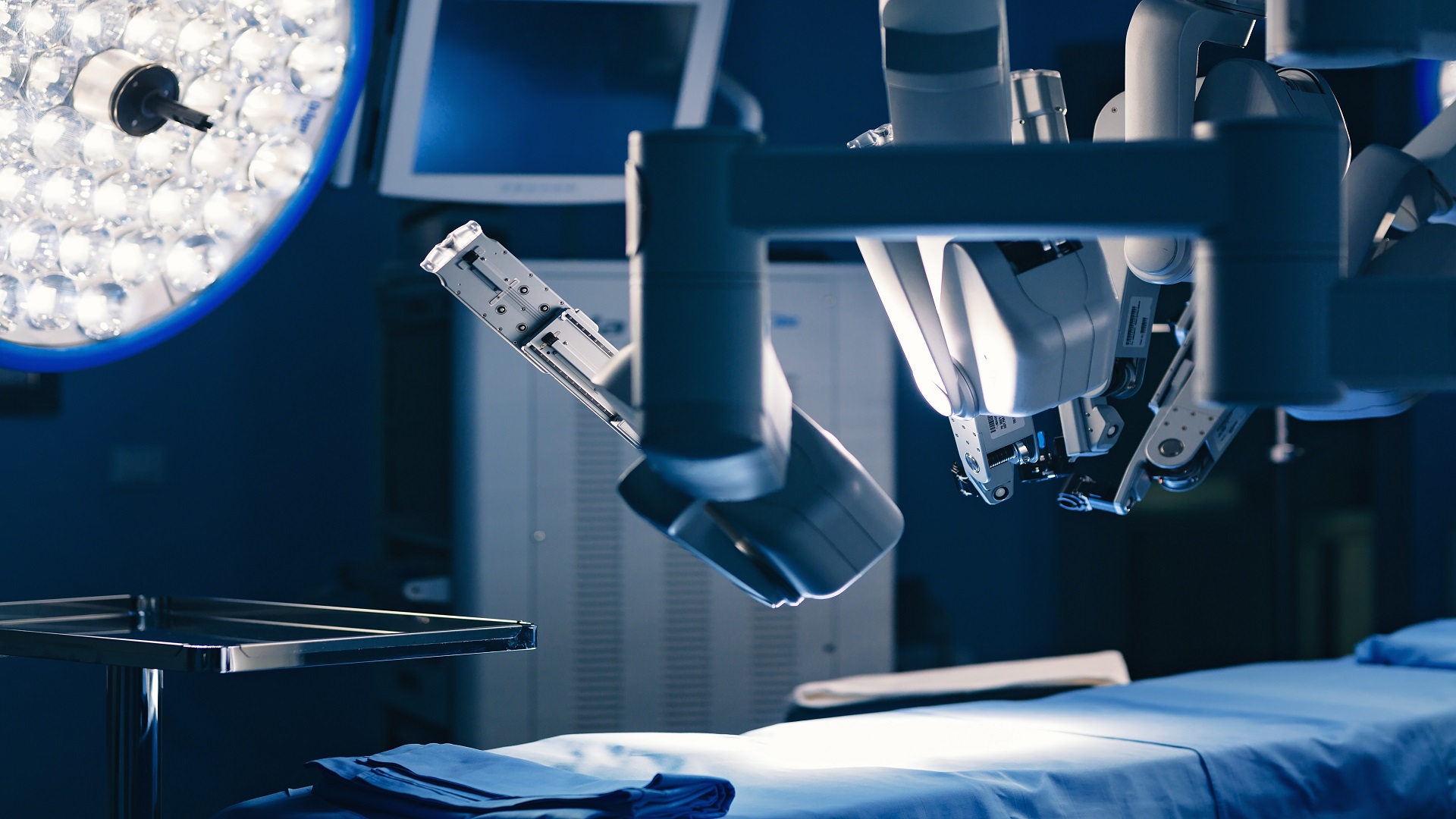
It’s a robot invasion —
in the operating room

Telehealth evolved rapidly during the COVID-19 pandemic, with phrases like tele-triage and tele-consultants becoming household words as governments adapted policies and encouraged remote services to manage an unprecedented health emergency. At the same time, a halt in most elective surgeries worldwide highlighted a need for advancements in robotic surgeries.

Now with progress in machine learning, AI the 5G network and robotic surgery equipment, surgeons can operate on patients from across the room and across the world.


As with most technology developments, there are kinks to iron out. Since the first telesurgery in 2001, skepticism, network issues, legislative differences between countries and the high cost of robotic equipment hindered growth. After the development of 5G, however, a team in China in 2019 performed successful telerobotic spinal surgeries on 12 patients from six cities.

While both robotic surgery and telesurgery offer more precision, are less invasive and result in quicker recovery time, telesurgery also eliminates logistical issues like travel health risks and cost of travel. It also offers better access to much needed surgeries for underserved countries.

CAPTION: Neurosurgeon remotely operates on a patient IMAGE: Shutterstock

The Lancet in 2015 published a study in which researchers estimate 5 billion people lack access to necessary surgical care. The main problem with this is not only the expense of the robotic systems, but also access to high-speed internet.

Gary Guthart, CEO of Intuitive — the company that created the Da Vinci surgical robotic system, which was the first to be approved by the U.S. Food and Drug Administration — said the company is developing innovative strategies to increase the number of surgically trained clinicians in low-resource regions.

“This is an urgent problem,” he says, “because of the significant global shortage of surgeons, particularly in low-resource countries. Every year, an estimated 16.9 million people die who might otherwise be treated.”


With the need for telesurgery development at the forefront, advancements in machine learning, AI and the 5G network, the market is expected to surge to an estimated compound annual growth rate of 11.9 percent between 2022 and 2029. The growth can be attributed to things like a desire for less invasive surgeries, precision ability, a 3D surgical viewpoint and the increasing volume of surgeries worldwide. A paper published in 2020 in Elsevier estimates that there are 310 million major surgeries each year.

Further benefits include data sharing ability between institutions, remote consultations and training surgeons.

Anthony Fernando, president and CEO of Asensus Surgical, a medical devices company that focuses on digitizing the interface between surgeon and patient, believes that using AI, machine learning and adding deep-learning abilities to robotics will result in “the best possible patient outcomes independent of surgeon skill level, training, and experience. This transition of thinking and innovation is what will drive the larger digital transformation needed to enable the future of telesurgery and other future surgical improvements that we have not even imagined yet.”

Robotic-assisted surgeries have been around for nearly four decades. The first procedure was a brain biopsy in 1985, which led the way for a gallbladder removal in 1997. This robot did not have a camera, so a human assistant had to hold the endoscope. The first telesurgery – also a gallbladder removal – was four years later.


UAE growing food security
with new agritourism park

The UAE is known around the world for having the biggest and best of many things, from the world’s fastest roller coaster to the world’s tallest tower. Now the nation is making itself known for the biggest and best in agritourism.

The UAE announced a plan in 2022 to build the largest agritourism park in the world. The park is set to begin construction in 2025 and open in 2030. The park will employ an estimated 10,000 people and host a fully green transit system and bio-saline agriculture.

While agritourism has been around since the end of the 19th century — in the form of city dwellers traveling in summer to visit family-owned farms — it is now a growing trend in sustainability and a popular choice for family vacations.

Activities in agritourism include anything from sampling food to an authentic farm-life experience in which a family might lodge on the farm and participate in daily operations. Many might have experienced agritourism and not even realized it when visiting a petting zoo, eating at a farm-to-table restaurant or picking berries.

Essentially, farmers or producers open their doors to the public for education, entertainment and an additional income stream. For some, however, it’s also about food security.

In a nation with a complicated climate and the pandemic highlighting difficulties with reliance on supply chains, food security is a major focus for the UAE. Approximately 90 percent of consumed food in the country is imported.

Credit: URB

In arid regions like the Middle East, developing technologies like vertical farms, a 400-hectare wheat farm fed by desalinated water in the desert and the world’s largest agritourism park are creating opportunities to become less reliant on imports.

The UAE’s leaders have expressed interest in becoming self-sufficient through driving local food production, incentivizing foreign investment and reducing red tape.

In a food and agriculture forum at EXPO 2021, Minister of Climate Change and Environment and Minister of State for Food Security Mariam Al Mheiri said, “We all share a vision for making our food system innovative, resilient and ultimately sustainable through increasing investment in agriculture research and development,” the National reported.

In 2021, the global agritourism market was appraised at $U.S.45,395 million and is estimated to reach $U.S.141 billion by 2030.

Drones help farmers grow greener

Growing demand for food is putting increasing pressure on the environment. Excess fertilizers and chemical sprays pollute waterways: In 2020, 2.66 billion metric tons of pesticides were used around the world. But drones could be the answer to transforming the way we farm, improving crop yield and limiting environmental impact.


Soil health is another area closely monitored by farmers, now aided by drone sensory data. Information captured by drones can help farmers analyze soil composition and decide where supplements are required, increasing crop yields.

Drones are a new technology allowing farmers and consultants to obtain overhead images of farm fields and land areas at greatly reduced prices over satellite and other methods,” says Randy Price, precision farming specialist at Louisiana State University Agricultural Center.

Drones can be fitted with sensors and imaging technology, and this data plays an integral role in active farming. Among other uses, the data can help farmers identify health issues with the crop, such as fungal contaminations, pest infestations or areas of growth congestion. Identifying these issues early and targeting specific locations eliminates the need to spray entire crops with pesticides — which means less toxicants in the air, soil and food supply.

Randy Price – Louisiana State University Agricultural Center

But drones aren’t only used for capturing data, they’re also good workers. Beyond identifying the problem, they can also be the solution.

“Once images are obtained, spatial variability maps can be made and downloaded to sprayer drones, which will allow automatic spraying of selected areas with very little pilot attention needed — this technology is evolving rapidly and will eventually lead to effortless, precision spraying over larger areas of land in an entirely computer-controlled fashion,” Price tells KUST Review.


With any new technology, there are obstacles to overcome. The drones are equipped with 5G and send the data back to be analyzed, but connectivity issues could inhibit data collection and transmission; wind or rain can affect drone flights; governments may require clearance to use drones; and with added technology comes added costs.

Still, with the agricultural drone market expected to grow to $10.8 billion by 2028, up from $1.3 billion in 2020, these obstacles are expected to rapidly diminish.

It’s not alive!

Whether it’s adhesions that mimic gecko toes or robotic technology inspired by land animals like cheetahs, many developments in science are inspired by nature. A team of mechanical engineers at Rice University in the United States took inspiration one step further, creating a new field of study called necrobiotics turning a dead wolf spider into a robot.

Spiders use their legs to walk and jump, but unlike most animals, they do so with the force of pressure rather than muscle contraction and extension. Spiders don’t have the ability to extend muscles in their legs, so after flexing, they push blood into their legs like a hydraulic system, allowing for powerful movements like jumping. When the spider dies, the legs curl up because there is no pressure present.

The team reintroduced pressure into the spider’s legs via a needle in its back, adding pressure to extend the legs and removing pressure to flex them. This allowed the researchers to use the legs as an actuator gripper to pick up items. They demonstrated the spider’s ability to pick up oddly shaped and delicate items and lift objects up to 130 percent above its body mass.

Its ability to pick things up isn’t the only benefit of using bio material: Nature will take care of the waste.

The actuator can camouflage in natural surroundings and the material would eventually fully biodegrade — unlike bioinspired or biohybrid mechanisms that use synthetic materials. The actuators were used in 700 actuation cycles before decaying — only one of the limitations of working with dead organisms.

Seven hundred actuation cycles is a low number compared with non-bio actuator grippers. A synthetic gripper used in farming to pick up lightweight food like mushrooms or berries, for example, would complete between 263,000 and 700,000 cycles.

In addition to limited performance, there are variables to consider when working with bio material.
Not all wolf spiders are exactly the same size so will not have the same longevity. Additionally, variation in size could affect the strength of the gripper.

“The concept of necrobiotics could play a role in inspiring more sustainable fabrication of actuators to reduce the accumulation of technological waste,” the team says in Advanced Science. Though this is a new area of research, they will continue to explore other organisms with similar hydraulic- movement systems.

Educators grapple with how to use ChatGPT

ChatGPT, Open AI’s artificial-intelligence tool that can write poetry, news articles or essays, has been banned in many schools around the world, but others are embracing it in the classroom, saying it may revolutionize education.

Ahmad Samer Wazan, associate professor at Zayed University in Abu Dhabi, encourages the use of the chat bot in his classroom, but says it will never replace the human ability to think critically.

Wazan, who recently gave a presentation on the subject at Khalifa University, says ChatGPT can offer superficial results, but the real learning takes place in the process of probing the AI tool.

Students need to understand the subject enough to know that the answer is superficial. They also need to think critically to probe for a more in-depth and accurate result, he says.

If it is asked a question, it will answer in a broad fashion — without real detail. The user needs to ask more meaningful questions to get a meaningful result. This, he believes, is where the learning can take place.

“The tool is not thinking critically” he says, indicating educators should use this tool to help students improve the technical aspects of their writing, but not rely on it.

Ahmad Samer Wazan, associate professor at Zayed University

Wazan is not alone. Other teachers are using the bot in other creative ways: to write story prompts, provide sample-test questions to prepare for exams, or have students critique the information and writing it produces to strengthen their own skills. It’s not only students who can benefit, however.

Educators can use the platform to save them administrative work, which means more time to focus on teaching. For example, ChatGPT can write lesson plans, emails to parents and meeting agendas. It can produce professional-development content for administrators to share with their teams or create curriculum-specific content. Some educators believe even with the risks, AI will continue to evolve and students should learn to use it effectively and ethically.

While ChatGPT can be used productively in education, there are risks. Educators need to be aware of the bot’s abilities in order to determine whether students are learning. Some teachers are adding impromptu oral examinations to test students suspected of cheating.

Because ChatGPT will not offer the same essay twice, however, it can be difficult to spot plagiarism.

Though the structure, grammar and punctuation is well-executed, professors have noted facts that are wrong. As a result, they’ve caught students cheating with AI-generated work.

To combat this issue, educators are turning to content detectors that can analyze the text and determine the likelihood that it was produced by AI. These detectors, however, are not reliable.

As a result of inaccuracies and risks of plagiarism, schools around the world have banned or restricted the use of chat bots.

Sciences Po, one of the top universities in France, is one of them, promising serious consequences for students who flout the rules governing the technology. “The sanctions for use of the software may go as far as exclusion from the institution, or even from French higher education as a whole,” the university says in a press release.

Tips for using ChatGPT

ChatGPT is simply the latest technology they will need to adapt their practice for. Similar fears of plagiarism circulated with the launch of the internet, mobile phones and tablets — all of which are now integral classroom tools.

Global online learning platform Coursera offers tips to use ChatGPT responsibly: ensure accuracy by reviewing and editing; use the tool as a starting point — not for a polished result; use for work that doesn’t require creative input; and use in tandem with other platforms and tools including your own thoughts, emotions and strategies.