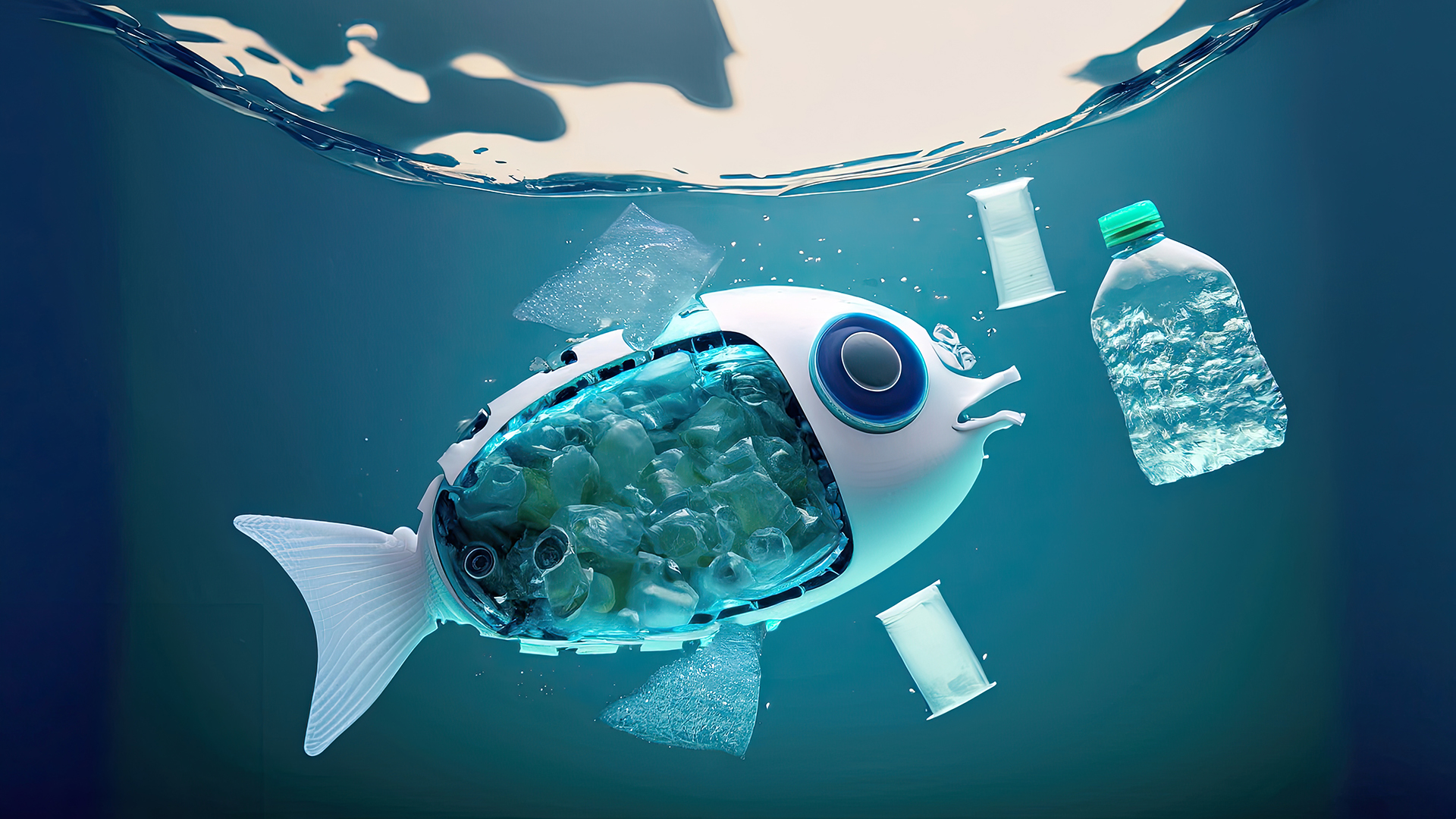


Humanoid robots are used in industries from medicine, law enforcement and hospitality, to maintenance and disaster relief. But Stanford University has developed a deep-sea humanoid robot that is diving in the robotics pool at Khalifa University with an end goal of exploring marine robotics for sustainable ocean ecosystems.
The OceanOneK robot — designed and built by Oussama Khatib and his Stanford team — has been five years in the making and made its Abu Dhabi debut tasked with retrieving plastic waste from the Khalifa University marine robotics pool.
But the team has bigger plans for OceanOneK
Having completed testing in the pool at Stanford on the trifecta of robotic function integration — navigation, bimanual manipulation (reciprocal hand movements needing disparity between hand actions), vision and body-control — it was time to take OceanOneK out to sea.
The robot performed several dives around the Mediterranean, reaching close to 1,000 meters — a record depth — exploring sunken vessels and retrieving artifacts.
As team members operated the robot through its haptic interface (communication system), they were able to feel what the robot was touching.
“It was pretty amazing feeling something that no other human could touch. While it was a (haptically mediated experience), it was still an amazing connection,” says Adrian Piedra, a Ph.D. student in Khatib’s Stanford lab.
 CAPTION: Stanford team shares in-field experience with OceanOneK IMAGE: Khalifa University
One of the vessels was Le Francesco Crispi, an Italian steamship torpedoed by the British while enroute from Italy to France in 1943. Delicate white coral has formed on the wreck, Khatib says, that the dive’s marine biologists were very excited to touch and then collect as samples. Also present and observed were iron-eating bacteria.
The robot was able to perform tasks for archaeology and for marine biology.
– Oussama Khatib
This is why a humanoid robot was essential for this project, adds Wesley Guo, another of the project’s Stanford Ph.D. students. “The way we control the robot is direct, as this helps the operator relate intuitively. The easiest way to do this is to have the body at a scale and shape similar to the human form. We also wanted it to appear non-threatening, as it will work in collaboration with human divers at different sites.”
A typical recreational diver can safely descend to about 30 meters – anything deeper requires specialized training and equipment. At 30 meters the pressure is approximately four times that at the surface. What happens to the human body beneath these depths depends on the person’s overall health and fitness levels. At 1,000 meters, the robot experiences 100 times the atmospheric pressure, team leader Khatib explains.
So, such robots are the key to deep-water exploration. And with more autonomy comes more skill sets.
Khatib says autonomy of a robot in the water is challenging, hence the haptic interface back to a human. But the goal is to diminish the need for human intervention as much as possible.
These deep-water diving robots, called remotely operated vehicles, or ROVs, are a new type of robot that can collect a lot of image data. “Operations under water require arms, hands and coordination between them, and that is what we’ve brought here with the OceanOne concept,” Khatib says.
“The interface we use goes beyond the visual – it delivers tactile-touch sensing using a haptic device. A haptic device allows humans to touch and feel what the robot is interacting with and permits one to guide the robot while it is executing delicate tasks. It acts as an avatar,” Khatib tells KUST Review.
“It interprets and affects movement and grasp request, maintains attitude and position for the human reference, and passes sensory information back to the human,” he says.
Human movement is just one of the considerations when building a robot like OceanOneK. The working environment must also be factored in. In this case that includes water and how it behaves.
Currents, for example, disrupt the intended movement, and this is where Khalifa University comes in.
The robotics pool at Khalifa University can simulate such environments, but under controllable conditions.
“Here, we can control the amount and direction of currents, we can control the waves, we can control those interactions in an ocean-like environment,” says Khatib. “This is perfect for training and learning.”
 CAPTION: Ku Robotics Pool IMAGE: Khalifa University
The Khalifa University robotics team will also work toward adding to the tasks the robot’s hands can carry out on their own.
“Full autonomy (without human intervention) will be the ultimate target; this, however, is challenging, and in the near-term humans will work with the robot to carry out tasks such as underwater valve-turning and plug-insertion,
Our objective is to increase the robot’s degree of autonomy while reducing the extent of human intervention.
– Lakmal Seneviratne, director of the Center for Autonomous Robot Systems and professor of mechanical engineering at Khalifa University
Stanford’s Khatib says these sensory-mechanical systems are also used out of the water in industries such as medicine, where a physician may interact through a haptic interface when not able to be present in the ICU. Similarly, the systems could be used for robots working on electrical grates or offshore platforms.
“In many of these applications we aim to distance humans from danger while connecting their skills to the task that must be carried out in that environment,” Khatib says.
 CAPTION: Stanford and Khalifa University robotics collaboration IMAGE: Khalifa University
“There is a lot of work needed before taking these robots into the field, and Khalifa University offers a unique environment for this preparatory marine robotic study,” Khatib says. “We are also collaborating in other ways,” including curriculum development and teaching, as well as through research focus groups and workshops,” he adds.
“We look forward to more interaction with the researchers, faculty and students here.”
Among future joint projects: Khalifa University KUCARS and Stanford University Robotics Lab have recently established a collaboration to research and develop marine robotics systems for sustainable marine ecosystem applications, including ocean monitoring and ocean cleaning.



 Khalifa University’s Athol Yates