

When most people think of polluted skies, they often think of smog.
But there’s another source of pollution that disrupts natural wildlife patterns, damages human sleep, contributes to the increase of CO2 in the air and obscures the stars at night.
Light
CREDIT: Apostolos Kyriazis, Abu Dhabi desert, UAE. This photo is available to download in high resolution here.
Streetlights, neon signs, car headlights and even the lamp at your window all contribute to light pollution. But there are things people can do as individuals and communities to prevent light pollution’s harmful effects.
In 2001, Flagstaff, Arizona, home of the Lowell Observatory and the Pluto Discovery Telescope, became the first city designated as an International Dark Sky Place. The U.S. city instituted progressive codes to prevent unnecessary lighting and preserve the integrity of the night sky for casual stargazers and professional astronomers alike.
The Pacific island of Niue in 2020 became the first country to be designated as a Dark Sky Place, as defined by the International Dark-Sky Foundation. But the foundation isn’t the only group promoting the concept. Oman’s leadership, for example, in 2019 decreed the formation of the Western Hajar Reserve, southwest of Muscat.
 CAPTION: This photo is an excellent example of how much light pollution obscures the night sky. The bright areas below are city glows that can be visible from hundreds of kilometers away. This photo is available to download in high resolution here. CREDIT: Apostolos Kyriazis, Abu Dhabi desert, UAE.
But even if they don’t live in an area with codes to protect against light pollution, individuals can do their part if they:
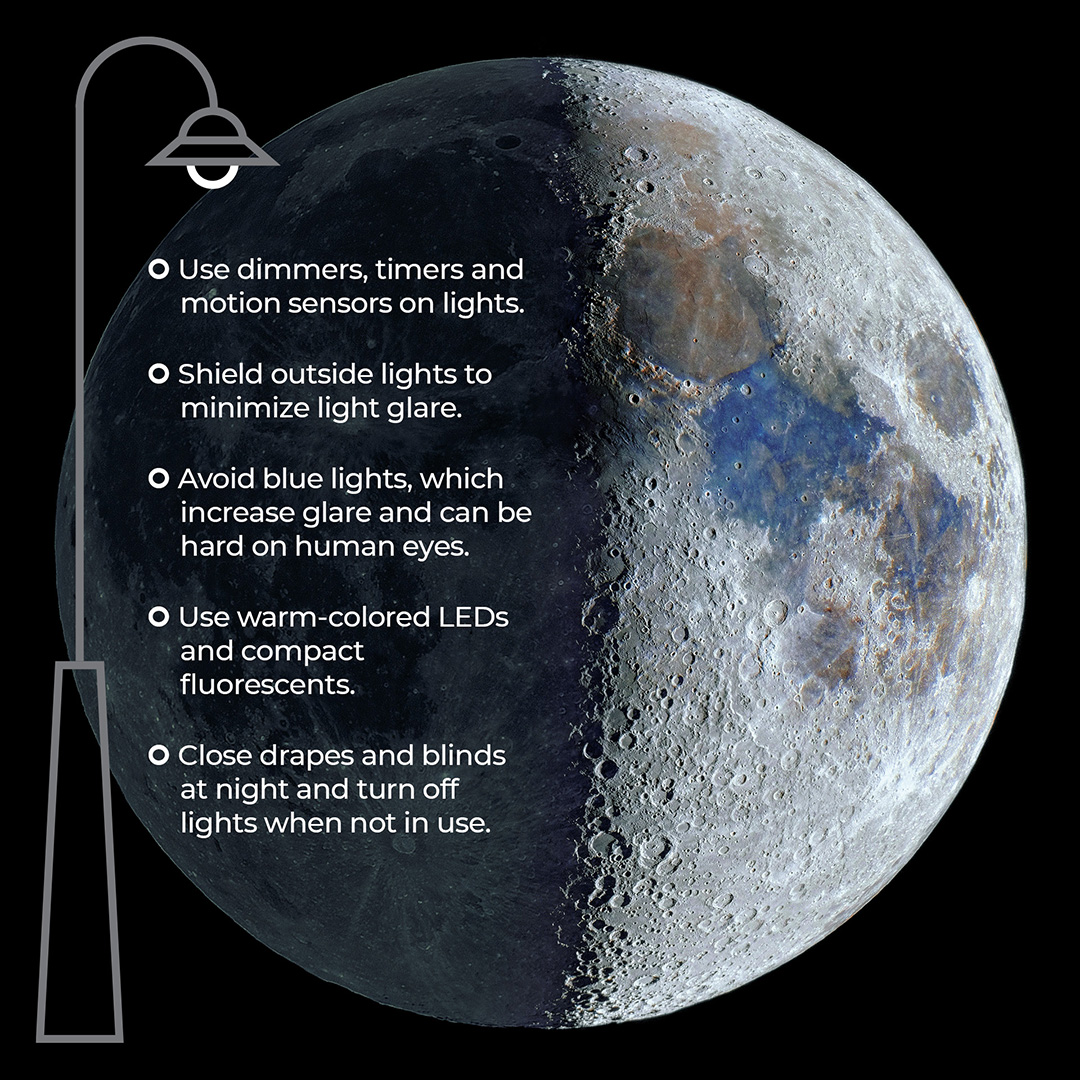 CAPTION: While the moon is quite bright, capturing such a photo is a bit tricky. Astrophotographers use multiple techniques to generate a final image, like stacking to enhance the details and reduce noise and abertation, and multi-exposure to capture both the bright and dark side of the moon. This photo is available to download in high resolution here. CREDIT: Darya Kawa Mirza, Irbil, Iraq.
These steps will help protect the beauty of a starry night as captured here by some of the Middle East’s best amateur astrophotographers:
 CAPTION: The Spaghetti Nebula is the remains of a dead star that exploded 40,000 years ago. It spans around 3.5 degrees across the night sky. It appears in the sky as big as seven full moons side to side. This photo is available to download in high resolution here. CREDIT: Maroun Habib, Lebanon.
 CAPTION: Our closest galactic neighbor, the Andromeda Galaxy (M31), is considered to be right next door on a cosmic scale, yet the light in this photo took over 2.5 million years to reach us. Talk about a blast from the past. This photo is available to download in high resolution here. CREDIT: Abdullah Alharbi, Kuwait. This photo was awarded an APOD (Astronomy Picture of the Day) by NASA on March 22, 2023.
 CAPTION: The NGC 2264 area has lots of star formations such as the Cone and Fox Fur nebulas and the Christmas Tree and Snowflake clusters. This photo is available to download in high resolution here. CREDIT: Anas Albounni, Abu Dhabi desert, UAE.
 CAPTION: Not all nebulas are created equal. Some emit light and some obscure it. In this case, the opaque dust clouds of the Horse Head and Flame nebulas obscure our view of glowing ionized gases. The brain’s ability to identify shapes helps us name them. This photo is available to download in high resolution here. CREDIT: Wissam Ayoub, Abu Dhabi desert, UAE. This photo was awarded an APOD (Astronomy Picture of the Day) by NASA on Nov. 3, 2021.
 CAPTION: A composite image of the Milky Way core includes many nebulas such as the Lagoon and Trifid nebulas on the left and Rho Ophiuchi nebula in the Scorpius constellation on the right. This photo is available to download in high resolution here. CREDIT: Amr Abdulwahab, White desert, Egypt. This photo was awarded an APOD (Astronomy Picture of the Day) by NASA on May 10, 2023.
 CAPTION: M78, a nebula located in the Orion constellation, is a cosmic cloud of glowing gas and dust where new stars are born. When you look at it, you see the light from these young stars bouncing off the surrounding dust. It’s a bit like a celestial nursery where stars are taking their first steps into the universe. This photo is available to download in high resolution here. CREDIT: Arun Vijay & Souhayl Ben Khaled, Abu Dhabi desert, UAE.