

Sand dunes form when wind blows sand into piles, creating shapes depending on the wind speed and direction. Sand blows up the windward side of a dune and slides down the leeward side. Like a game of leapfrog, the dune slowly moves.
This movement is glacial — incremental movements as small as a grain of sand each time — but over time these movements add up. And climate change could change their speed, shape and direction.
Deserts around the world are already encroaching on civilization, threatening farmland and infrastructure. The rate at which dunes move varies, depending on the velocity of the wind and the topography of the region.
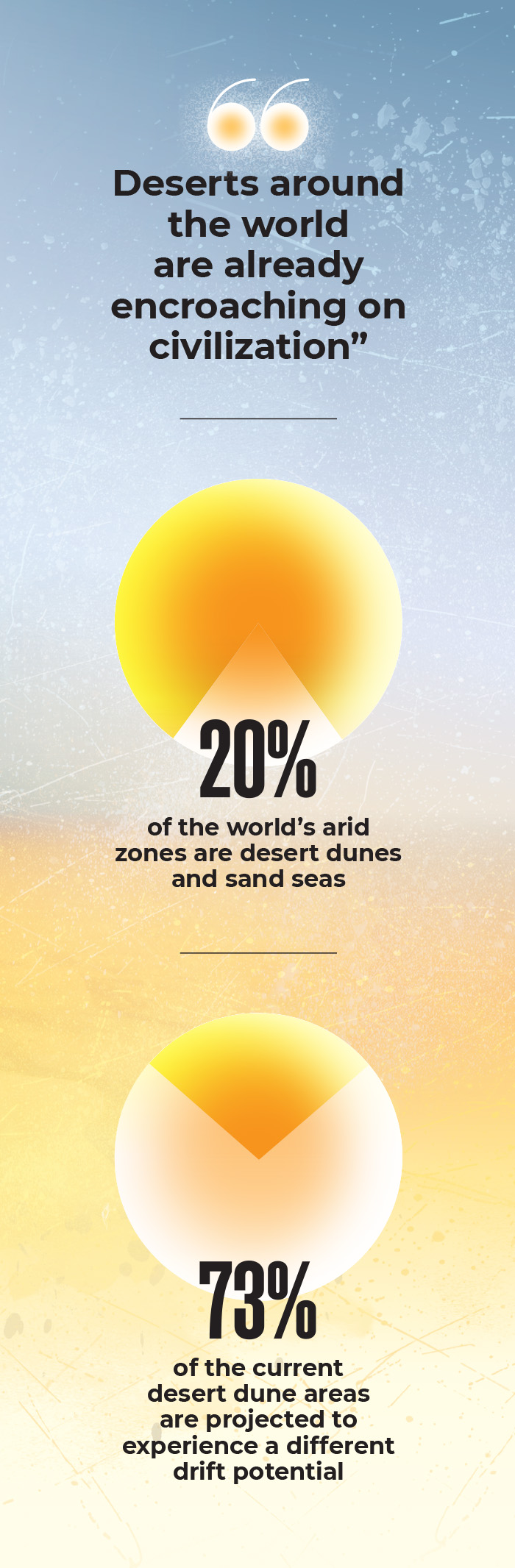
“Sand dunes in arid regions are conspicuous mobile landforms that require adaptation and mitigation strategies to protect human infrastructure and economic assets from encroachment, and (they) play a substantial role in desertification and atmospheric dust emissions,” says Andreas Baas, professor of aeolian geomorphology at King’s College London. “Desert dunes and sand seas cover approximately 20 percent of the world’s arid zones, and their morphology and patterning are an important diagnostic of environmental surface conditions, not only on Earth, but also on other planetary bodies.”
Baas’ latest research focused squarely on terrestrial sand as he and King’s College London colleague Lucie Delobel investigated how the shape, migration speed and direction of mobile desert dunes are projected to change by 2100 around the world in direct response to changes in wind patterns. The researchers say a changing wind climate plays a key role in this — and climate change is in the driver’s seat.
“We were surprised to find many regionally significant future increases in potential sand drift and changes in wind regime, which can impact the migration and shape of desert dunes,” Baas tells KUST Review. “The general assumption previously was that global warming leads to smaller temperature differences around the world (because poleward regions are heating up more) and that these smaller temperature differences would lead to weaker winds. We found that the poleward expansion of monsoon systems in particular will have a major impact on dunes in places like Oman and Mauritania.”
Baas points out that while most dunes around the world are unlikely to change their shape due to changes in winds, around 10 percent will, and some dune fields are likely to change their direction of movement.
Watch: The Global Impact of Middle East Dust Storms
“We found that 73 percent of the current desert dune areas are projected to experience a significantly different drift potential,” Baas says. Drift potential is defined as the total amount of sand transportation by wind. “Around one-third of desert dune areas will see an increase, while the other two-thirds will see a decrease.”
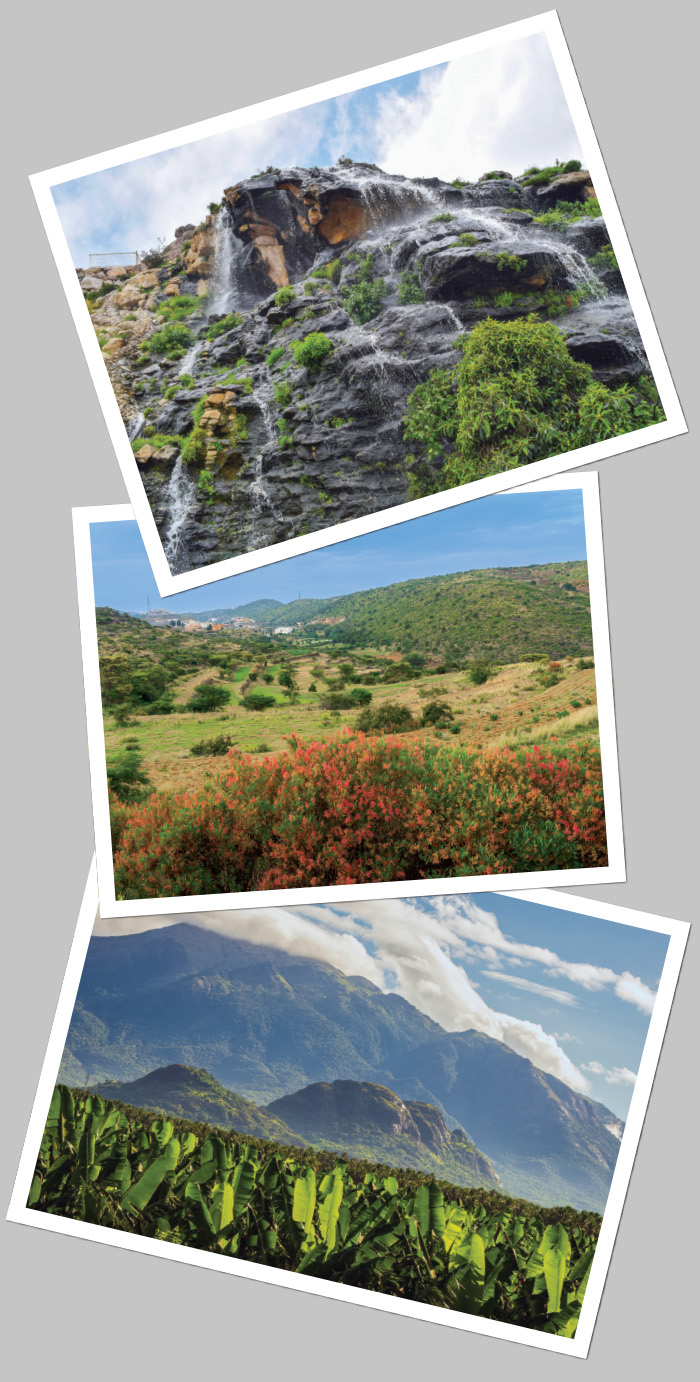 CAPTION: These photos are not of tropical forests in Brazil nor the country side of Italy, but of south of Saudi Arabia. IMAGE: Shutterstock
Longer springs, warmer nights
The arid and semi-arid regions in northern Africa and southwest Asia have been expanding, exacerbated by rapid population growth and climate warming, according to a study in Scientific Reports from Khalifa University’s Diana Francis and Ricardo Fonseca. Read more›››
The study investigates atmospheric circulation changes and their effects on clouds, moisture, dust and radiation across northern and equatorial Africa, southern Europe, the Middle East and southwest Asia.
The researchers note that daily nighttime temperatures are increasing faster than daytime temperatures, particularly in summer, due to higher atmospheric moisture and dust levels.
In winter, convective regions have shifted eastward in Africa, increasing low-level clouds in subtropical regions and shifting dusty areas southward. Future climate projections (2066-2100) suggest longer springs and shorter autumns.
The subtropical highs over North Africa and the Arabian Peninsula are projected to migrate poleward by 1.5 degrees in latitude, a trend statistically significant at 95 percent confidence level, in line with the projected expansion of the Hadley Cells. The Hadley Cells are the convective cells over the tropics. As they expand, the southern Arabian Peninsula (currently subtropics) may shift toward a tropical-like climate with increased rainfall frequency per year
The study highlights the importance of accurate, high-resolution climate models that account for dust and pollutants in the MENA region. Such models, the researchers note, are crucial for reliable climate projections and for supporting climate resilience and mitigation initiatives, including the transition to renewable energy sources.‹‹‹ Read less
Dune movement will still be very slow and incremental, but over time it could cause serious problems to infrastructure and the fragile ecosystems surrounding areas of sand.
“In many desert countries, the layout of settlements and infrastructure has been historically adapted to the local dune shapes and dynamics,” Baas says. “In the UAE, for example, there are many villages and infrastructure — even airports — that are built in between long seif dunes that run from west to east. If those seifs break up into smaller dunes, they may migrate towards a more southerly direction and those settlements will become buried by sand. In other places, such as Rajasthan, sand dunes may migrate faster and become a bigger problem to deal with where they’re overrunning agricultural fields.”
The researchers note that changes in dune behavior may need to be considered in planning and management efforts as mitigations designed for the current wind climate, such as sand fences and green belts, may become locally less effective — under a changing wind direction, for example — or even unnecessary, if dunes transform from a migrating to an elongating type. More precise models are needed for site-specific recommendations.
“The planet’s history has seen many vast changes in deserts and dune fields in its long history, but now is the first time that humans have come along and have built assets in between the dunes,” Baas says. “Our projections based on a global climate-change model suggest that potential sand drift in the UAE may decrease somewhat in the future, but these global models are not good at representing regionally important weather events like the shamal. And other studies predict that such extreme events will become stronger, in which case future shamal winds may kick up more dust and move more sand.”
More like this: Dust busters