
Of mummies, mice and medical students

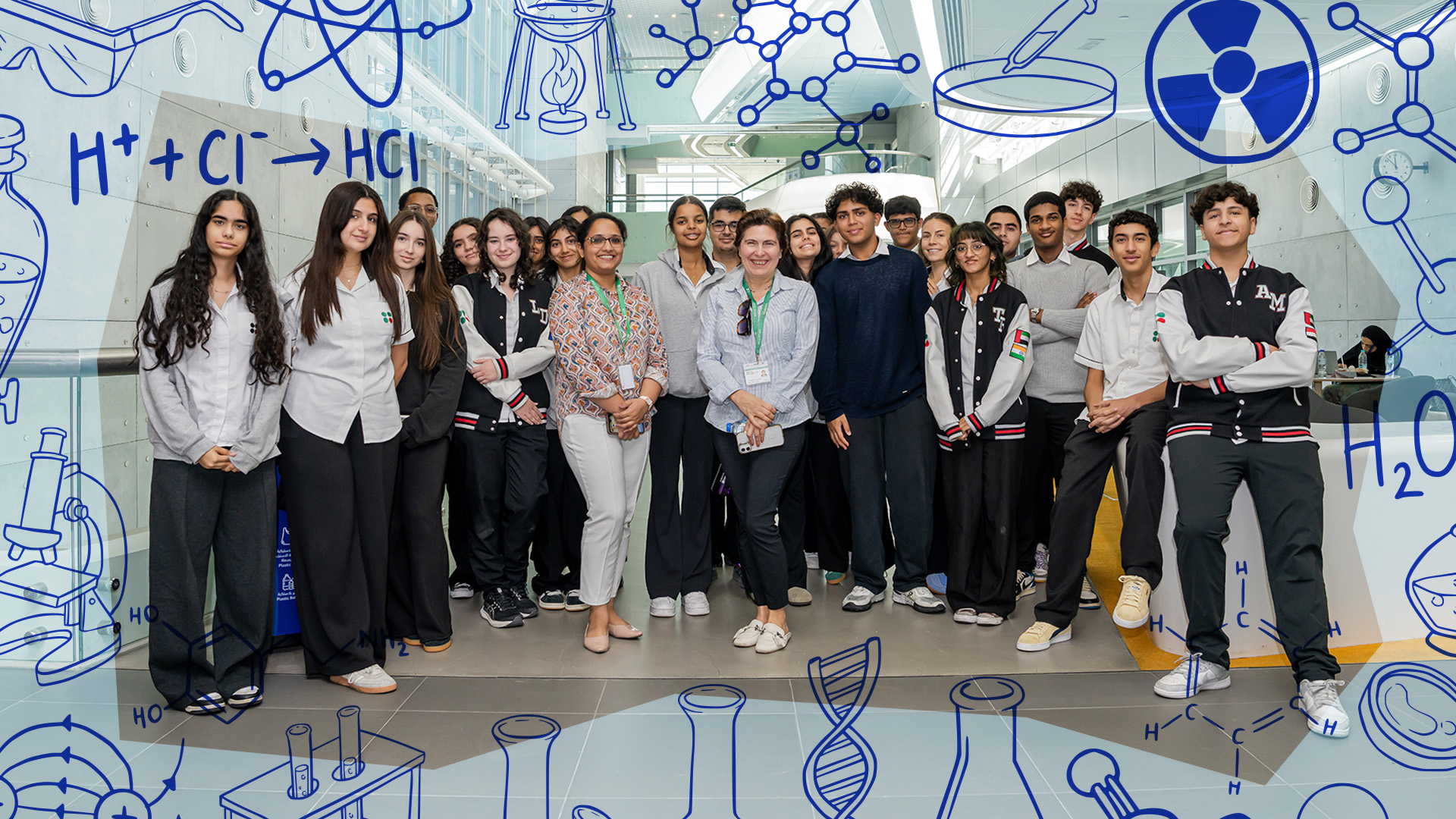
A crew of curious biology and chemistry students recently marched into Khalifa University’s main campus in Abu Dhabi for the science lesson of a lifetime.
IMAGE: Courtesy of UAE Year of Community website


With two packed days meeting med students, seeing how genome sequencing can help diagnose a centuries-old mummy and learning how to anesthetize a mouse, this was a field trip to remember.

The Raha International School, Khalifa City campus students’ bus was met by the academic coordinator of KU’s College of Medicine and Health Sciences, Hibba Samir El-Atar, and members of the KU public outreach team that had orchestrated experiences and welcome packs with their first (but hopefully not their last) lab coats.

“Our primary goal with these outreach programs is to make higher education in STEM fields tangible and accessible. We want to show students the ‘why’ behind the ‘what’ they learn in school. By bringing a piece of the KUST campus experience to them, we hope to plant a seed, showing them the incredible opportunities and dynamic environment that await them at a university like ours,” Khawla Alsaedi, specialist with the KU outreach team, tells KUST Review.

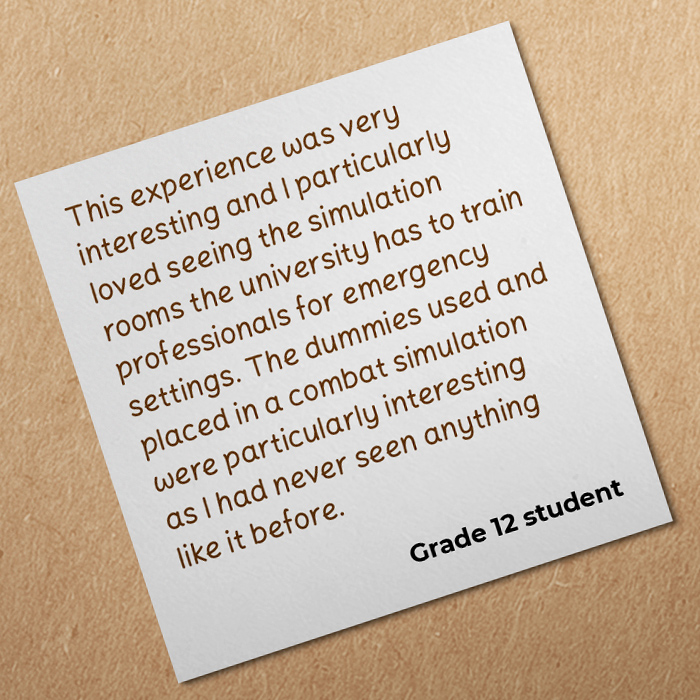
Next, the students visited the KU Experiential Learning and Clinical Simulation Center, where KU students are exposed to life-like situations and advanced imaging technology for an immersive learning experience.

The students, led by Ahmed Khalam Mohamed and his team, observed CPR demos, tried out vital-signs equipment and participated in a clinical-skills workshop.

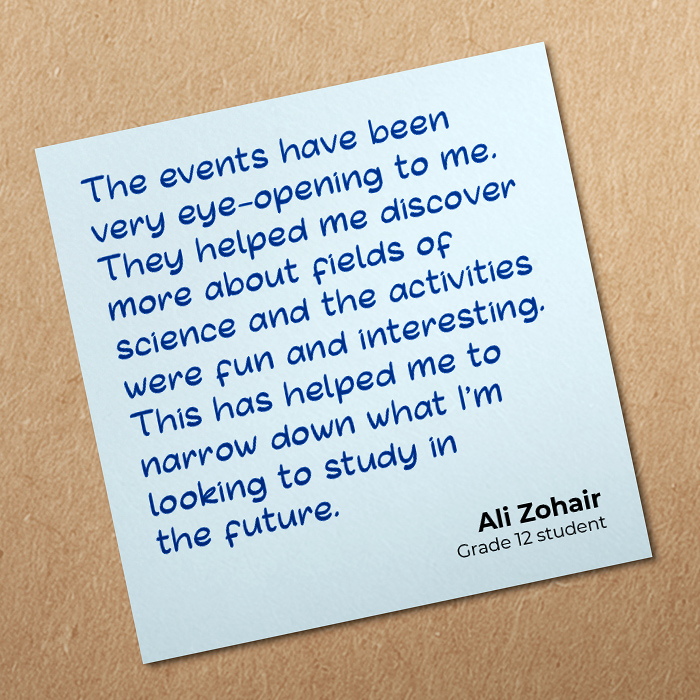
“I got to experience the facilities that I plan on studying in,” says Ali Zoheir, a Grade 12 student and self-proclaimed future plastic surgeon.

The remainder of the first day was a bit of a dream for potential future docs as they worked with the team from the medical sciences through a real-life case study and spent the final hour with a couple of KU med students, Layth Rafat and Carl Kassab, to find out what it’s really like to live in their lab coats.

The soon-to-be Raha graduates threw questions at the duo and received valuable advice: Take chances, manage your time well and get involved in research right out of the undergrad gate.

KU lab instructors Trust Nyirenda and Samson Chengetanai and KU faculty member Okobi Ekpo led the students on a guided tour of the anatomy and histology labs.

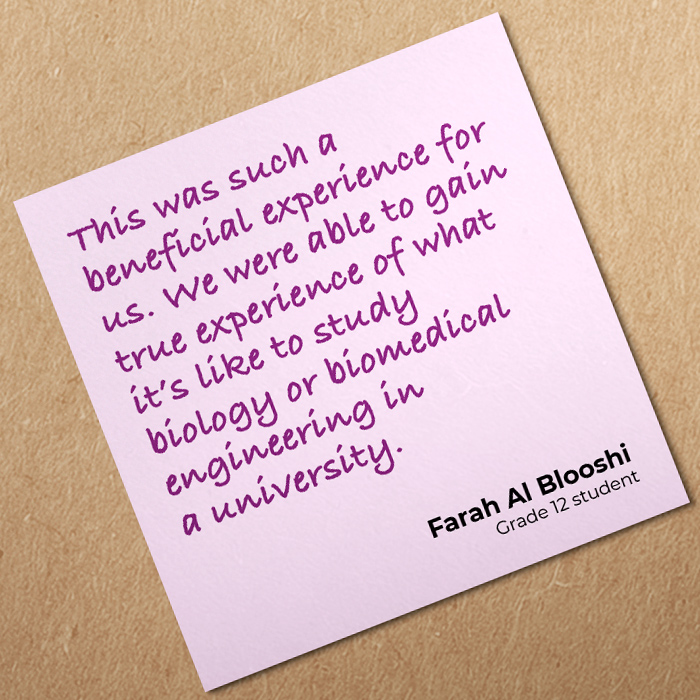
“It was very unconventional for us as (high school) students to be put in such a developed lab,” said Grade 12 student Farah Al Blooshi.

Next came the KU Body Museum tour. The museum opened in 2023 and is a permanent exhibition of dissected human bodies presenting both regional and systems-based anatomy in healthy and diseased adults. It is open to the public and often hosts school tours.

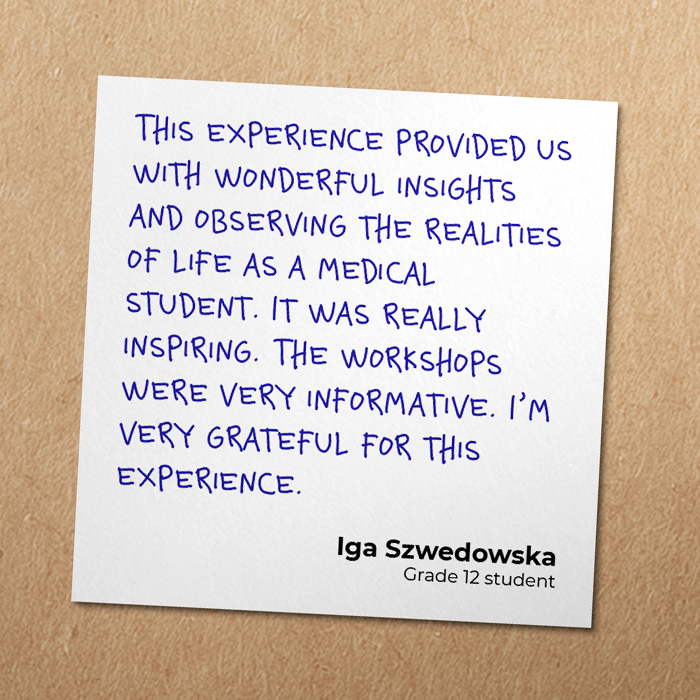
Within its walls the Raha students witnessed what a brain looks like after a stroke; what a person’s internal organs can tell us about their lifestyle and quality of life; the vastness of a fully extracted and intact human nervous system; and much more.

Siobhan O’Sullivan from the Department of Biological Sciences talked about her career path and an Egyptian mummy she studied as an undergraduate to determine the cause of death.

FYI, it was sickle cell anaemia.

O’Sullivan used the DNA extracted from the mummy’s toenails, which sat in a jar on her desk for a time. Gross or super cool? We’re going with cool.

There was more “cool” to come as the students moved on to a talk about what a biomedical engineer does with faculty member Anna-Maria Pappa and a demonstration of medical technology by Rateb Katmah.

They discussed wearable technologies like foot and heart sensors, sleep-pattern monitoring caps and stress-testing tech currently in use.

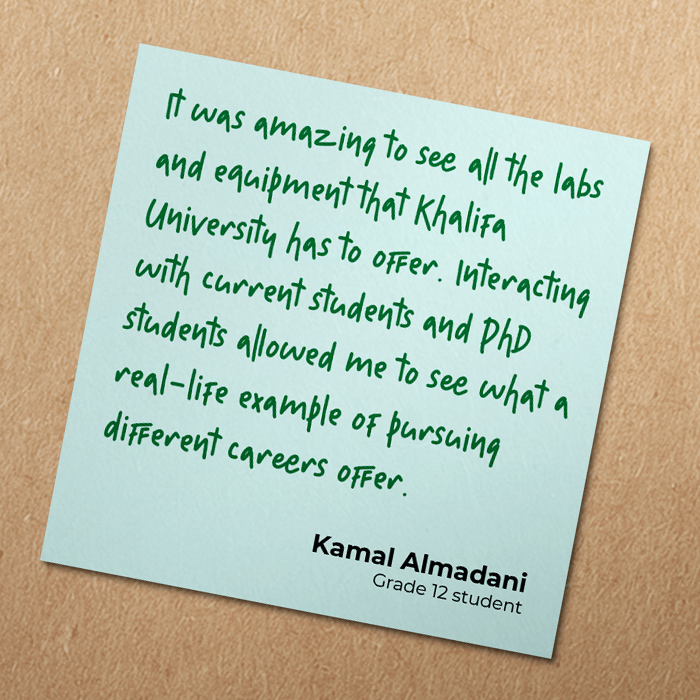
In the final part of the KU journey, students spent more lab time with Hamdan Hamdan for a talk about neurological conditions like ADHD, autism and Alzheimer’s.

They watched a video of a surgery on a mouse, learned how to anesthetize said mouse and why mice are used in the lab more than other animals (FYI, it’s cheaper and we can increase the testing size).

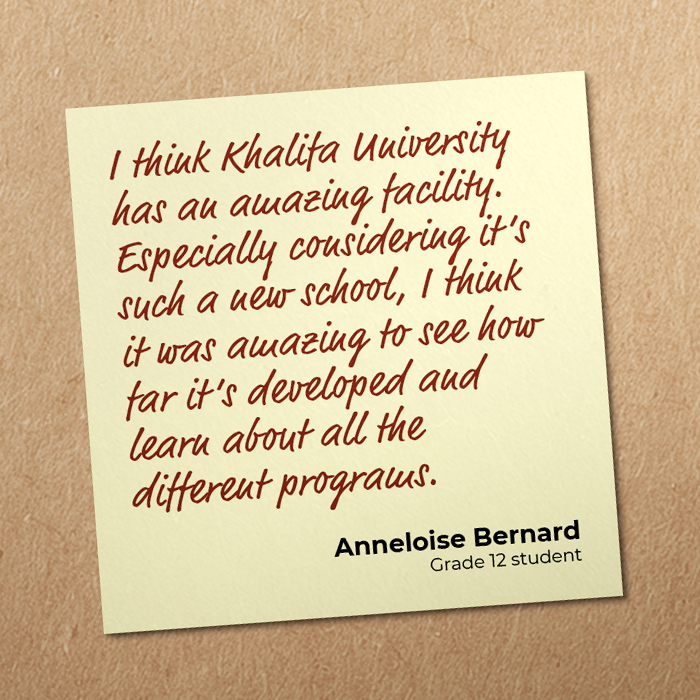
KU hopes to share these experiences with the Raha Grade 11 class soon and will continue to open its doors to other academic institutions.

“Our DP2 Science students’ visit to Khalifa University was an inspiring and intellectually enriching experience.

The students learned a tremendous amount — from exploring the body museum and how different parts of the body function, how genetic testing is conducted on ancient Egyptian mummies, to understanding how artificial intelligence can be used to personalize medical treatment, to observing how multiple sclerosis is diagnosed and treated, among many other fascinating insights.

“We are deeply grateful for the warmth, guidance, and professionalism shown to us throughout the visit — particularly to Ms. Hibba (Samir El-Atar), who was present and continually sought ways to enrich the experience, and to Ms. Khawla, who accompanied and supported us throughout the two days.

This visit was truly memorable and profoundly educational for our students, and we extend our sincere thanks to everyone who made it possible,” said Margarita Lozinova, secondary chemistry teacher at the Raha, Khalifa City campus.

El-Atar says she very much enjoyed being part of organizing and hosting the visit is thrilled with the outcome and participation from the students and KU team alike, “Seeing everything come together and watching everyone engage so enthusiastically made it all worthwhile. I’m so grateful for the teamwork and support that made the day a success. I am looking forward to many more events like this in the future and welcoming students from schools all over Abu Dhabi.”

More like this: Every splash counts

Every splash counts

It’s early evening at the Raha International School campus pool in Khalifa City. Gentle waves ripple across the 25-meter pool in anticipation of Arabian Swim Academy and GOALS UAE’s Monday class of student swimmers.

This class, however, is different from the speed training that took place earlier in the day.

CAPTION: Courtesy of UAE Year of Community website

Whether navigating physical challenges, cognitive delays or neurodivergence, participants are diving into more than just water — they’re gaining confidence, building coordination and lighting up new pathways in the brain.

Arabian Swim Academy has been operating at both Raha campuses for 12 years and works in tandem with Wolfi’s Cycling, Athletics Academy and PASS Abu Dhabi to promote sport and inclusivity in the community through their association with the GOALS UAE program for people of determination.

The swimmers in the pool at today’s lesson range in age from 7 to 37, and the program is designed for them to not only enjoy the water but also learn how to swim, stay safe and self-rescue.

Anaaya is a little girl with cerebral palsy and new to the program. Today is her third lesson, and she is able to kick in the water with her right foot — something she was unable to do just a few weeks prior.

Watch: Beyond the Surface: Inclusive Swimming

Cerebral palsy is a neurological condition that impacts how a person moves. It is caused by damage to parts of the brain responsible for movement, typically before birth. The main challenge people with this condition experience is muscle movement control.

Anaya can walk with assistance, and moving in the water is a great way for her to gain strength and develop muscle control. Water reduces body weight by 90 percent, eliminating impact on her joints so she can acquire these benefits without stress on her body.

As with most sports, an increased heart rate offers improved overall fitness, circulation and endurance — and ultimately, for kids like Anaaya, better flexibility.

Other swimmers in the program experience similar benefits — and then some — depending on their conditions.

GOALS UAE coaches-Raha Khalifa City campus

FROM LEFT BACK: Danny Dela Torre, Dhammika Kondaramge , Helen Wilson FROM LEFT MIDDLE: Hasinthara Shamini Mohamad, Malshi Wathudhura, Donabel Macusi, Mariecris Bordali, Rosario Ortega FROM LEFT FRONT: Ibrahim Akanni, William Wilson, Kelly Dongmo, Ninia Manlapig

Many of the swimmers in the pool today have autism spectrum disorder (ASD), much of which is sensory. This means those on the spectrum experience sensory processing complications: Noises may sound louder, textures feel more intense or rough. It’s a lot more for their brains to process, and it can result in considerable discomfort. The spectrum is broad — so for some, it might be mild discomfort, but for others, it can feel unbearable.

According to Helen Wilson, owner of Arabian Swim Academy and member of the GOALS UAE program, the pool can be a very soothing place to calm sensory overload. The light ripple of the water, the soft way it surrounds the body, and the silence it provides when ears are immersed makes water an attractive and relaxing place for a person with ASD.

It sounds soothing, but with water, there can also be risks.

The Autism Society of Florida says drowning is the leading cause of death for children with autism. They often wander and evade caregivers, and in many cases, don’t recognize danger. Children with autism are 160 times more likely to drown than those not on the spectrum — so it’s imperative they learn to swim.

And that is exactly what this program offers them.

Malek is 22 years old. He has ASD and learns by verbally repeating the coach’s instruction. He can swim and today is working on his technique. His coach today is a Grade 10 student named Ryan Pelser, who swims with the Raha Cobras senior  swim team and volunteers with GOALS. Ryan demonstrates technique and encourages Malek to complete his swims.

Malek’s mother says he has been with GOALS since 2018. “He has learned to swim, he’s competed in triathlons, duathlons, they’ve won bronze, silver, gold and he absolutely can’t wait to come to this. He loves the socialization and the coaches are amazing,” she tells KUST Review.

Raphael is 37 and also has ASD. He swims well and is here for the health benefits, and his coach swims alongside him just to encourage him to keep going.

Raha Gardens campus Arabian Swim Academy coaches

LEFT TO RIGHTTigist, Nestor, Anna-Leah, Chandrika, Helen, Debbie, Perera, Evo (GC student), Sylus

Adam has autism and limited language. Communication can be a challenge, so he has two people working alongside him to help him progress. Coach Danny Dela Torre and another Raha Cobras volunteer student, Hayden Kinsella, who says he understands Adam’s thought process and responds to his behavior and body language. This allows Hayden to instruct in a way Adam learns — often with physical demonstration rather than verbal direction.

Grace, Adam’s shadow teacher, says this is the perfect program for him.

“I can see that the swimming activities are very helpful for Adam, as well as communication and interaction with others,” she says. Grace says she feels the program gives his very active mind some downtime.

Heliodor, a 10-year-old-boy with Down syndrome, works on his arm movements and kicking. Keeyan, also with ASD, is calmed by the water and is working with pool noodles to support his body while he learns to kick. Muhammed lights up and is ready to show off his skills as soon as a camera comes into sight.

Every person of determination will have different needs. The autism spectrum, for example, is vast — so some will require minimal assistance, while others have little language and, like Adam, respond best when someone demonstrates rather than instructs him verbally.

That is what programs like this offer: tailored training to help each swimmer succeed — whatever success looks like for them.


It’s an overwhelming feeling for me, personally, the joy that it brings to the kids and the joy that it brings to the family as well.

Helen Wilson, owner – Arabian Swim Academy


Other benefits for members of the program include increased core strength, improved motor and fine motor skills, and stronger muscles due to water resistance. But Wilson says the social aspect and confidence building are just as important.

“The program is set up in stages. They all start in stage one, which is one-on-one with a coach. Once they get past this stage, they’ll move into a double lesson with another individual. Once they’re more confident, they’ll go into a group lesson. There is a lot of social growth and achievable tasks.”

Once the swimmers move beyond these stages, they have the option to move into the aquathon and triathlon programs at the Raha Gardens Campus run by Debbie Schrieber, if that is something they and their families wish to pursue.

Anne, mother of Raphael, is here with her son, who enjoys the calm of the pool. She says the benefits are ample.

“The pool is soothing for him, and of course there are all the benefits — the respiratory and health benefits. It all comes together for him.”

The parents are collectively positive and supportive of the program, and they see numerous benefits for their children.

CAPTION: SPIA AWARD

In 2025, GOALS UAE won the gold medal for Best Inclusive Initiative at the Middle East Sports Industry Awards (SPIA).

“It’s an overwhelming feeling for me, personally,” Wilson says. “When I hear things about successes or read a message from a parent or a review they’ve posted — to know that something is so appreciated and giving back just 45 minutes of your day to something that’s so worthwhile. The joy that it brings to the kids and the joy that it brings to the family as well,” she tells KUST Review.

More like this: Exercise and the longevity question