T
he phrase “good things come in small packages” is proving true as agriculture turns to microgrids — small-scale powerhouses that could offer farmers much-needed energy without the use of fossil fuels.
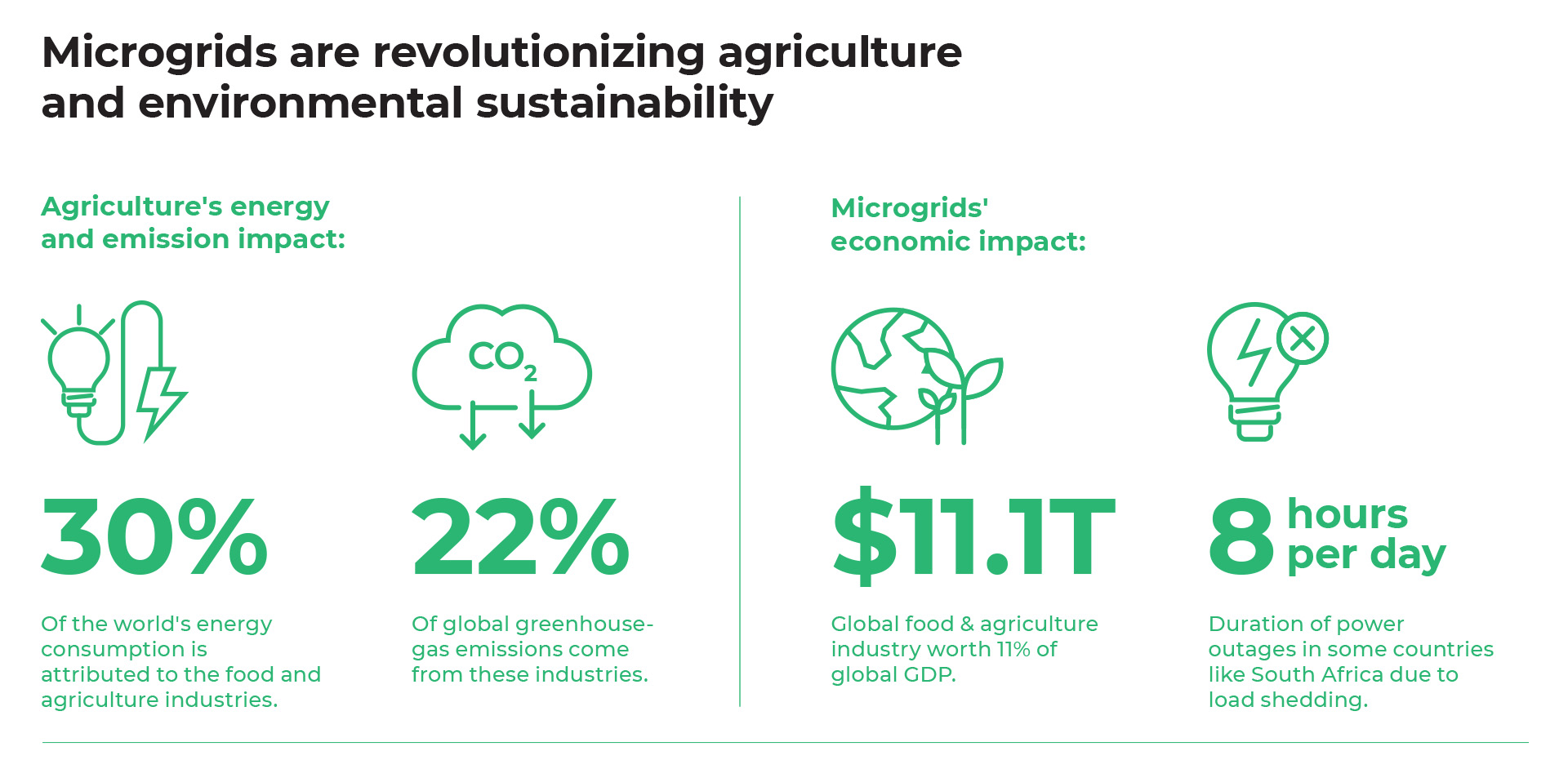
The food and agriculture industries are responsible for approximately 30 percent of the world’s energy consumption and 22 percent of global greenhouse-gas emissions.
Disconnecting from the larger power grid and running off a smaller grid powered by green energy sources like solar or wind can reduce the agricultural carbon footprint, save on cost, protect from cyber threats and even serve as an extra income stream.
Microgrids are energy distributors that serve a small geographical area like a college campus, hospital or farm.
They can operate autonomously or can be a hybrid model that disconnects from the main power grid and continues to function in “island” mode when needed — such as in the event of a power outage due to a storm or in the event of a cyber-attack.
Microgrids promise a climate-safe, sustainable and inexpensive way for rural communities.
– Renewable Energy World
After an attack, a hospital, for example, could detach from the main grid and keep running.
Microgrids, when connected to the main grid, can also balance power supply and demand by using complex computational techniques using real-time data analysis. Two-way communication between a microgrid and the main power grid means it can take power or give it, based on over-supply or a required injection. This symbiotic relationship offers stability to both.
And if you have excess energy, you can sell it back to the main grid. Depending on tariff rates you could end up with extra cash. But the microgrid can also be an autonomous entity receiving its power injections solely from green energies.
In this case, the grid can receive energy — say, from solar panels — store it and supply it, with zero reliability on the main grid.
Agricultural industry leaders, farmers and food suppliers can now turn to this more reliable, cost-effective and sustainable energy source to maintain uninterrupted operations.
Bigger isn’t always better
Microgrids may be smaller than the traditional power grid but in a big way, they are a reliable source of power during unexpected outages and can mitigate interruptions to business continuity.
The ability to disconnect from the main grid and run off stored energy allows communities or businesses including farms and food suppliers to operate when the main grid is inaccessible.
They’re also resilient, able to modify and recover from severe and sudden disruption.
Plunkett Research’s 2023 statistics report estimates the global food and agriculture industry to be worth U.S.$11.1 trillion, which equates to 11 percent of total gross domestic product. Losses during downtimes therefore, can be catastrophic.
Dairy farmers, for example, require power for milking, processing and storing the product. An electricity shutdown effectively means a business halt and potential for spoilage.
And in countries experiencing an energy crisis, agriculture takes a significant hit.
South Africa, for example, protects its main grid by load shedding. This means power is temporarily shut down when demand comes close to shedding the grid of what it has to offer in order to avoid grid failure. These outages can last up to eight hours per day.
Though this protects the main grid, shutdowns wreak havoc on agriculture.
“It is beyond dispute that every sector of the South African economy has suffered from the impact of rolling blackouts. But agriculture has suffered disproportionately,” says Christo van der Rheede, chief executive officer of AgriSA, in an article for the Daily Maverick.
So a country that experiences extensive outages would seem a perfect fit for microgrids.
“A technology of the future, microgrids promise a climate-safe, sustainable, and inexpensive way for rural communities to harness their own resources and meet their communal needs,” says Renewable Energy World, which covers news and trends in the renewable-energy industry.
The problem is, while microgrids might offer security and save money over time, it takes funding to make the switch. And not everyone has this kind of money.
Is it worth it?
Countries like Australia are less vulnerable to power loss than developing countries that experience many power outages throughout the year, but increased cost of power could be incentive enough to invest in an energy shift.
And switching to green energy means significant cost savings.
Tania Chapman, general manager of farming operations at Nutrano Produce Group, one of Australia’s leading producers of fresh fruit, says it’s complicated to maintain earnings among rising energy costs and maintaining governmental sustainability guidelines.
“If I look at one of our sites the annual bill is around $110,000 currently for the electricity, putting in solar would cost me $120,000 and it would reduce the electricity bills by around 25 to 30 percent,” she tells ABC Rural.
Adding a microgrid into the solar mix could be significantly better.
With global temperatures on the rise, the volume and severity of extreme meteorological events can be catastrophic to not only large industries, but like those of developing countries or remote communities. And access to the main energy grid can be unstable, which also limits socioeconomic development.
Microgrids are less costly than extending the main grid, so many countries are investing in their rural communities. It’s not only a cheaper option but it also allows governments to meet commitments and goals set forth in the Paris Agreement. Tax breaks can also help offset the costs of renewable-energy equipment.
As of 2019, there were 4,500 microgrids globally, but the market is expecting a major growth spurt in the coming decade as governments are keen to mitigate financial risk and develop rural areas.
More like this: Growing a hydrogen economy