MOOVE over cows, there’s a new
milk provider in town!

“Milk, it does a body good” is a vintage 1980s advertising slogan used to emphasize the health benefits of cow’s milk on the human body. Milk is still packed with loads of nutritional value required for optimal health, but the next time your palate craves an icy, cold glass of refreshing milk, consider a shift in sourcing from animals in green pastures to those wandering the dunes.

According to Home Food and Agriculture Organization of the United Nations, milk offers 48 percent of the protein and 9 percent of the calories a child of 5 to 6 years with light physical activity needs. Cow’s milk is packed with 13 essential vitamins and nutrients like calcium and vitamins A and D that contribute to a healthy diet.

But the impact of the dairy industry on the environment and the subsequent impact of the environment on dairy farms has farmers shifting to camel-milk production to meet demand and their environmental commitments.

It seems camel milk can provide the health benefits of cow’s milk and then some with the bonus of a much lower carbon hoofprint.

THE ENVIRONMENT TAKES THE HIT

With 270 million dairy cows producing milk along with 2.1 gigatons of carbon dioxide every year, the dairy industry is responsible for 30 percent of all anthropogenic emissions. The environmental impact is ample, and with dairy product demand expected to triple by 2050 due to population growth and increased consumption, it is primed to worsen.

Primarily, methane emissions are a ruminant’s worst offender. Methane is produced in the digestive process and expelled into the atmosphere through cows belching, accounting for 20 percent of total global emissions. What’s worse: It’s 20 times more potent than carbon dioxide.

IMAGE: Unsplash

To be fair, all livestock emit their fair share of methane but pound for pound, camels are the eco-friendlier option.

Emissions aren’t the only environmental issue with dairy farming — there’s also land use to grow feed, pesticides for those crops, and all the water required to get milk from cow to shelf.

WHAT-ER?

The average water volume used to produce 1 liter of milk, including to grow the livestock feed, is 911 liters. This will differ between farms but it’s a big ratio, and when water supplies are also threatened, the cost could escalate.

Water pollution due to manure mismanagement can also impact surrounding water supplies. Overflowing and cracking manure vats sometimes cause seepage and, subsequently, groundwater contamination. This makes its way over time to all manner of bodies of water including rivers and oceans.

IMAGE: Unsplash

Camels, however, require significantly less water and can go two weeks without any, compared with two days for a cow. With a high threshold for extreme conditions, and the ability to lose 30 percent of their body weight and still survive, camels emerge as a definitively more resilient choice as global temperatures rise and food security becomes a pressing concern.

Food security is also impacted by the abundant land mass required to meet the nutrition needs of grazing animals and the pastures for grazing. This leads to not only extensive deforestation but the knock-on effects of further emissions and impacts on biodiversity and ecosystems.

Whereas camels can eat almost any plant that grows where they live. Their long necks also mean they can reach higher for trees and will happily snack on shrubs, grass or even thorny plants.

Camel milk sounds like the clear winner when it comes to nutrition and sustainability, but it’s not easy to transition a massive industry. Dairy farms have been around for generations and in many cases are still family businesses. Plus, in places rich with grasslands and more temperate weather, cow farms still make sense. But when it’s more a matter of survival than that of public buy-in, people find a way.

FARMS IN AMERICA ARE LEADING THE CHARGE HERE

Historically, cows have been an essential part of many African economies, diets and traditions but heading into what could be another year of drought, the Horn of Africa and surrounding areas are in a state of emergency. A three-year drought that began in 2020 resulted in crop destruction, loss of grazeable land, livestock depletion and dried-up water sources.

Camel milk offers a lot of benefits, but the key is a stable market.

James Salfer, dairy educator-University of Minnesota Extension

In Samburu, a Kenyan county with a population of almost 310,000, people were struggling with malnutrition as most of their cattle perished.
Cattle farmers noticed neighboring villages with camel farms struggled very little, however.

The government had started a camel program offering one camel to each person eight years prior. So far, 4,000 camels have been gifted. Other African countries are also seeing their camel populations grown.

CAMELS TRAVEL TO AMERICA

Camel farms are not limited to sub-Saharan African countries — they’re also gaining popularity in the United States.

A 35-acre family farm in Nebraska called Camelot Camel Dairy offers camel milk to consumers who struggle with milk allergies or who just might be curious and somewhat adventurous. They are one of only two licensed camel-milk providers in the country and are hopeful that with demand, the price of a liter of milk, currently U.S.$16, will eventually become affordable and accessible.

“Camel milk offers a lot of benefits, but the key is a stable market. Farmers need assurance of demand, and consumers must be willing to pay the price of what it costs to raise and milk camels,” says James Salfer, a University of Minnesota Extension dairy educator.

The global camel-milk trade could exceed U.S.$13 billion by the end of the decade, up from $1.3 billion in 2022.

A Hot Topic

Climate change is undeniably affecting the Earth. But how will those changes affect us and our neighbors near and far? We asked our experts: What are the anticipated implications of rising temperatures for human societies?

Rising oceans put lives and economies in peril
— Elizabeth Phillips

Today we can see that rising sea levels are negatively affecting coastal ecosystems and communities, ushering in a wave of unprecedented challenges.

Over the past century, sea levels around the world have risen on average 23 centimeters, and this number is increasing every year. Research published in February 2022 shows that sea level rise is accelerating and projected to rise by 30 centimeters by 2050.

Sea level is controlled by both water temperature (thermal expansion) and melting ice caps and glaciers. Due to climate change, the oceans as well as the atmosphere are getting warmer.

In the past century, the oceans have become about 0.1 degree Celsius warmer. This does not sound like a lot, but warmer, expanding oceans caused about half of the rise in sea level in the past century. The other half can be attributed to melting ice caps and glaciers.

Elizabeth Phillips

Elizabeth Phillips is an environmental Consultant with GHD Global Pty Ltd. with industry experience in Canada and consulting experience in South Africa. She holds a B.Sc. from the University of Calgary.

The global ocean covers close to three-quarters of the Earth’s surface, and around 40 percent of the world’s population lives within 100 kilometers of the coast. Densely populated cities like Shanghai, Jakarta and Hanoi are in danger of flooding from even a small rise in sea levels. If the flooding is too much, vulnerable populations may be displaced temporarily or permanently.

Higher sea levels are eroding coastlines, resulting in the loss of land and habitat for plants, animals and people. Coastal erosion also causes loss of infrastructure, including homes, roads, agricultural land, ports, airports and power plants or at least making them more susceptible to damage and disruption.

Some of the world’s most visited beaches are suffering coastal erosion. It happens faster when supercharged storms repetitively hit beaches, chipping away at the coastline. Over recent years, we have seen increased frequency and severity of storm surges during hurricanes and tropical storms, leading to more severe flooding in these coastal regions.

As sea levels rise, salt water will contaminate freshwater sources, the water we drink. It will also make things more difficult for farmers, plants and animals and will have a huge economic impact on coastal areas. Many ocean species are in decline because of pollution and warming seas. Coastal ecosystems, such as mangroves here in Abu Dhabi and coral reefs, suffer significantly due to submersion and habitat degradation.

The economic consequences and global implications are huge. Coastal economies, especially those dependent on tourism and fisheries, may suffer from the loss of infrastructure and the decline in natural resources.

Displaced people and disrupted economies can have global effects, influencing trade, food supply chains and international relations.

Addressing the multifaceted impacts of rising sea levels demands a comprehensive global response. Sustainable coastal development, adaptation measures and efforts to mitigate climate change are essential to helping our coastal communities and the planet.


Here’s how agriculture weathers new challenges
— Tarek Kapiel

Rising temperatures have a number of anticipated implications for human societies, but one of the most critical for the UAE and other Arab nations is their effect on food security.

The agricultural systems of Arab nations, with their arid and semi-arid climates, are vulnerable to disruption in several ways.

Changes in precipitation patterns: Rising temperatures can alter rainfall patterns. In some regions, this may result in more frequent and severe droughts, negatively impacting soil moisture levels and crop growth. In other cases, intense rainfall can cause soil erosion and waterlogging, further affecting agricultural productivity.

Tarek Kapiel

Tarek Kapiel is assistant professor of plant biotechnology, botany and microbiology at Cairo University.

Droughts: Higher temperatures can exacerbate drought conditions by increasing evaporation rates, reducing soil-moisture content and intensifying water scarcity. Droughts can lead to decreased crop yields, reduced livestock productivity and increased competition for water resources. Such disruptions in agricultural production can result in food shortages, price increases and economic instability, with potential implications for social unrest.

Increased pest activity: Insects, fungi and other pests thrive in warmer conditions, leading to increased infestations and crop damage. This can further reduce crop yields and necessitate the use of more pesticides, which may have environmental and health consequences.

The implications of rising temperatures for food security vary across the UAE and other Arab nations due to differences in climate, geography and agricultural practices.

In arid regions, such as the Arabian Peninsula, water scarcity is already a significant challenge, and rising temperatures can compound this issue. Coastal areas face additional risks due to the potential for sea-level rise and saltwater intrusion into agricultural lands.

Fortunately, there are potential solutions. These include:

  • Improving water-management practices, including increased water efficiency, desalination and wastewater reuse.
  • Promoting sustainable agricultural practices, such as precision farming, organic farming and agroforestry, to enhance resilience to climate change.
  • Investing in research and development to develop drought-resistant and heat-tolerant crop varieties suitable for the local climate.
  • Enhancing agricultural infrastructure, including irrigation systems, storage facilities and transportation networks, to reduce post-harvest losses and improve market access.

In the meantime, the implications of rising temperatures on food security have sparked ongoing policy debates in the UAE and other Arab nations.

These debates revolve around issues such as balancing agricultural development with environmental sustainability; promoting climate change adaptation and mitigation measures; encouraging international cooperation and knowledge sharing to address common challenges; and integrating traditional knowledge and local practices with modern technologies and innovations.

Understanding the regional variations, exploring potential solutions and engaging in ongoing policy debates are crucial for mitigating the adverse effects of climate change.

By adopting sustainable practices, investing in research and development and fostering international collaboration, the UAE and other Arab nations can enhance their resilience and ensure food security for their populations in the face of rising temperatures.


There’s a human cost to a warming world
— Maryam Saad

Throughout Earth’s history, only creatures capable of adapting to environmental shifts have survived. to enhance resilience to climate change. This principle presents a stark challenge as we face the escalating threat of global warming.

As the planet heats up, we must confront its myriad implications on human health.

Scientists have dedicated immense effort to studying these complexities, revealing a range of potential health risks. These include heat-related illnesses, compromised water and air quality, rising rates of vector-borne diseases, and threats to food safety and nutrition.

Maryam Saad

Maryam Saad holds an M.Sc. degree in biochemistry from Alexandria University, Egypt.

In global climate action at COP 27, parties renewed commitment to limiting global temperature rise to 1.5°C. The Intergovernmental Panel on Climate Change (IPCC) report assessed the impacts of a 1.5 – 2 degrees Celsius increase above pre-industrial levels and the potential consequences if we fall short of maintaining the global average temperature increase of less than 1.5°C.

One of the direct risks is increased heat-related illnesses and diseases, particularly to vulnerable populations like the elderly, pregnant women, children and urban residents.

Cardiovascular diseases top the list of heatwave-related fatalities, followed by dehydration, hypertension and respiratory and cerebrovascular issues. A chilling estimate suggests that a 2 degrees Celsius increase could make heatwaves, such as the one that struck Pakistan in 2015, frequent occurrences.

Another threat is an escalation of infection with vector-borne diseases, especially in tropical regions like Africa. Increased heat could lead to an increase in mosquito populations, thus escalating the risk of malaria, dengue and other vector-borne infections.

Warmer temperatures would also cause a shift in flowering time pollen initiation in allergenic plant species, and continuous exposure can worsen allergic responses in predisposed individuals. Those health risks will exert extra pressure on the health-care system.

Embracing climate mitigation and adaptation strategies is crucial to protect human health. Transitioning to a low-carbon future presents an opportunity for both sustainability and economic growth. By acknowledging the threats and taking decisive action, we can forge a healthier, more secure future for all.

More like this: Feeding tomorrow

Croptimal choices

The long haul toward food security begins at the source, and precision farming is capitalizing on the latest technologies to feed the world while ensuring we still have a habitable Earth.

Agriculture has a long list of impacts on the planet from water use to pesticides. And the more we farm, the more impact we make. Fortunately, a revolution in farming technologies is helping farmers maintain yields and honor the land that provides them.

“Good farmers, who take seriously their duties as stewards of creation and of their land’s inheritors, contribute to the welfare of society in more ways than society usually acknowledges, or even knows.

These farmers produce valuable goods, of course; but they also conserve soil, they conserve water, they conserve wildlife, they conserve open space, they conserve scenery,” wrote Wendell Berry, American writer and environmental activist, in his book “Bringing It to the Table: On Farming and Food.”

Randy Price, precision farming specialist at Louisiana State University Agricultural Center, says precision farming has ample benefits for farmers, consumers and the environment and presents solutions of how farmers can live up to this standard.

Pesticides protect the crop and the global population’s food supply, but they have a significant impact on the environment.

According to a 2023 study out of Chang Mai University in Thailand, “The transport of pesticides from crop-growing regions has resulted in widespread contamination, not only of soils, water bodies, and/or crops but also of the atmosphere via various pathways.” Precision farming technology, however, might be a part of the solution.

Send in the drones

Drone technology can help, Louisiana State’s Price says. “Drones are allowing farmers and consultants to obtain overhead images of farm fields and land areas at greatly reduced prices over satellite and other methods.”

Drones can be fitted with sensors and imaging technology, and this data plays an integral role in active farming. Among other uses, the data can help farmers identify fungal contaminations, pest infestations or areas of growth congestion.

Identifying these issues early and targeting specific locations eliminates the need to spray entire crops with pesticides — which means less toxicants in the air, soil and food supply: better for the land, better for the consumer, less costly for the farmer and safer for farm workers.

IMAGE: AI Generated, KUST Review
In the greenhouse

While other innovators are focused on open farmland, the researchers at Khalifa University are looking at ways to automate greenhouses. Read more›››

“We have a significant community of scholars working in the area,” says Lakmal Seneviratne, director of the university’s Center for Autonomous Robotic Systems.

Research focuses on using robots, whether drones or mounted on rails, to collect information about plant health and readiness for harvest. Machine-learning resources help predict disease and fruit yields and analyze soils, he adds.

“Tactile devices (could also) predict fruit ripeness,” Seneviratne says. KU is partnering with UAE agtech giant Silal on a 2,000-square-meter greenhouse in Al Ain, but commercial greenhouses could easily be hectares in size, he says.

For now, the project is focused on strawberries, blueberries and tomatoes.

KU is also partnered with ASPIRE’s International Virtual Research Institute for Food Security in the Drylands. “A lot of investment is happening in the UAE,” Seneviratne says.‹‹‹ Read less

Once the problem is identified, a drone is programmed to spray the affected area with the appropriate pesticide avoiding overuse. Price says the more common precision tools are yield monitors.

This technology allows farmers to determine their crop yield within a specific unit area of their land and perform on-farm analysis, allowing for informed planning and decision-making. Understanding which areas are underperforming or overperforming is crucial to this process. Monitors and analysis assist irrigation allotment, fertilizer volumes and crop rotation.

Research also includes testing. “They will try different application rates (fertilizer, irrigation, additives, etc.) on small areas of a field, such as twelve rows plot down the whole field, etc., and then use the yield monitor at the end of the year to quickly (and easily) see the differences in that plot,” Price says.

Mapping the land

All of this information helps farmers create a prescription map of their land — something Price says is challenging and labor intensive. He says he believes for areas over 3,000 acres, mapping needs to be easier. The knowledge bases are inadequate at this stage and still required are “systems that will convert remote sensing data into actual disease and pest damage assessments.”

He and his team are working to make this happen with automatic flying drones.

“They take off, fly a field, land and recharge automatically,” he says, adding that low-level flights that record data at 10 meters from the crop surface allow high-resolution images of plant leaves to be recorded (with location) for automatic analysis with AI and other techniques.

Price’s team has been collaborating with several companies to create automated flight platforms for remote-sensing drones and additional yield monitors for sugarcane.

Price says AI will be the major contributor going forward to analyze crop damage and assess pests and disease. This would allow for fully automated treatment by sprayer drones. The drones then would collect the next remote-sensing data for analysis. Assess, treat and repeat.

In addition to crop health, AI offers data-driven decision-making opportunities for soil conditions and weather patterns.

“Over time, precision farming should allow farmers to more precisely treat various areas of land, without over-treating other areas and create a more sustainable agriculture,” Price tells KUST Review.

AQUA BOTS

In a world hungry for nutritious food, aquaculture is clearly a winning idea.

It isn’t a new one, either. Humans have been farming seafood for millennia. In more recent years, aquaculture has expanded to land-based tanks, where farmers raise fish and other seafood. Those tanks, however, take up increasingly valuable space on land and worsen competition for scarce water and other supplies.

Hear the writer read this story

This has more farmers looking back to the sea, where space is abundant and water and nutrients are free. Mariculture, the subset of aquaculture in the open seas, however, presents additional challenges.

A UAE tradition

Robotics could be on tap to move traditional Emirati fishing techniques into the future. Read more›››

The robots Lakmal Seneviratne and his team are working on at Khalifa University could eventually be employed to clean and repair hadra – fence traps placed perpendicular to shore – and gargour – fishing traps woven from palm leaves into a semicircular form, he says. ‹‹‹ Read less

Traditional mariculture relies on intensive manual labor to clean and repair equipment, monitor conditions, inspect nets and care for the plants and animals raised for human markets. That kind of manual labor is expensive, requiring trained commercial divers who are increasingly spread thin as aquaculture operations expand. It can also be dangerous work for those divers, particularly as farms move out into deeper and more perilous waters.

Mariculture can also pose threats for the environment, spreading disease, antibiotics and parasites or allowing farmed fish to escape and negatively affect native species.

Eleni Kelasidi, a senior researcher at SINTEF, one of Europe’s largest independent research organizations, thinks those issues could have a common solution: robots.

Putting a robot into the open water can be a bigger challenge, however, than putting a robot on the land.

For one thing, Kelasidi says, it’s important that autonomous systems do not harm farmed fish and/or damage the flexible structures.

This is both an ethical and economic consideration, she says. The ethical consideration: “We cannot harm any living thing and/or let them to escape from the fish farms.” The economic: “The fish are the profit of the industry.”

Happy fish

Kelasidi and her team have access to industrial scale fish farms and operate full scale research facility to investigate how robots stress or otherwise affect fish using equipment originally designed for the oil and gas industry. They test systems to see how well they function but also to observe how fish react to, say, different colors, sounds or lights. The goal is to learn what stresses fish and ensure healthier fish stocks and better profits.

Humans on the surface currently perform many aquaculture jobs using remotely operated machines, she notes.

“Our job is to cut the dependence from the humans to get the robotic systems to operate themselves. They need to understand their environment and make sure they don’t collide with structures,” Kelasidi says.

Another challenge for researchers, she says: making remote-operating vehicles “more clever.”

‘An exciting frontier’

Self-operating aquatic systems is an issue Lakmal Seneviratne, director of the Center for Robotics and Autonomous Systems at Khalifa University, is working on as well, and he’s optimistic.

CAPTION: Aquabots from Khalifa University

“It’s a very exciting frontier in underwater robotics,” he says, noting that 70 percent of the Earth is water but humans have explored only 5 percent of that.

Seneviratne and his team are also working on land-based agricultural robots such as “dogs” that can step lightly between rows of crops; “hands” that can gently pick fragile fruits; and robots on rails that can move up and down a field to monitor individual plants for signs of disease or readiness for harvest.

But ocean farms present a different set of challenges for autonomous systems.

“The problem isn’t that aquaculture is very deep, but (maintaining) navigation and control,” Seneviratne says, echoing Kelasidi’s concerns.

GPS doesn’t work beneath the water’s surface and robots have to be able to navigate currents and waves without damaging each other or farm structures.

Cameras, to capture images, and artificial intelligence, to sharpen and analyze those images, are important to managing these conditions, he says.

Looking to nature

But being able to see in the murky depths is only part of the issue for mariculture robotics. The machines also need control. So researchers are looking at life forms already adapted to aquatic environments for inspiration. Although not specifically designed for aquaculture, the biomimicry could prove useful in ocean farms. Among the ideas:

Aquaculture’s promise and challenges

As the world’s population grows and climate change puts more pressure on traditional terrestrial farming, sustainable aquaculture could play a key role, says Naveed Nabi, an assistant professor at Chandigarh University. Read more›››

“In the present times, when food security is a matter of serious concern, aquaculture has played a key role to mitigate this crisis, supplying about 178 million tons of food in which 20.2 kg per capita is destined for human consumption,” he says. “Aquaculture not only adds resilience to the global food system through improving resource-use efficiencies, but also by diversifying the farmed species.”

But he warns that farmed fish present challenges to the environment including fish escapees that harm native species and the spread of disease and parasites.

There’s also the issues of eutrophication, in which water becomes overloaded with nutrients, leading to deadly algae blooms; antibiotics in the environment through unconsumed food or fish waste; and threats associated with pesticides. ‹‹‹ Read less

A team from Harvard and the University of South Carolina in 2021 presented the Finbot, which uses four independently controllable fins.

In 2023, a team from Zhejiang University, China, in 2023 published results of their Copebot, designed to mimic the copepod, a small crustacean known to escape from predators with explosive jumps. Their bot, they report, was able to leap out of the water, land on a small pad, transmit data and jump back into the water.

Back at Khalifa University, meanwhile, researchers have other ideas.

“Looking at aquatic environments, many animals evolved flexible or completely soft bodies to improve their swimming capability and adaptability to the intricate underwater world,” says Federico Renda, who heads the team. “For instance, octopuses can squeeze into small apertures to hide or catch prey, and jellyfish developed the most efficient locomotion strategy of all. In my team, we take inspiration from soft creatures to build new underwater robots capable of replicating these functionalities while understanding the physical principles involved.”

One of KU’s designs mimics flagella, the whiplike structures that propel bacteria through liquid to solve another issue with underwater robots: Many are tethered. While the tethers allow the machines to be operated from the surface, they can also become tangled together.

“Recently, we have developed an untethered underwater robot inspired by flagellate microorganisms capable of efficient and safe locomotion in close proximity to sensible underwater habitats,” Renda says. “Furthermore, each flagellum can be used as a coiling gripper in addition to propulsion, achieving redundancy and multifunctionality, which can significantly simplify underwater operations.”

To test robots’ ability to navigate choppy waters, Khalifa University built a wave pool that simulates currents. Stanford University’s Oussama Khatib recently used it to run Ocean One, a humanoid robot designed to perform such tasks as monitor coral reefs and offshore oil rigs, through its paces.

SINTEF’s Kelasidi would like to see robots replace human divers or assist them on highly risky operations. Seneviratne likewise expects robots to allow human divers to inspect more often and longer.

“We see robots as helping divers instead of replacing them,” he says.

Vertical farms and 3D-printed reefs
part of UAE’s plans for food security

There are many reasons countries struggle with food insecurity: poverty, high populations in developing countries, conflict affecting supply chains, climate change and more. But some simply don’t have the temperate climate required to grow food and depend on outside sources.

The UAE is one such country, importing 90 percent of its food supply. And it isn’t waiting for global warming to affect the imports it has always relied on.

This doesn’t mean the country will do it alone. Part of the UAE’s National Food Strategy 2051 is to diversify international food sources through collaboration and trade, but the aim is to ensure food security. And that means getting creative.


The National in 2020 reported that the UAE government invested U.S.$100 million to bring in four agritech companies to explore how countries with hot and dry climates can use their technologies.

One of the companies is U.S. based Aero Farms. The company’s founder and chief executive, David Rosenberg, told The National, “Most places in the world, they don’t even want to be second. They want to be fifth or sixth, get it tried and true then come here, they say. In the UAE, you have boldness of ‘let’s do it bigger, better,’ and that was very attractive to us.”

Aero Farms in 2023 opened the world’s largest vertical-farming research-and-development center. The Abu Dhabi facility’s goal: Forge ahead with inside vertical farming and sustainable agriculture in dry regions.

But the UAE is not just looking at agricultural development, it’s also focused on the sea — in particular coral reefs.

According to URB, the Dubai-based company known for building sustainable cities and tasked with the reef project, coral reefs are one of the world’s most varied ecosystems.

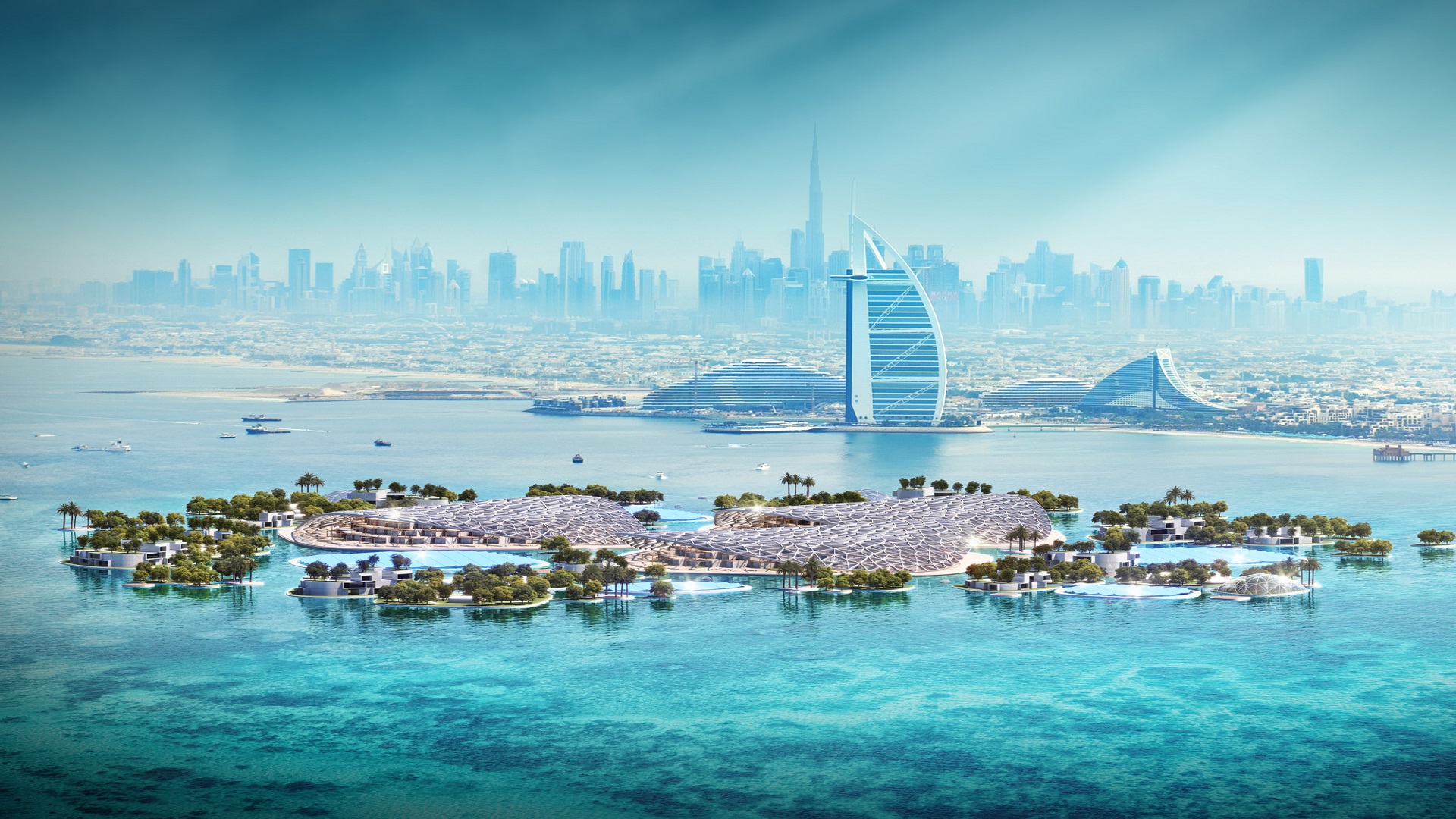
The recently announced Dubai Reefs project plans to create an artificial, 3D-printed coral reef spanning 200 square kilometers.

The ultimate goals: Repair the coastline from oil dredging and building; generate more fish; and boost eco-tourism and research.

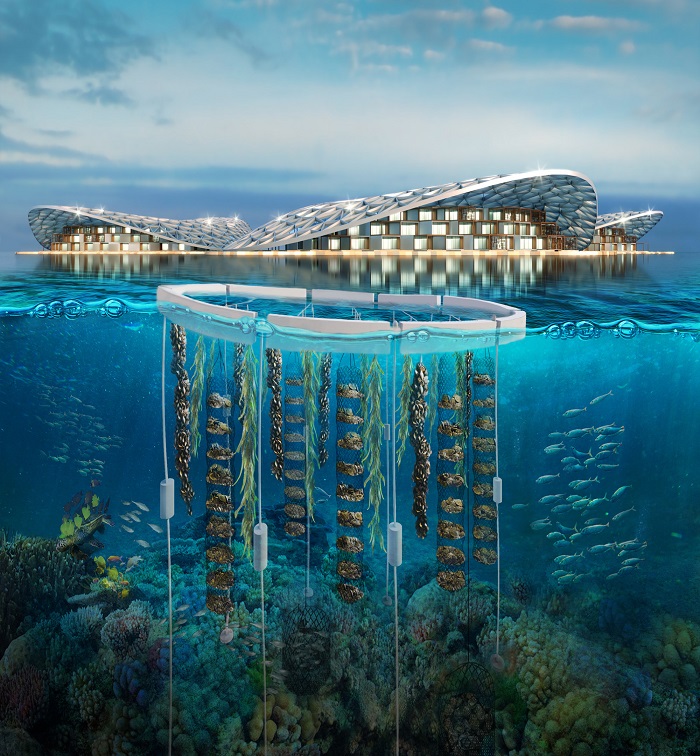
Caption: Underwater farming    Credit: URB

“Coral reefs provide an important ecosystem for life underwater whilst playing an important role in water filtration, fish reproduction, shoreline protection and erosion prevention,” the company says in promotional material for the project.

The bottom line when it comes to food security: More coral reefs equals more fish.

Coral reefs and their surrounding areas are home to 25 percent of all marine animals; 94 percent of the Earth’s wildlife live in the sea.

The project also aims to boost the tourism sector with eco lodges, eco resorts and a research center parked right in the middle of it all.