Brad and Angelina made Brangelina and now a mashup of names has hit the materials science world as scientists take graphene, known for its strength, flexibility and electrical conductivity, and mash it with a type of glass.
Graphene typically acts as a superconductor and the silica glass as an insulator, kind of like a wall that blocks electricity. When these opposites are layered together just right, some cool magic happens.
The atoms begin to communicate across layers, reshuffling their electrons. As a result, Glaphene becomes a semiconductor.
This means it can conduct electricity in a way for use in electronics like solar cells, sensors or futuristic computers. The technology we use daily, like cell phones, cannot function without semiconductors.
Future applications may include next-generation electronics, photonics and quantum devices.
The researchers emphasize this could lead to new ways to mix and match 2D materials and create something entirely new that could lead to custom-built materials tailored for specific functionalities in advanced tech.
With the global population on the rise, the demand for food is increasing. Meeting this demand requires sustainable agricultural practices, including water management. Reusing industrial and municipal wastewater for irrigation presents a practical solution, but while this practice mitigates the environmental and economic burdens of agriculture, it also brings its own significant environmental challenges.
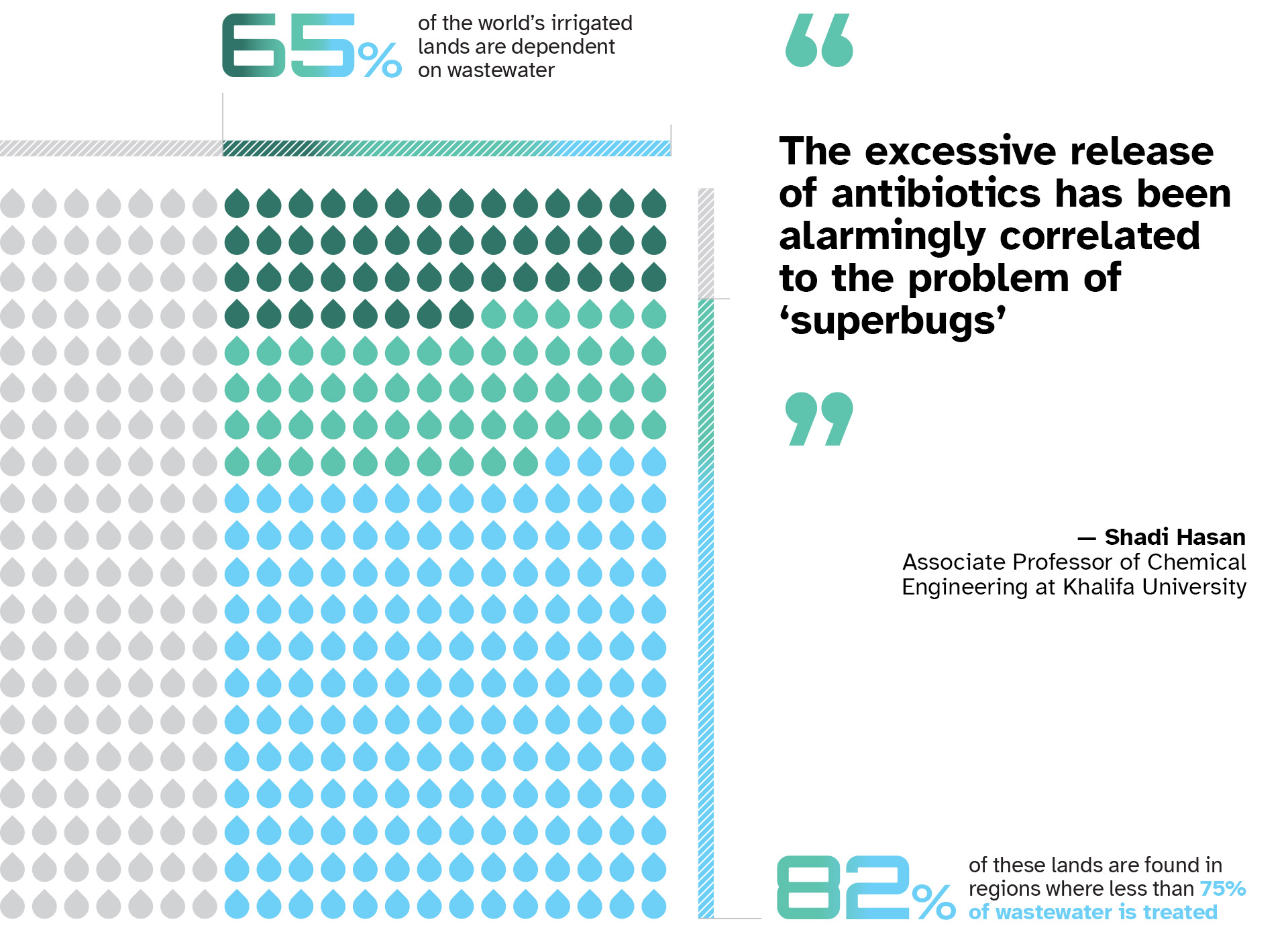
Wastewater is exactly that: water that has been used in the home, a business or industrial process. It’s not necessarily clean or the ideal water for agricultural irrigation, but 65 percent of irrigated lands around the world are dependent on wastewater, and 82 percent of these lands are found in regions where less than 75 percent of wastewater is treated.
Wastewater can be polluted with heavy metals or dyes from industrial applications, for example, but a growing concern is pharmaceutical pollution found in both treated and untreated wastewater. The persistence of pharmaceuticals in the environment is well-documented, and these pollutants have far-reaching implications, including the potential to impact soil health, plant nutrient uptake and the development of antimicrobial resistance across the wider food chain.
The introduction of pharmaceuticals into the environment predominantly occurs through treated wastewater because treatment facilities are ill-equipped to remove these substances. Medications not fully absorbed by the human body are excreted and end up in sewage systems, while improper disposal of medications — down the sink, flushed or even thrown in the bin — contributes further.
Researchers at Dartmouth Medical School, United States, found that the constant release of pharmaceutical waste into water bodies was impacting aquatic life: Estrogen-caused vitellogenesis in male Japanese medaka fish, caused more male fish to convert into female fish and led to an increased mortality rate. Further research found an increased prevalence of breast and testicular cancer in areas with drinking water contaminated with pharmaceutical waste.
Wastewater treatment plants are not designed to remove every environmental pollutant possible, but new treatment processes could be introduced to combat the impact of pharmaceuticals. Reducing contamination at the source is one option and programs for responsible, proper medication disposal and public education should reduce the volume of pharmaceuticals entering the waterways in the first place. Surveys conducted by UC Santa Barbara suggest a willingness among the American public to support these initiatives, but there remains the need to remove those drugs that have already made their way into the water system.
Fortunately, there are methods available.
Anaerobic wastewater treatment is deemed to be the most cost-efficient technology for treating organically polluted effluents from industrial use, according to researchers from Kalinga Institute of Industrial Technology, India. Biodegradable material is digested into biogas and “sludge,” which can then be removed.
Advanced oxidation processes use ozone to remove antibiotics, acetaminophen (paracetamol) and hormones from wastewater. These processes use photocatalysis to remove penicillin and can even be solar-powered. Electrochemical conversion removal techniques can also modify pharmaceutical particles into biodegradable compounds.
The World Atlas of Desertification estimates that only 18 percent of cultivated lands are irrigated. But these irrigated lands produce 40 percent of all food.
Another way to remove antibiotics involves composite membranes made from 2D nanomaterials and MXenes. MXenes are a family of 2D materials that can be used as sheets and stacked on top of each other into flexible and stable films. Researchers from Khalifa University designed membranes to tackle the removal of pharmaceuticals from hospital wastewaters.
“The excessive release of antibiotics has been alarmingly correlated to the problem of ‘superbugs,’” Shadi Hasan, lead author of the study, tells KUST Review.
Algal-based treatment technologies are also on the rise. Microalgae are already used to remove excess nutrients from wastewater, such as nitrogen, phosphorus and carbon, as a natural disinfection process. The algal biomass absorbs the nutrients and can then be harvested and used as a bio-fertilizer. Studies have shown algae can absorb lipophilic pharmaceuticals, which could make them a viable alternative for removing certain drugs like artificial hormones from wastewater.
Finally, nanotechnology could have great potential in adsorbing contaminants from wastewater. Silver and titanium dioxide nanoparticles have been applied for disinfection and decontamination of organic compounds, while iron nanoparticles can be used to remove heavy metals. Nano-based technologies could make industrial wastewater treatment more efficient, cost-effective and eco-friendly.
“Space exploration is a material-science saga, because independent of the electronics and so forth, materials are the enabling technology for the challenges that exist in space.”
That’s according to Carlo Iorio, director of the Center for Research and Engineering in Space Technologies at the University of Brussels. And the game-changers he’s most excited about: graphene and other 2D materials. “2D materials can be used and embedded for solving (many) different problems,” he tells the KUST Review.
Listen to the Deep Dive
IMAGE: Anas Al Bounni/KUST Review
Graphene might be the granddaddy of 2D materials, but it is relatively new, discovered in 2004, winning Andre Geim and Konstantin Novoselov a Nobel Prize in 2010 for its isolation. The material is a single layer of carbon atoms in a hexagonal pattern. It is tough, flexible, light and offers high resistance.
“The properties of graphene are exceptional in many ways,” says Yarjan Abdul Samad, who earned his Ph.D. at Khalifa University, studied the properties of 2D materials as a postdoc at Cambridge University, and has recently returned to Khalifa as an assistant professor in aerospace engineering.
Samad says the discovery of graphene launched a tidal wave of 2D material research: “There are thousands of new 2D materials now under investigation because of the discovery of graphene. It’s as if a new periodic table has erupted,” he says.
“Every property can be utilized for an application not possible for traditional materials. That keeps me intrigued. For me, especially when I look at the challenges of space, whether it’s thermal management or radiation protection or long journeys, there are so many issues that need unconventional solutions. 2D materials are versatile and tunable to solve many problems,” Samad says.
Here’s a look at some of the issues of space travel and settlement Iorio and Samad say 2D materials might address:
Radiation protection
Space radiation is often considered the top limiting factor of long-term space travel, with astronauts likely facing risks of cardiovascular and degenerative disease and cancer.
“I may be biased on this, but top of the list (of 2D applications) is radiation protection. Everyone is concerned about radiation and there have been many radiation-related incidents. So, how can we protect against radiation?” Samad asks. “It’s a very complex phenomenon, and conventional materials won’t work against galactic cosmic radiation. We need to come up with an approach where we can have selective protection.”
Graphene and hybrid solutions might be the answer, he suggests.
Space radiation is also on the top of Iorio’s list of 2D applications for space – “first and foremost,” he says.
Space shields will allow human exploration over long distances, he says. “At present it’s fairly challenging to settle on Mars.”
Samad worked with the UAE’s Mohammed Bin Rashid Space Center on the Rashid Rover project that was presumed lost when its lander apparently crashed in April 2023.
IMAGE: Anas Al Bounni/KUST Review
But plans are underway for Rashid 2, and Samad says studying radiation’s effects on 2D materials is under discussion. “(This) is one of the most pressing challenges, in my opinion,” he says.
Suits and habitats
Advanced materials are required for making temperature-resistant suits and structures for people to use on Mars or the moon, Iorio says. 2D material molybdenum disulfide will play a role in this specific challenge, he adds. 2D materials could also be useful in other construction applications.
Khalifa University is exploring rubber-based components with graphene to not only withstand the extreme temperatures but help the infrastructure sustain moonquakes, Iorio notes. “If it’s rigid (the structure) will break. Imagine if the cracks allowed the O2 out.”
Transporting materials from Earth into space is expensive. But 2D materials are light. And Samad sees potential for them to turn matter found on the moon or other worlds into building blocks for settlements. “There could be composites or hybrid materials,” he says. “There are many approaches that can be taken.”
IMAGE: Anas Al Bounni/KUST Review
And once the habitat is built, keeping it a healthy environment for human residents could also fall on 2D materials.
“Graphene and graphene oxide can play a role in materials that can prevent the spread of bacteria and foreign biological elements,” Iorio says. “Imagine in a sealed human base if an epidemic is spread. We’re at the level of a sci-fi scenario.”
Thermal regulation
“How can we stand the lunar nights and what kinds of materials can help with that?” Samad asks.
2D materials show promise: Not only can they resist the extreme temperatures of space, they are excellent candidates to transfer the heat from, for example, a sun-facing side of a craft to the side facing away, where the temperatures could vary by 200 Celsius. And because 2D materials are, well, 2D, they require little space, freeing up room for bigger habitats.
“In space you have a lot of heat that is lost. So (2D) materials like MXenes have been used because they have a low infrared signature,” Iorio says.
Propulsion systems
“Another application is the propulsion system for a rocket. 2D materials can easily be functionalized,” Iorio says.One possibility: sails made from graphene membranes powered by light from the sun or lasers, freeing spacecraft to travel farther and longer without having to carry fuel on board. The craft would also be lighter, nimbler and easier to launch. The European Space Agency says graphene has passed initial tests that show it is a viable candidate.
IMAGE: Anas Al Bounni/KUST Review
Earthside applications
What we learn from our space exploration attempts can be quite useful for us at home too, here on Earth. The problems graphene and other 2D materials solve in space can easily be transferred to Earthbound issues, Iorio says. “The problem of scarcity that we solve in space will be used to solve the problem of rising scarcity anywhere,” he says.
Filters and membranes developed for recycling water on a moon base, for example, can help conserve resources on Earth.
“The technology that we develop for space is capable of exploiting every single drop of water, which is the same goal of a sustainable economy,” Iorio says. “There is also a scarcity of power. That means that the concepts we develop for space are to use the least energy. Regardless of how far we get in space, this will possibly be used on the ground to reduce energy consumption.”
Samad sees advances in radiation protection eventually protecting data centers on Earth whose systems are vulnerable to cosmic radiation. Additionally, thermal management in spacecraft could eventually improve technology for trains and transportation in general.
“In the Emirates there is a growing interest in sustainability,” Iorio says. “Despite the luxury of the lifestyle, there is more attention to sustainability, reducing the carbon footprint and so forth. I have been in developing countries but one of the things that strictly relates space exploration with sustainable development is they share the need to tackle the scarcity of resources.”
Join our mailing list
Get the latest articles, news and other updates from Khalifa University Science and Tech Review magazine