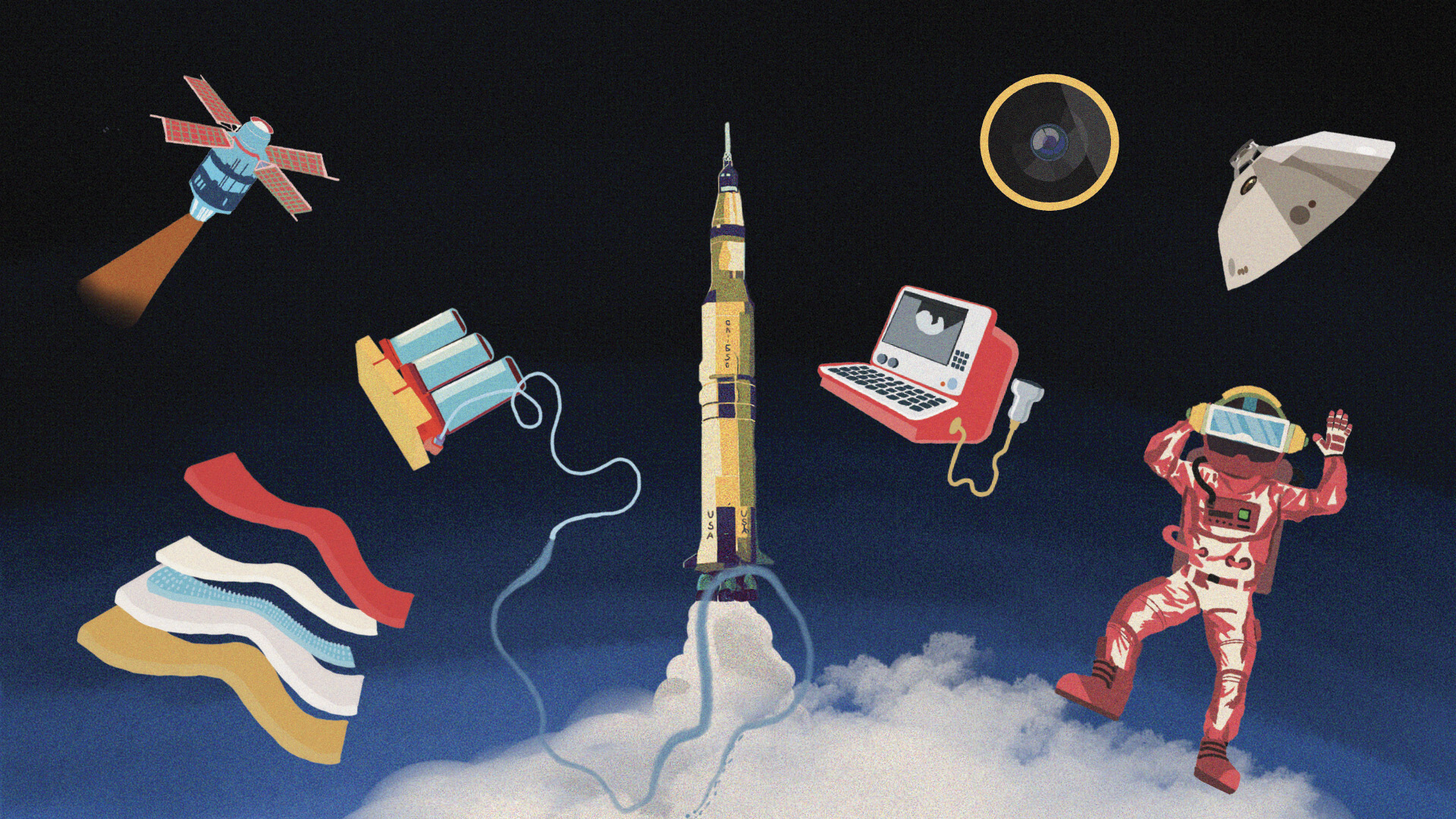
The space race — the Cold War competition between the United States and the Soviet Union — brought innovations not just into the aerospace realm but into everyday life. Here are eight technologies that came out of that period — and three you thought came out of NASA but really didn’t.
| SATELLITE TECHNOLOGY AND GPS
Satellites were developed as a way to communicate with spacecraft and relay information back to Earth. Today, satellites are used for a wide range of purposes, including communication, navigation and weather forecasting. The Global Positioning System (GPS) was developed to navigate and track the position of spacecraft. Now, the average consumer uses GPS for navigation, while farmers use it for precision agriculture. By combining GPS location data with readings from sensors on farming machinery, farmers are able to determine crop yields in different areas of their fields.
| LISTEN TO THE DEEP DIVE
| COMPOSITE MATERIALS
The need for lightweight materials that could withstand the extreme conditions of space led to the development of advanced composite materials. These are now used in a wide range of applications, including aircraft, automobiles and sports equipment. Innovations in shock-absorption materials coupled with robotic and extravehicular activities in space are now being adapted to create more functionally dynamic artificial limbs on Earth.
| WATER-PURIFICATION SYSTEMS
Water in space is precious, so systems were developed to recycle and purify it for reuse. These systems are now used in such settings as hospitals, disaster-relief efforts and developing nations. The electrolytic silver ionizer developed by NASA in the 1960s is widely used on Earth to clean recreational pools.
| MEDICAL EQUIPMENT
The space race led to the development of medical equipment that monitored astronauts’ health during long-duration missions. Plus, digital imaging technology developed for use in space helped create CAT scanners and radiography.
| SMARTPHONE CAMERAS
Experiments miniaturizing cameras for use in space led to the active pixel sensor now used in the standard smartphone camera. Today’s smartphones also employ embedded web technology used onboard the International Space Station to conduct experiments remotely over the internet.
| INTERNET OF THINGS
From embedded web technology came the Internet of Things: remote wireless connectivity between devices in smart homes, smart cities and wearable technology.
| INSULATION MATERIALS
To combat extreme temperatures in space, NASA developed insulation from aluminized polyester called Radiant Barrier, used today in home insulation. Plus, the foil blankets draped over athletes at the end of a grueling event evolved from a lightweight insulator NASA developed to protect spacecraft and people in space.
| WIRELESS HEADSETS AND VIRTUAL REALITY
Astronauts need to float free, hence the development of wireless headsets. Earth-bound high-resolution virtual-reality systems use the head-mounted panoramic display developed to let astronomers and geologists study 3D images of other worlds.
| 3 THINGS NOT INVENTED FOR SPACE
Urban myths link NASA to many materials and gadgets. In fact, the agency didn’t invent Teflon, Velcro or the powdered-drink mix Tang. Teflon had been around since the 1930s, Velcro since the 1950s and Tang was on the market just as NASA was finding its feet.
Mercury astronaut John Glenn drinking Tang in orbit as part of an experiment did, however, do a lot for the brand. NASA may not have invented these products, but it helped to popularize them. Having your product associated with astronauts and the space race connected it with science and discovery.
The space race of the 1960s was about which country would put boots on the moon first. While some of the frontrunners are the same, today’s space race is quite different: Today it’s about who might build on the moon first.
It’s been more than 50 years since a human set foot on the moon. Now China and the United States are working toward habitable long-term structures.
But why would we want to build on the moon?
Listen to the Deep Dive
Basically, it’s a first-come, first-served situation. No one owns the moon — there is no border divide, no land-ownership dispute and no indigenous aliens to bargain with (that we know of) — it’s all just there for the taking. So, it only makes sense that everyone wants to take it.
Though the Outer Space Treaty states no one owns the moon and no one can own parts of the moon, the rules for private companies are ambiguous. In 2020 the U.S. Trump administration produced an executive order that allows private companies to mine on the moon.
IMAGE: Darya Kawa Mirza
Charting a journey through the history of lunar water exploration
For centuries, scientists have theorized about whether water exists on the moon. From bountiful lunar oceans to arid, thirsty regolith, theories of water on the lunar surface have been extreme. Today there is no longer need for theory as the lunar surface provides answers to the question: Can I get a drink of water on the moon? Follow the science as it reveals how early theories led to what we know today: Read more›››
1645: First map of the moon is produced by Dutch astronomer Michael van Langren, suggesting the dark holes on the moon visible to the naked eye are oceans.
1892: American astronomer William Pickering suggests that because the moon has no atmosphere, any water would evaporate.
1960s: Scientists theorize the extreme cold of parts of the moon that never see the sun could be home to frozen water.
1969-’72 Regolith collected by the Apollo mission turns up devoid of water.
2008: Re-examination of lunar soil samples reveals H2O molecules.
2018: A team of scientists confirms ice rests inside craters at both lunar poles. The temperature here never rises above -250 degrees Fahrenheit.
2020: NASA confirms water on the sunlit surfaces as well.
2023: China mission discovers tiny glass beads containing water in lunar soil where meteorites smash into the moon. There are billions, perhaps trillions, on the surface, each no bigger than the width of two hairs.‹‹‹ Read less
And now that we know the moon isn’t made of cheese, players are hard at work to get pieces of what it is made of.
It must be something spectacular for them to want it so badly, right?
Sorry to disappoint, but with the exception of a handful of new minerals, it’s really not much different from what we have here on Earth.
“The Earth and the moon are made out of the same stuff because the solar system was made out of the same stuff,” says Ian Crawford, professor of planetary science and astrobiology at Birbeck University of London.
Locally sourced materials
The problem is that stuff here on Earth doesn’t help us build structures in space, and that‘s the long-term plan: Build on the moon without carting materials all the way from Earth or robbing Earth of its resources. “Gradually increasing access to lunar resources may help bootstrap a space-based economy from which the world economy, and possibly also the world’s environment, will ultimately benefit,” Crawford says.
Don’t forget about the cost, says Sean Swei, director of the Space Technology & Innovation Center at Khalifa University. “Here, the cost is most likely measured by the amount of energy needed to perform mining and conversion. For example, sending 1 liter of water to the moon costs about U.S.$1.2 million. If we could come up with a much more effective launch vehicle, the cost could drop to U.S.$10,000. Hence, large payload delivery to the moon might still be reasonable, though for sustainability we’d still want to enable in-situ resource utilization.”
Progress is underway
NASA in 2022 announced it hired four private companies to mine the lunar surface. The first is Lunar Outpost, a company with a mission to settle humans on the moon. Lunar Outpost charged NASA a dollar for the private company’s rover to pick up a bit of lunar soil, take a snapshot of it and transfer ownership to NASA.
This marked the beginning of commercializing lunar minerals. It also marked the first action in NASA’s plan to build a long-term dwelling for humans on the lunar surface by 2030
NASA’s Artemis program launched its first phase to test its new mega-spaceship in 2022. It was uncrewed — by humans — and it successfully returned to Earth with all of its mannequins and stuffed toy Shaun the Sheep unharmed.
Artemis II will take astronauts on a junket around the moon, and Artemis III will be the boots-on-the-moon finale with an ultimate goal of establishing habitable bases.
Printing a place to live
But for those bases they’ll need building materials. And they’ll use modern technology to produce them. This is where 3D printing comes in.
NASA has toyed in the past with 3D printing on the International Space Station, using lunar regolith for research purposes. But in 2022 the agency announced it had awarded a U.S.$60 million contract to tech-construction company Olympus to construct a 3D laser printer that will build on the moon and Mars.
Meanwhile, Khalifa University is working on autonomous/robotic assembly of large habitat infrastructures on the moon. This race is on.
The Chinese space program also aims to mine the moon for exploration purposes. And while building a safe, sustainable shelter on the moon is paramount for all players, so is the discovery of possible energy sources.
China, too, is pursuing 3D printing. According to a 2023 Reuters report, China is hoping to use the technology to 3D print a lunar station. Its 2028 mission has a robot tasked with constructing a brick from moon minerals.
CAPTION: This photo might look a bit strange, yet those are the actual colors of the lunar surface (with a bit of a push to make them distinguishable and more visible). Those colors come from the minerals found there. Areas rich in iron, for example, have an orange tint, while areas rich in titanium have a blue tint. IMAGE: Ritesh Biswas
The United States and Russia have discovered five new minerals on the moon. But China’s 2020 lunar mission resulted in the discovery of a sixth: a phosphorus mineral named Changesite-(Y). On Earth, phosphate plays an essential role in plant growth. While it is not known what the phosphate from the barrel-shaped moon crystals will reveal, it could be a possible energy source for those long-term lunar visits.
Scientists in China analyzing the Changesite-(Y) crystal determined it contains an isotope of helium-3, which is scarce on Earth.
A better nuclear material?
This discovery could be an energy game-changer, says Gerald Kulcinski, director emeritus of the Fusion Technology Institute at the University of Wisconsin-Madison.
“The amount of energy in the helium-3 on the moon could produce all the electricity needed on the Earth for about 1,000 years,” he says. Astronauts from the U.S. Apollo program discovered in 1970 that helium-3 is in almost every sample brought back from the moon, Kulcinski says.
Helium-3 is effused by the sun and transported through the solar system by solar winds. But Earth’s magnetic field repels helium-3; only a small amount penetrates the atmosphere.
The moon, however, has about 1 million metric tons of the material, Kulcinski tells KUST Review.
The moon’s resources could be a proverbial goldmine for nuclear energy. Experts say 40 grams (eight teaspoons) of helium-3 could provide the energy equivalent of 5,000 tons of coal. Because helium-3 is not radioactive itself, it could provide safer and cleaner nuclear energy.
“He-3 is one of the advanced fusion fuels that can release enormous amounts of energy without the drawbacks of greenhouse gases from fossil fuels or large amounts of radioactive waste from fission reactors,” Kulcinski says.
What else is there?
So if there’s energy resources in abundance on the moon, surely, you might think, there are many other untapped assets there too. Sadly, you’d be wrong, says Birbeck University’s Crawford.
Though much of the moon is unexplored, Crawford says he believes there won’t be any significant future finds to benefit us on Earth. He contends this race is about what we can use while in space — whether it’s a lunar station or a Jeff Bezos hotel in Earth’s low orbit — and the media hype of the race is geo-politics at play.
“It’s interesting and important from a scientific point of view, and though there are only 10 locations on the surface of the moon from which we’ve actually collected samples and analyzed them, I doubt there are going to be any big surprises that are going to be relevant,” he tells KUST Review.
Outer space, including the moon and other celestial bodies, is not subject to national appropriation by claim of sovereignty, by means of use or occupation, or by any other means. — Outer Space Treaty
It’s the year 2122. A space tug owned by the Weyland-Yutani Corp. and diverted by a distress signal has discovered a potentially valuable asset on a distant planet. But rival company Blue Sun says it registered an intellectual property claim on the planet’s biological resources even though it had never sent teams there.
| Listen to the Deep Dive
Who should prevail in court? The scenario may be set in the far future, but the law the decision might be based on is rooted in our past.
| Individuals in space
All countries have laws, rules and governing bodies determining what is legal — and what is not. Emigrate to a new country, adopt a new legal system. But what about moving to a new planet or space station? Under which — or whose — jurisdiction would your new home fall? Would there be one at all?
Maritime law could be one model to follow. When a ship is in international waters, the laws of the country of registration apply. An American cruise ship in the middle of the Pacific follows the American legal system. Should that ship drift into another country’s territorial waters, it would fall under the jurisdiction of the country whose territory it is physically in.
Currently, a spacecraft is considered an extension of its country of origin. So while on your space shuttle bus to your new home on the moon, the maritime international waters model applies. Upon landing, that’s where things get complicated.
According to the 1967 Treaty on Principles Governing the Activities of States in the Exploration and Use of Outer Space, including the Moon and Other Celestial Bodies (more commonly known as the Outer Space Treaty or OST), “outer space, including the moon and other celestial bodies, is not subject to national appropriation by claim of sovereignty, by means of use or occupation, or by any other means.”
Space belongs to no one — no law applies universally. Literally.
Enter “extraterritorial jurisdiction.” According to this principle, people are subject to the laws of their home country even outside its territories. When a person is in another country, that country’s laws supersede the home country’s laws — but when they aren’t in any country, like on the moon, the home country’s laws do apply. Two people on the moon could be subject to different laws.
The 1998 Space Station Agreement says, “Canada, the European Partner States, Japan, Russia, and the United States may exercise criminal jurisdiction over personnel in or on any flight element who are their respective nationals.” Extraterrestrial jurisdiction applies.
Yun Zhao is head of the department of law at the University of Hong Kong. In an article for Space Policy, Zhao writes: “Objects and personnel inside space objects that are transported from Earth into outer space do not enter a legal vacuum during their sojourn; they continue in a confirmed legal relationship with the Earth. This legal relationship is maintained and connected by registration.”
The Convention on Registration of Objects Launched into Outer Space requires entities to establish and maintain the registration of space objects. It’s maritime law again, just in the vastness of space instead of the waves. According to Zhao, whether the space object is governmental or non-governmental is of no consequence: If an American company launches a spacecraft, it’s an American spacecraft and any person on board is subject to American law.
So far, fewer than 700 people have been to space. All planned to return — but what will govern those who choose to stay there?
| Extraterrestrial human settlement
The China National Space Administration has been rapidly developing its space program, including a successful landing of a rover on the far side of the moon in 2019, and Mars in 2021. It has expressed interest in establishing a crewed lunar base and plans to send crewed missions by 2030.
Outer space, including the moon and other celestial bodies, is not subject to national appropriation by claim of sovereignty.
The Russian space agency, Roscosmos, has a long history of space exploration and has expressed interest in establishing a lunar base in partnership with other countries. NASA plans to send astronauts back to the moon by 2024 under the Artemis program, with plans for long-term space exploration and settlement. Within the next 100 years, the UAE aims to establish a human settlement on Mars. Historical explorations on Earth have taught us that whoever gets there first lays claim to the land.
But can this — and should this — apply to the extraterrestrial?
For the most part, current space exploration is an international collaborative effort. The challenges of exploring and utilizing space are immense and no single country can achieve them alone. By working together, countries can pool their resources, share expertise, and spread the risks and costs of space exploration. Look up at the International Space Station, a prime example of successful international collaboration in space, an unlikely if not impossible endeavor if it weren’t operated by a partnership of five space agencies: NASA, Roscosmos, the European Space Agency (ESA), Japan Aerospace Exploration Agency (JAXA) and the Canadian Space Agency (CSA).
Space exploration is inherently a global effort, and if this spirit of collaboration can continue, the Outer Space Treaty of 1967 could be enough to protect humankind’s interests in space. As no one may claim ownership of any celestial body, everything in space becomes the common heritage of humanity.
Perhaps this will suffice. Certainly, president of the International Institute of Space Law and ESA’s special advisor for political affairs Kai-Uwe Schrogl believes in it:
“Common heritage is the only thing that can save us,” Schrogl tells KUST Review. “We can learn from our experiences here on Earth and develop these principles of common heritage for space. Look at Antarctica or deep-sea mining.”
GRAPHICS: Anya Lambert & Anas Albounni
In 1960, U.S. President Dwight D. Eisenhower proposed that the principles of the Antarctic Treaty of 1959 be applied to outer space. The signatories to the Antarctic Treaty (of which there were only 12 in 1959, but a further 17 signed by 2010) recognize “that it is in the interest of all mankind that Antarctica shall continue forever to be used exclusively for peaceful purposes and shall not become the scene or object of international discord.”
Sounds familiar. There are many overlaps between the Antarctic Treaty and the Outer Space Treaty, which makes sense: They’re both remote, extreme environments with potentially valuable resources, and lots of people want to explore, exploit and possibly make territorial claims.
While only 50 countries have signed the Antarctic Treaty, 112 countries are party to the Outer Space Treaty, with another 23 signed but not ratified. This is encouraging to those with Schrogl’s worldview of optimism and common heritage, but there may be a more earthly reason: The Outer Space Treaty started as the 1963 Limited Nuclear Test Ban Treaty, which prohibited nuclear weapons tests or detonations under water, in the atmosphere or in outer space. One hundred twenty-six countries signed that one.
However, as Schrogl points out to KUST Review: “We haven’t seen anyone break the Antarctica Treaty, and we haven’t seen anyone break space law.”
Within the next 100 years, the UAE aims to establish a human settlement on Mars.
As for claiming land, the Antarctica example works again. During the Antarctic Treaty discussions, many countries wanted to claim part of the continent by virtue of their citizens having reached there first, with some claims overlapping. The moon and Mars may offer more surface area to divvy up, but just like it was decided no country could claim sovereignty over any part of Antarctica, so too should the Outer Space Treaty hold up.
Zhao agrees: “More than 50 years after the OST entered into force, it is justifiable to hold that the non-appropriation principle has successfully ensured the safe and orderly development of space activities.”
| Commercial space activities
The increasing commercialization of space is leading to new legal challenges, particularly in the areas of intellectual property and the use of space resources. Private companies like SpaceX and Blue Origin are playing an increasingly important role in space exploration, and there is a growing need for regulation of their activities. This includes issues related to liability, intellectual property and the use of space resources. As private companies begin to exploit resources like water and minerals on the moon and other celestial bodies, clear legal frameworks will need to be developed to govern these activities.
For the University of Hong Kong’s Zhao, intellectual property protection plays a significant role in promoting the sustainable development of space commercialization.
“Over the past few decades, the space sector has witnessed an accelerated speed of commercialization,” Zhao says. “Due to the advancement of space technology and gradual reduced cost of space exploration, private entities are looking for new chances to participate in the development of space commercialization. However, existing policies and treaties fail to consider international intellectual property.
GRAPHICS: Anya Lambert & Anas Albounni
“Given that space exploration heavily relies on technology, which certainly requires intellectual property rights protection, the expansion of space commercialization further enhances such demand. Without an explicit and standing legal basis in space law that provides IP protection to private entities, they may be deterred from investing and thereby actively participating in commercial space activities.
“Space commercialization cannot be disconnected from IP protection. The essentially public nature of outer space law appears to clash with the private nature of IP law,” Zhao adds.
At its core, IP law relates to the establishment and protection of intellectual creations, such as inventions, designs, patents and trademarks. IP law offers economic incentive because it allows people to benefit from the information and intellectual goods they create, protecting their ideas and preventing copying.
For the companies charging ahead in an unclear framework, the Outer Space Treaty holds up.
“Article II of the OST also states that outer space cannot be appropriated by means of use,” Zhao says. “Therefore, from a legal point of view, neither the scientific use nor commercial use of outer space will ever be sufficient to validate a territorial sovereignty claim. Landing on the moon constitutes a ‘use’ of outer space, but it does not and can never constitute a ‘national appropriation’ that leads to territorial sovereignty. The major purpose of Article II was to protect outer space from the potential conflict which may be caused by territorial or colonization-drive[n] ambitions.”
While he wants further clarification for the future, Zhao isn’t too worried for those private entities going forth now: “In general, the IP regime we have now should be fine.”
| Space debris
With more and more objects being sent into space, the amount of space debris is increasing rapidly. This debris poses a significant risk to both manned and unmanned space missions, and there is currently no comprehensive international legal framework to regulate its removal.
University of Hong Kong’s Zhao points to the Outer Space Treaty:
“Article VI makes states internationally responsible for their national activities in space, and Article VII makes states internationally liable for their launch of space objects into outer space and the damage caused thereof.
Sounds simple enough, and Kaitlyn Johnson, author of the Center for Strategic and International Studies report on key governance issues in space, calls space debris mitigation one of the best developed areas of space law.
“Space debris is a growing problem with almost every launch,” she writes. “Many space experts acknowledge that without norms of behavior or debris removal missions, the space environment may be permanently damaged.
We haven’t seen anyone break the Antarctica Treaty, and we haven’t seen anyone break space law.
– Kai-Uwe Schrogl
There are several international mechanisms, national policies, and industry efforts to curb the creation and proliferation of space debris, but despite this progress, few international standards or norms exist.”
The few that do exist, Johnson adds, are out of date with today’s technology and the proliferation of commercial satellites. She points out the recent near miss between an ESA Earth observation satellite and one of SpaceX’s first satellites for its broadband internet provision plan. The U.S. Air Force tracked the two satellites, noting the chance of collision as 1 in 1,000. In the end, ESA chose to maneuver its satellite away from the SpaceX orbital path.
“In just this single example, it is clear that the lack of agreed international norms and processes for space-traffic management could have caused a devastating event in the space environment,” Johnson writes. “A lack of defined international regulations means the choice of how to proceed is left to the satellite operators, but in cases where satellites are not operational, and cannot be maneuvered out of the way, all the international community can do is wait and watch.”
P.J. Blount, IISL’s executive secretary and lecturer in law for Cardiff University, firmly agrees the most pressing concern for policymakers is the safety of operations in Earth’s orbit.
“At the moment, there is increasing congestion in parts of Earth’s orbital space, which has been coupled with a proliferation of space debris,” he tells KUST Review. “Space operations are coordinated through a variety of ad hoc frameworks, but as operators and objects increase these frameworks are strained under these burdens. While understanding how resource activities may work out in the future is important, on-orbit congestion and the need for space traffic is a problem that the space industry faces today.”
Johnson says 2019 saw the real start of united efforts to better coordinate space-debris management and space-traffic management measures. It started with the International Astronautical Congress in 2019, she says, where the international space community collectively called for better space-situational awareness and the need to mitigate debris-creating events in the space domain.
These guidelines are voluntary and not legally binding, but Johnson says they signify a united effort to track all objects in space and to limit debris.
Part of this is the guideline encouraging increased communication between countries and non-governmental entities, and a United Nations information platform to manage space traffic.
2019 also saw the International Organization for Standardization (ISO) update its primary document on space-debris mitigation guidelines, making its compliance requirements stricter. The ISO crafts and promotes international standardization for policy areas including food safety, health care, agriculture, commercial technology and space.
GRAPHICS: Anya Lambert & Anas Albounni
Compliance with ISO standards is generally accepted as industry best practice, and Johnson points out that several nations follow ISO guidelines and either write the standards directly into their national policies or use them as a basis for crafting unique policy.
Developing international guidelines and policies takes time, and Johnson worries that real efforts to protect the space domain will not occur until a major debris-creating event takes place. However, she also highlights the strong industry and multinational consensus that protecting the space environment and focusing on efforts to mitigate the creation of debris should be an international priority.
| What lies ahead?
“The 1967 OST was made before the era of space commercialization,” Zhao tells KUST Review. “It contains only general principles; there is a need to further clarify the application of these principles in our modern life with a lot of new development. There are loopholes in the current legal regime and an urgent need for the international society to negotiate to come up with some documents guiding new space activities.”
Schrogl also highlighted the need to update and develop space law for the modern space race, but remains optimistic about the future:
“The threat that member states (of the OST) go alone is omnipresent,” he tells KUST Review. “We have cases and cases where we see this on Earth but we have also seen over the last 50 years or so where respect for international law and the rule of law is growing. Wherever countries think ‘I can be first,’ they try and find loopholes or even use brute force, and we have to be realistic about that. But at the same time, if you look at it with a historical perspective, it’s not so bad how, in particular, space law has been applied and respected.”
So what does 21st century space law look like?
For Zhao, expert in intellectual property law, IP is the main concern. He highlights scientific experiments carried out in space where no countries can claim sovereignty and says we’ll need to determine the rules for IP claims for these results. For him, whether the national legal regime would apply to these situations is the big question.
Schrogl doesn’t know what the future holds for space law but recognizes the sheer number of issues to be ironed out:
“Space law has expanded. From the beginning, it was meant to provide an understanding of the status of outer space and the status of the actors in outer space. This it did extremely well: It’s a space for free use and non-appropriation, states are responsible and liable, and private actors can only act if they are authorized by the states. This holds true today. But space law’s extension has to regulate the behavior of these actors. We need provisions for space traffic management to avoid accidents and collisions, for cleaning space debris, and for long-term sustainability.”
Space law isn’t standing still: There’s COPUOS working to develop guidelines and principles for the exploration and use of space resources. The International Institute of Space Law helps international organizations and national institutions cooperate to develop space law, and the International Astronautical Federation leads space advocacy across 75 countries. There are 11 academic journals dedicated to space law and policy.
And while Schrogl admits progress is slow, “we’re building a new dimension of space law.”
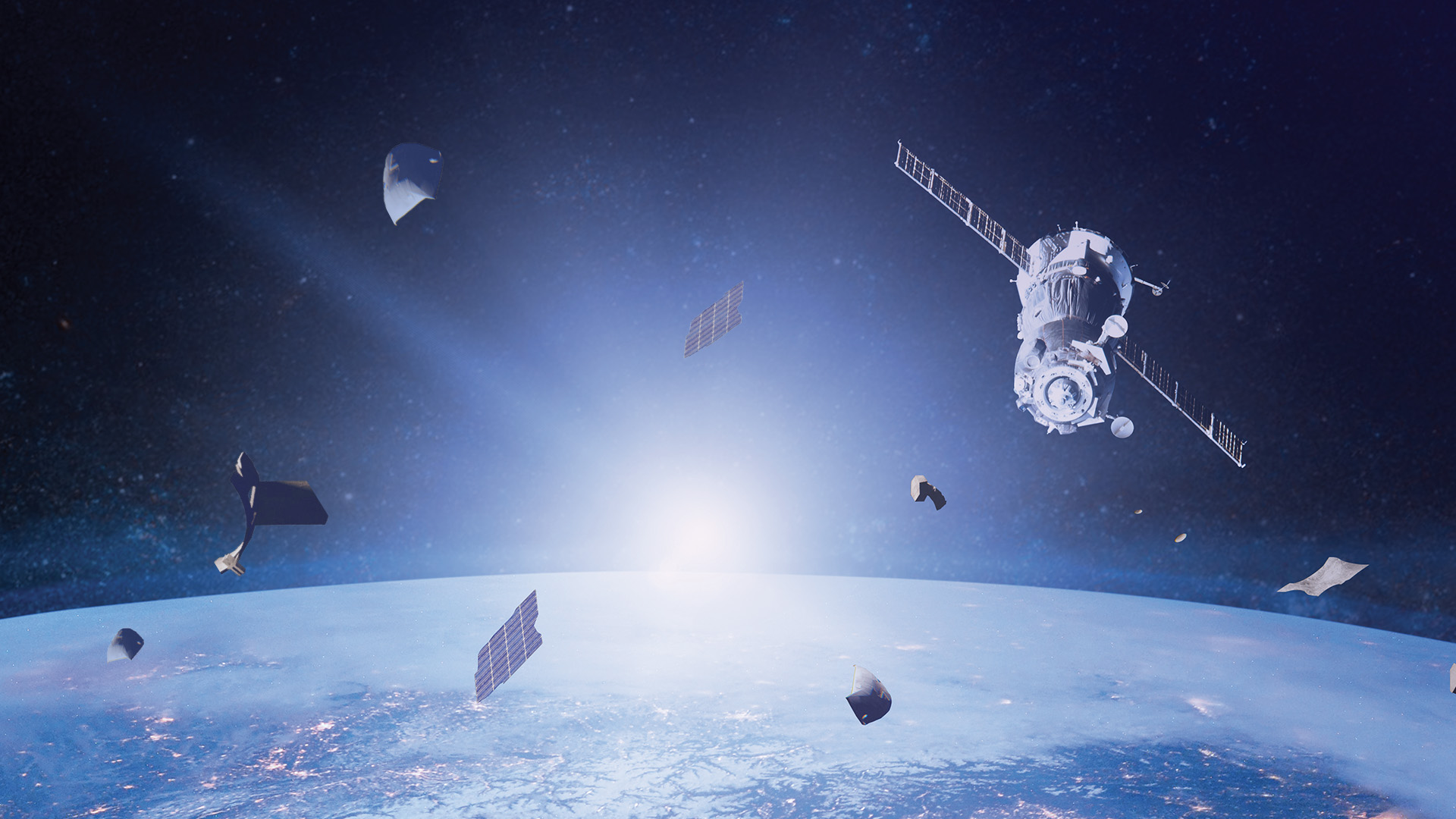
As the race to explore space intensifies, so does the problem of space junk. With millions of pieces of debris orbiting the Earth, scientists are sounding the alarm that the issue poses a serious threat to future space missions.
Earth’s low orbit, 2,000 kilometers or less from the Earth’s surface, is home to the vast majority of space debris. The debris consists of defunct satellites, upper launch stages, fragments from explosions and pieces left over when countries shoot missiles to take down their own satellites. Many pieces of debris are larger than tennis balls, and most no longer serve any functional purpose. Basically, there’s a lot of garbage flying around up there.
And this garbage is flying at astounding speeds.
Imagine you’re driving home from work, traveling 80 kilometers per hour when a small stone flies up, striking your windshield. It makes a loud noise, and later you notice a crack in the windshield. The velocity of both objects — the car and the rock — determines the level of damage.
Now imagine you’re traveling at over 25,000 kilometers per hour, and so is the stone. At this speed, collision with a stone would be catastrophic, but even something tiny can cause serious damage.
European Space Agency astronaut Tim Peak in 2016 noticed a crack in the observation window of the International Space Station. In a press release, Peak described a photo he took of the crack: “I am often asked if the International Space Station is hit by space debris. Yes — this is the chip in one of our cupola windows, glad it is quadruple glazed!”
The damage was caused by a rogue fleck of paint.
There are about 27,000 pieces of debris larger than 10 centimeters being monitored by the U.S. Department of Defense. More than 100 million smaller pieces fly around untracked. Any impact with other spacecraft, satellites or space stations could be devastating and in turn cause more debris, and so on and so on.
IMAGE: NASA, ESA, Shutterstock
The chain reaction, theoretical at this point, is known as Kessler syndrome. Astrophysicist and one-time NASA scientist Donald J. Kessler proposed that at some point there will be so much debris in Earth’s low orbit that it will continue to crash and create more debris, eventually becoming autonomous and unstoppable and making future space travel impossible.
Though Kessler syndrome is an extreme example, it’s not impossible. Moog Professor of Innovation and SUNY Distinguished Professor at the University at Buffalo, John Crassidis, says he believes we will reach this point in this generation.
“I really think that we’ll be in trouble in 50 years or less if we keep putting objects up in space like we are doing now,” he tells KUST Review.
Though 50 years isn’t far off, more imminent risks exist to satellites and other spacecraft in Earth’s low orbit.
Crassidis, who works with NASA and the U.S. Air Force to monitor space debris, says the biggest risk is to humans — specifically to those doing extravehicular activities. “Debris is moving at 17,000 miles per hour. That can go right through a spacesuit, even a very tiny piece of debris,” he says.
CAPTION: Japanese company Astroscale is hoping to inspire a movement of space cleanup IMAGE: NASA
Other risks exist for active satellites in Earth’s low orbit. This may not sound concerning but these satellites allow Earth dwellers to make calls on their iPhones, watch videos on TikTok, participate in Zoom meetings and make millions as YouTubers. So, if these satellites are knocked out by debris traveling over 25,000 kilometers per hour, Gen X, millennials, and well, pretty much everyone, could be in for a trip — not to space — but back in time.
Among other concerns are for the 10 individuals living on active space stations. There are two inhabited space stations in Earth’s low orbit — the International Space Station and China’s Tiangong space station. Space stations are protected by their outer shields from debris up to 1.5 centimeters in diameter, but other than that, it’s either evacuate or duck. Thus far, both have proved successful solutions.
Russia in 2021 launched a rocket at one of its own satellites as a test, creating more than 3,500 pieces of debris and putting those living on the International Space Station at risk. The astronauts were forced to move into their spaceship capsules docked on the station should they need to make a quick get-away. And in October 2022, the International Space Station had to be raised by 0.2 miles to avoid more fragments resulting from this test.
This evasive maneuver — with a price tag of about U.S.$1 million — was effective, but even a collision with a piece of debris between 1 and 10 centimeters in diameter could cause damage costing up to U.S.$2 million to fix. Crassidis says this is only one of more than 20 maneuvers the space station has performed to avoid large pieces of debris.
Though moving the space station is currently a feasible — albeit expensive — solution, experts are concerned that with the increasing volume of debris each year, a safe space environment will cease to exist.
And researchers have discovered that collisions aren’t the only environmental risk factor.
A 2023 study by the National Oceanic and Atmospheric Administration found metallic particles consistent with materials used to build spacecraft within the world’s stratosphere. This is caused when defunct satellites and rocket bits vaporize as they re-enter the Earth’s atmosphere.
BUT WHAT IS THE SOLUTION?
While the United Nations holds guidelines for space-debris mitigation, there is no legislation in place to hold space explorers responsible for their mess. So, it’s basically down to innovation and doing the right thing.
“We can’t even get countries to follow United Nations Guideline Number 4: Avoid intentional destruction and other harmful activities. Our leaders need to start talking with each other. That’s the first step, but not all countries are doing that. We (the Americans), the Europeans and other countries do follow many of the guidelines,” Crassidis says.
CAPTION: Debris orbiting the Earth poses a risk to satellites, astronauts and future space missions IMAGE: Shutterstock
So, while some governments are doing what they can to clean up their mess, start-up businesses are popping up to pick up the pieces. Take Japanese company Astroscale, for example.
Astroscale offers space-debris removal as a service. Space programs or private companies world-wide can hire it to collect debris and drag it into Earth’s atmosphere to burn up. Astroscale plans its first official removal mission to take place in 2025. The company is hoping to inspire a global movement of debris removal.
In the meantime, the European Space Agency has partnered with start-up Clearspace to launch a claw that will grab hold of space junk and pull it back into the atmosphere to burn up. The claw is expected to remove its first piece of debris in 2025.
But that may cause problems, too. The 2023 NOAA study found that the offset contributes to ozone depletion.
Until these projects become regular practice, Crassidis’ research focuses mainly on prevention by “trying to determine the characteristics of debris from unresolved images. These updated models can be used to better predict where the debris is in space, thereby helping to better determine the probability of collision with functioning satellites,” he says.
Crassidis and his colleagues are also working on a plan to recycle space debris but, “This technology is 15 to 20 years away from being practical.”
Crassidis says that one day there will be a practical and affordable solution to space debris.
“What is today’s science fiction is tomorrow’s reality. The best thing we can do is follow the U.N. guidelines, slow the growth of the debris, and then have technology catch up to clean it up,” he tells KUST Review.
Five centuries after the start of the scientific revolution, men still dominate STEM fields. But women’s contributions to science have gained ground, a 2022 study suggests.
In honor of International Women’s Day, we celebrate a few of Khalifa University’s many outstanding women who are helping to break barriers.
ANNA MARIA PAPPA
“Women should always remember that there are numerous examples of highly successful women who have excelled despite challenges, serving as leaders in their respective fields. Importantly, many have successfully balanced their careers and family life,” says Anna Maria Pappa, assistant professor of the Department of Biomedical Engineering & Biotechnology.
Pappa, who has a Ph.D. from École des Mines de Saint-Étienne in France, leads the on-chip/biosensors group focused on developing cutting-edge technologies for next-generation miniaturized sensors with applications in health care and environmental science.
Pappa credits her decision to leave her home in Greece to study abroad with being a risk-taker.
CAPTION: Anna Maria Pappa
Her reward: meeting and working with people from all over the world. “Creativity thrives in diverse environments, ultimately leading to progress,” she says.
During her time at Cambridge University, she served as a science ambassador, visiting schools to embolden girls to chase STEM careers. She believes that “the dominance of males in key senior positions contributes to a lack of female role models and a scarcity of a female mindset.”
CAPTION: Anna Maria Pappa labwork
Pappa’s advice to young women is to remain open, never underestimate their abilities and don’t be deterred by stereotypes. She also credits her success with surrounding herself with a strong support system of successful women and men.
Pappa is on the editorial board of several journals and has received multiple awards for her research, including the L’Oréal-UNESCO Women in Science Award. She is listed among the MIT Technology Review’s Innovators Under 35 and has won several awards in entrepreneurship and innovation.
ELENA FANTINO
“Diversification is a protection against ignorance,” Warren Buffett once advised. While he was talking about investing, this advice is applicable across any industry — science included. And Elena Fantino agrees.
Fantino, an associate professor in aerospace engineering who holds an M.Sc in astronomy and a Ph.D. in space sciences and technologies, credits her new ideas these days to her unusual and diversified career path.
CAPTION: Elena Fantino
“My journey as a scientist has passed through different fields, disciplines and experiences. I started as an astrophysicist with a passion for celestial mechanics, then I became a space engineer. I worked in space-mission development. For some time, I worked as a software engineer in the private sector. Eventually, I returned to academia and specialized in satellite dynamics,” she says.
Fantino believes that education is at the base of inclusion and there is much work required to equalize the gender gap in STEM.
The solution, she says, is a shift in societal mindset, and that comes from hard work with campaigns, programs and incentives for girls and women. And these require dedicated action.
She also believes that Khalifa University is on the right track, but there’s always more that can be done.
“Khalifa University with its large female-to-male student ratio is leading this transformation, and we must be very proud of it. However, we need to hire more women faculty and researchers not only for their contribution to science and engineering, but also to inspire and encourage the younger generations through their example,” she tells KUST Review. “From my experience as an educator, I can say that female students are strongly inspired by women faculty and researchers. I can sense this in my lectures. Our girls see us as examples to follow because we reached where many of them would like to be. We show them that everything is possible despite the challenges.”
CAPTION: Trajectory looping around Enceladus, the moon of Saturn that became popular after the detection of vapor plumes emanating from its pole. This trajectory enables extended observations of the surface including the polar regions IMAGE: Elena Fantino
Fantino says her career path was inspired by one of her own teachers, and though she encountered gender bias, she credits maturity and experience with overcoming challenges.
Role models are also key to successful women in STEM, but not just to even out the numbers.
“For sure, we need to see more women in senior management roles, and not just as a means to ensure inclusion and fight gender inequalities. We need them because of the different perspectives and unique ideas that women can bring to those jobs,” she says.
Fantino specializes in space-mission analysis, space geodesy, space astrometry, celestial mechanics and astrodynamics and has participated in several mission projects. She has advised more than 40 graduate students and is a member of both the Astrodynamics Technical Committee of the International Astronautical Federation and the Space Dynamics Group of the Technical University of Madrid.
At Khalifa University, she leads the astrodynamics research group and participates in the activities of the Space Technology and Innovation Center.
LOURDES VEGA
When Lourdes Vega, director of the Research and Innovation Center on CO2 and Hydrogen at Khalifa University, spoke at EXPO 2020 to a group of secondary students, she asked them for the names of five male scientists. The answers came easily. But when she asked them to name five female scientists, the only name put forward was Marie Curie.
Curie, arguably the most famous female scientist of all time known for her work on the properties of radium as therapeutics and winner of two Nobel Prizes (physics and chemistry), is not a surprising answer. What is surprising is that she was the only answer.
Vega says she has had many experiences in her career in which being a minority stood out, but she also believes that doing what you love is the key to a rewarding life. And these choices should be made inherently. “Our girls and young women need to know that (a career choice) is a natural choice, depending on their curiosity and interests, and that they have an important voice. A scientific career is not easy, but it is very rewarding.”
Though science is highly competitive, Vega says most of her successes were when working in a team environment, and she says this is something women bring to STEM — a different perspective and collaboration.
CAPTION: Lourdes Vega receiving the Mohammed Bin Rashid Medal of Scientific Distinguishment for her contributions in clean energy and sustainable products IMAGE: MBR Academy of Scientists
Not everyone has the privilege of going to work every day to do what they love. But Vega knew from a very early age that science was her path.
And her path began in Seville, Spain, studying physics.
In a program with only 10 percent women, Vega says it didn’t take long before the fact that she was a woman was no longer an issue. Her capabilities spoke for themselves. She ultimately acquired a Ph.D. in physics and 30 years of experience in research, teaching, innovation and strategy in chemical engineering and materials science on three continents.
She has published over 230 papers in top journals, has 10 commercialized products, and six patents. She is known for applying fundamental science to the living world focused on clean energy and sustainable products, carbon capture and utilization, sustainable fuels, sustainable cooling systems and water treatment.
Vega has been recognized globally. She was selected in 2024 as one of the 60 impactful women in the Middle East driving sustainability and one of the top 100 Women Leaders in Spain. In 2020 she was awarded the Mohammed Bin Rashid Medal of Scientific Distinguishment for her clean-energy contributions. And this is only a handful of honors.
CAPTION: Lourdes Vega with postdoctoral students at Khalifa University IMAGE: Khalifa University
Representation matters, and for Vega, that means taking any opportunity to inspire and mentor young women. “I try to engage at all levels, first with the people next to me — undergraduate and graduate students — (and) with those collaborating with me — graduate students, postdocs, faculty and colleagues,” she says. Vega also worked in the UAE with the Spanish embassy and the Association of Scientists and Researchers on Women Have the Formula, highlighting the role of women in science.
To young women considering a career in STEM, Vega says, “believe in yourselves. Difficulties should not stop you from pursuing your dreams of being scientists. Even though there are difficulties there are always opportunities ahead and people willing to help and support. Work hard and be resilient. Science is not an easy profession but we can contribute to improving the quality of life of our people and also leave a better planet.”
HESSA EBRAHIM ALI MEJLAD ALFALAHI
“I believe that in our region (the Middle East), female scientists in STEM play an instrumental role in driving the innovation and science advancement, and I am optimistic that the future will be even brighter,” says Hessa Alfalahi, biomedical engineer, researcher and Ph.D. candidate at Khalifa University.
Alfalahi’s plan to contribute to that brighter future? She’s hoping to gear her research toward those who struggle with neurological and psychiatric disorders.
Early diagnosis and intervention are imperative with neuropsychiatric disorders to improve quality of life and manage complicated symptoms, but many diagnoses, like Parkinson’s, typically come after years of neurodegeneration. Alfalahi wants to get in front of it before it gets to this stage. Her research could also prove valuable for conditions like depression, which, according to the World Health Organization, affects 280 million people globally.
CAPTION: Hessa Alfalahi
She plans to use AI technology and smartphones.
“I aim to leverage AI algorithms for the detection of depression in the wild using smartphone typing data, i.e., the finger kinematics during typing captured as a series of timestamps of key presses and key releases,” she says.
Typing behavior might help detect psychomotor impairment and diagnose depression passively at an early stage, she adds.
She won the L’Oréal UNESCO Women in Science award for her work in 2022.
Alfalahi says taking an active role in science is the key to “mitigating evolving challenges in quality of life and the sustainable development of society.”
Alfalahi shares her research by publishing papers and participating in high-ranking international conferences. But she says she really enjoys interacting with the younger students at Khalifa University, sharing her experiences as she transitioned from student to researcher.
Alfalahi says she is grateful for the inclusive research environment at Khalifa University and hopes to share her vision with the women of the Middle East.
“The time is ripe now to take part in accelerating the research production and innovative solutions in all the scientific disciplines,” she tells KUST Review.
Join our mailing list
Get the latest articles, news and other updates from Khalifa University Science and Tech Review magazine