
How Coldplay takes sustainability on tour

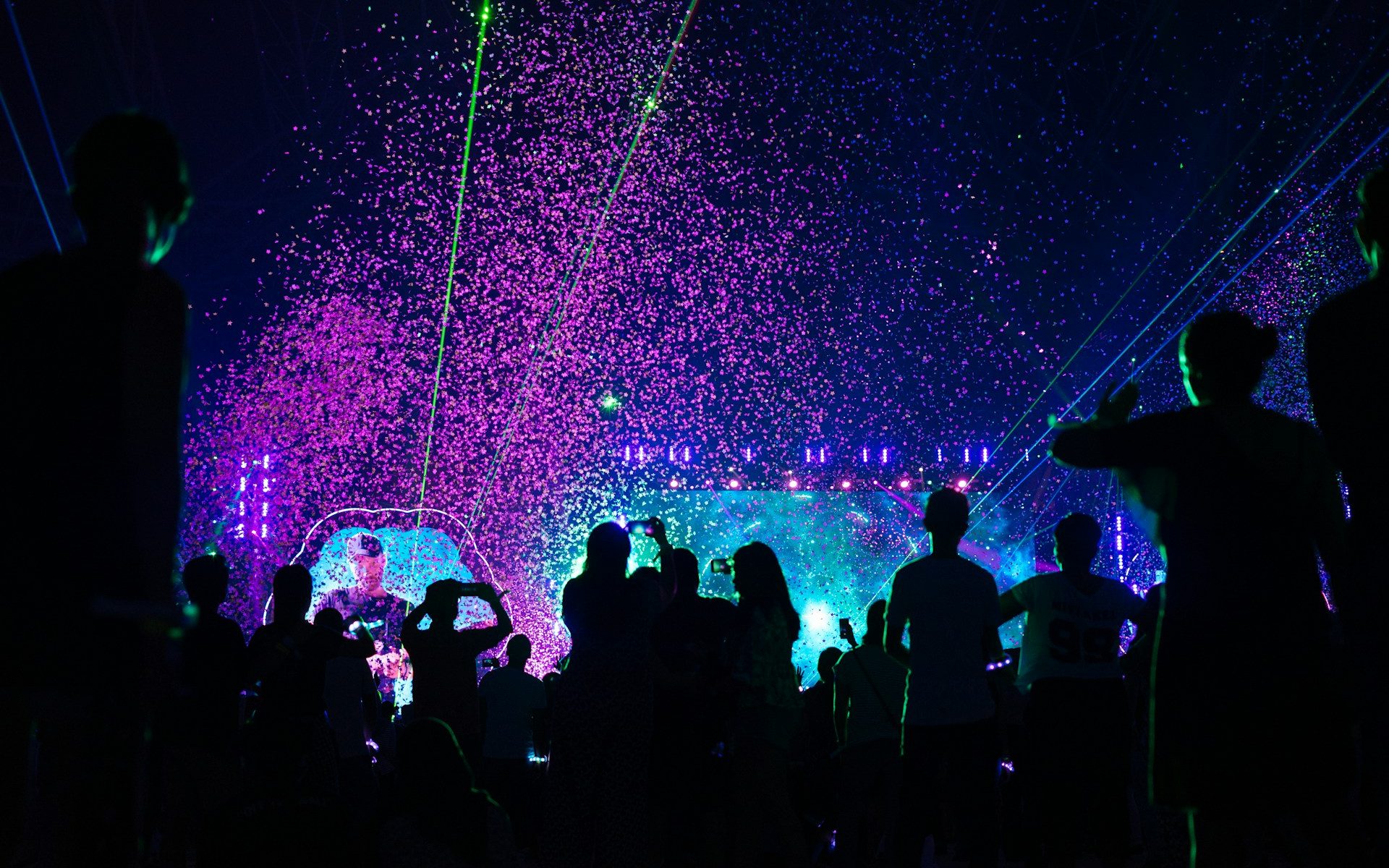
With 45,000 other fans, I went to a Coldplay concert last month. It had been 20 years since my last one and this time was a very different experience. The technology wasn’t just a flashy addition, it was an essential part of the sustainable show.

Concert-related CO2 emissions come from a wide range of sources — travel, ticketing, audience electronics, energy consumption for staging, lighting, sound, ventilation, hotel stays for attendees, band members, and crew, as well as waste from packaging and plastics.

After launching “Everyday Life” in 2019, Coldplay told the BBC that they would stop touring until they could ensure it could be done sustainably.

“We’re taking time over the next year or two to work out how our tour can not only be sustainable but how it can be actively beneficial,” frontman Chris Martin said.

Fast forward to 2021 and the announcement of their Music of the Spheres Tour, where the band vowed to cut direct carbon emissions by 50 percent, covering every aspect of production and travel.

Among the innovations used to cut their carbon emissions: Energy centers placed around each venue consist of 44 sustainable tiles for fans to dance on and 15 kinetic bikes that generate energy to help power the show. Data collected from these centers records the amount of energy produced during specific songs, shows and across tours.


“From collecting unprecedented amounts of data to taking specific actions today based on rigorous analysis, Coldplay is modelling a trajectory toward a low-carbon, biodiverse and equitable future.”

John E. Fernández, director of the MIT Environmental Solutions Initiative


On average, these installations — along with solar panels set up around the stadium — generate about 17 kWh each night, enough to power the center stage.

The band also encourages concertgoers to use public transportation and shuttle buses organized for the event; set up water stations around the venue; and requests that fans bring refillable bottles.

Every flight, including freight and charter, uses sustainable aviation fuel, and the stage is built with reusable and recycled lightweight materials.

In 2023, the band reported powering 18 shows from a portable battery system made from recycled BMW i3 batteries. Over 2022–2023, they also achieved a 59 percent reduction in CO2 emissions compared to their 2016 tour.

But it’s not all about direct emissions and energy consumption.

Coldplay also focuses on food and waste management. So far, 72 percent of all tour waste has been sent for reuse, recycling or composting. They’ve also donated nearly 10,000 meals from tour catering to the homeless over the same two-year period.


For each ticket sold, a tree is planted, and the band partners with several sustainability-focused organizations, including ClientEarth and One Tree Planted. To top it all off, Coldplay’s tour merchandise is made from organic and recycled materials.

It seems like they’ve got the bases covered. But is it enough?

Carbon Market Watch praises the band’s efforts but points out that some information is missing from their data — such as emissions from fan travel. They also suggest the numbers could be reduced by playing fewer concerts.

The data and sustainability claims have been audited and verified by the MIT Environmental Solutions Initiative.

“For some time now, Coldplay has been leading by example in taking seriously and acting on the various interrelated environmental and social challenges facing humanity; climate change, biodiversity loss, air and water pollution, environmental injustice and more,” says John E. Fernández, director of the MIT Environmental Solutions Initiative.

“With each subsequent year of their tour they demonstrate an evolving vision and expanded commitment to move the entire music industry toward true and humane sustainability and planetary resilience. From collecting unprecedented amounts of data to taking specific actions today based on rigorous analysis, Coldplay is modelling a trajectory toward a low-carbon, biodiverse and equitable future,” he adds.


After all, they’re one of only a few taking such measures.

Comprehensive industry-wide data is scarce. That’s why MIT is conducting its own research, led by Fernández and MIT research scientist Norhan Bayomi of The Climate Machine, an MIT Environmental Solutions Initiative research group.

“This latest analysis of Coldplay’s impact on the environment from touring is again setting a new standard for the entire music industry. The data and the methods of analysis support the conclusion that substantial progress has been made to reduce emissions in touring,” Fernández says.

From Nobel-winning breakthroughs to
local innovation

Advances in protein design and the use of AI for predicting protein structures made the headlines with the 2024 Nobel Prize in Chemistry. But closer to home, researchers at Khalifa University in Abu Dhabi are leading the way in using computational methods to predict the crystal structures and properties of materials.

This foundational work is driving progress in energy storage, drug development and the creation of components for advanced optoelectronic devices.

Listen to the Deep Dive

“The basic idea is to use computers to predict the atomic arrangement of solids before we synthesize them in the lab,” says Sharmarke Mohamed, head of the Chemical Crystallography Laboratory (CCL) at Khalifa University. “If we can do this accurately for all target molecules of interest, then this gets us one step closer to answering the scientifically interesting question of what experimental conditions are necessary to target the crystallization of a material with this particular structure.”

Using computers is time-saving, cost-effective and minimizes trial-and-error experiments. But why is this important?


Today, the challenge is not whether we can use computers to predict crystal structures, but how the predicted crystal structures can be used to guide experiments in the synthesis and discovery of functional materials.

Sharmarke Mohamed, head of the Chemical Crystallography Laboratory (CCL) at Khalifa University


Crystallizing proteins allows scientists to understand their structure in detail.

Proteins are complex macromolecules, and their shape determines how they function in the body. By creating crystals of proteins, researchers can use techniques like X-ray crystallography to study their 3D structure. This helps in designing medicines that fit a protein perfectly to treat diseases. It also advances understanding of conditions like cancer and Alzheimer’s by revealing malfunctions in the protein structure.

CAPTION: Sharmarke Mohamed (from left), Praveen Managutti and Thomas Delclos

“Fifteen years ago, when I was doing my Ph.D. in chemical crystallography and computational structure prediction, the question of whether computers can predict crystal structures was still an open question. The problem was also somewhat niche and confined to the academic community because very few industrial researchers were engaged in method development and testing. Today, most pharmaceutical companies around the world have some sort of computational crystal structure prediction research program in-house,” Mohamed says.

But the field has developed immensely over the past couple of decades thanks to a little healthy competition.

Critical Assessment of Structure Prediction (CASP) is a biennial event where researchers assess the performance of methods used to predict protein structures. Scientists worldwide participate in testing algorithms that aim to determine how proteins fold into their 3D shapes based solely on their amino acid sequences. Given the importance of protein structure in areas like drug development and disease research, CASP plays a critical role in advancing computer-based biology research and guiding improvements in prediction methods.

A similar blind test has been ongoing since 1999 for assessing progress in using computers to predict the crystal structures of small molecules.

The Crystal Structure Prediction (CSP) Blind Tests, organized by the Cambridge Crystallographic Data Centre, bring together scientists from academia and industry to evaluate their methods on real-world examples in a controlled setting. These tests also foster collaboration within the CSP community.

Mohamed and his team — including M.Sc. student Mubarak Almehairbi, Ph.D. student Zeinab Saeed and postdoctoral research fellows Tamador Alkhadir and Bhausaheb Dhokale — participated in the most recent CSP blind test.


“This seventh blind test featured the most challenging target molecules to date,” Mohamed tells KUST Review. “The results show that the field has progressed significantly since the first blind test in 1999, as reflected in the success rate in both structure generation and ranking. But as with all advancements in science, when we make progress in one area, new questions and challenges arise.

“Today, the challenge is not whether we can use computers to predict crystal structures, but how the predicted crystal structures can be used to guide experiments in the synthesis and discovery of functional materials,” Mohamed says. “This is now the focus of many researchers in the field, including our group in the Chemistry Department of Khalifa University.”

For example, machine learning has improved how we rank predicted crystal structures, helping researchers identify which ones are likely to form successfully under normal temperature and pressure conditions.

Ranking crystal structures helps researchers figure out which ones are most likely to be observed under real-life conditions. This saves time and effort by focusing on the best options for experiments.

Mohamed’s group is developing new methods and codes to help experiments target new materials with desirable solid-state properties. For example, the team recently created the MechaPredict code, which is able to predict the mechanical properties of crystals on any surface of interest without the need for sensitive nanoindentation experiments.

CAPTION: MechaPredict code summary IMAGE: Khalifa University

This code is already being used by academics around the world and has attracted interest from pharmaceutical companies for its potential to extend the shelf life and improve the solubility and stability of drug products. Additionally, the code can be applied in designing new materials like hole-transport layers for solar cells, which can lead to more efficient, versatile, cost-effective and longer-lasting solar panels.

But with all the advances made in computational CSP methods, a well-equipped crystallography laboratory is necessary to validate the accuracy of the computational predictions.

“The Chemical Crystallography Laboratory (CCL) is the best-equipped crystallography lab in the UAE for performing single-crystal X-ray diffraction, the gold standard for determining the crystal structures of materials,” Mohamed says. “The CCL provides experimental crystallographic services to Khalifa University researchers as well as to collaborators in the UAE and around the world. The synergy between experimental chemical crystallography and computational CSP methods is the key to seeing further advances such as those recognized in the 2024 Nobel Prize in Chemistry.”

This is Planet Earth

Following are ASTER (Advanced Spaceborne Thermal Emission and Reflection Radiometer) images taken from space that show the sometimes strange and wild beauty of our world as well as its vulnerability to climate change.


Glacial retreat
New Zealand contains over 3,000 glaciers, mostly in the Southern Alps on the South Island. The glaciers have been retreating since 1890. Click here to see the same location in 1990.

Find out how the dust in your country might be contributing to glacier loss here.

IMAGE: NASA/METI/AIST/Japan Space Systems, and U.S./Japan ASTER Science Team

Bottom of the world
Space imagery revealed a wide crack in Pine Island Glacier in the Antarctic. The area has undergone a steady loss of elevation with retreat of the grounding line in recent decades.

Satellites brought you these images, but they can be vulnerable to attacks. Find out here how experts are safeguarding our assets in space.

IMAGE: NASA/GSFC/METI/ERSDAC/JAROS, and U.S./Japan ASTER Science Team

Water sculpture
Erosion has carved the mountain slopes along the western flank of the Andes of Lima, Peru, into long, narrow serpentine ridges.

Click here to see how water erosion can change a landscape.

IMAGE: NASA/GSFC/METI/ERSDAC/JAROS, and U.S./Japan ASTER Science Team

Troubled waters
This image shows the Rio Negro, a tributary of the Amazon River, at Manaus, Brazil, in 2023. Compare this image to one taken in 2020 to see the effects of drought. Here, vegetated areas show up as pink to red. Water is black or blue.

IMAGE: NASA/METI/AIST/Japan Space Systems, and U.S./Japan ASTER Science Team

Fan dance
An alluvial fan spreads between the Kunlun and Altun mountain ranges at the southern border of China’s Taklimakan Desert in this ASTER image. The blue left side is the active part of the fan, made up of water flowing from many small streams. An alluvial fan is an area where rivers deposit silt, sand and other debris over a long period of time.

IMAGE: NASA/GSFC/METI/ERSDAC/JAROS, and U.S./Japan ASTER Science Team

In the pink
Lake Natron in Africa’s Great Rift Valley is the world’s most caustic body of water. The alkaline lake gets its color from salt-loving spirulina algae, whose pigments are passed along to the lesser flamingos that feed on them.

IMAGE: NASA/GSFC/METI/ERSDAC/JAROS, and U.S./Japan ASTER Science Team

A summer thaw
After a 4,400-kilometer journey north from the mountains of south-central Russia, the Lena River fractures into streams that empty into the Arctic Ocean via the Laptev Sea. The Lena River Delta is frozen for as long as seven months of the year, but it thaws during the summer into an ecologically important wetland. Changes in the volume of water emptying into the sea as well as the depth of the permafrost (soil that remains frozen year-round) indicate Arctic climate change. Vegetation shows up as green; places scoured by annual spring floods appear bright white; and mudflats and other areas covered by shallow water are light blue.

Related: The history of remote areas can help guide laws as humans move out into space. Read more here

IMAGE: NASA/GSFC/MITI/ERSDAC/JAROS, and the U.S./Japan ASTER Science Team.

Down under
Lake Mackay is the largest of hundreds of ephemeral lakes scattered throughout Western Australia and the Northern Territory. It is also the second largest lake in Australia. Darker areas indicate desert vegetation or algae, moisture within the soils and lowest elevations where water pools.

IMAGE: NASA/GSFC/METI/ERSDAC/JAROS, and U.S./Japan ASTER Science Team

Endangered glacier
This image of the southwest part of the Malaspina Glacier and Icy Bay in Alaska is a composite of infrared and visible bands. Snow and ice appear light blue; dense vegetation is yellow-orange and green; and less vegetated, gravelly areas are orange. According to Dennis Trabant of the U.S. Geological Survey in Fairbanks, Alaska, the Malaspina Glacier is thinning. Its terminal moraine protects it from contact with the open ocean; without the moraine, or if sea level rises sufficiently to reconnect the glacier with the ocean, the glacier would start calving and retreat significantly.

IMAGE: NASA/GSFC/METI/ERSDAC/JAROS, and U.S./Japan ASTER Science Team

On target
This prominent circular feature in the Sahara desert of Mauritania has attracted attention since the earliest space missions and is now a landmark for shuttle crews. The conspicuous bull’s-eye in the otherwise rather featureless desert has a diameter of almost 50 kilometers. Although it was initially interpreted as a meteorite-impact site, it is now thought to be merely a symmetrical uplift (circular anticline) that has been laid bare by erosion. Paleozoic quartzites form the resistant beds outlining the structure.

Read here to find out how low- and high-tech methods are helping to turn deserts green.

IMAGE: NASA/METI/AIST/Japan Space Systems, and U.S./Japan ASTER Science Team

Heart of sand
The Rub’ al Khali or Empty Quarter is one of the largest sand deserts in the world, encompassing most of the southern third of the Arabian Peninsula and including parts of Oman, United Arab Emirates and Yemen. The desert covers 650,000 square kilometers, more than the area of France.

A hearty desert resident might be the key to a more environmentally responsible food source. Read here for more.

IMAGE: NASA/GSFC/METI/ERSDAC/JAROS, and U.S./Japan ASTER Science Team

Ancient impact
The Shoemaker Impact Structure in Australia is estimated to be between 1,000 and 600 million years ago. The structure is 30 kilometers in diameter and is recognized by the deformation of the resistant ironstones of the Frere Formation, shown here in dark green. Low-lying areas are salt-encrusted seasonal and dry lakes.

IMAGE: NASA/METI/AIST/Japan Space Systems, and U.S./Japan ASTER Science Team

Wind up
The Songhua River meanders through northeast China. The image also shows oxbow lakes, lakes that form in abandoned meander loops of a river channel.

IMAGE: NASA/GSFC/METI/ERSDAC/JAROS, and the U.S./Japan ASTER Science Team

Written in the earth
The Messak Settafet plateau’s dark, erosion-resistant sandstone separates the Ubari Sand Sea to the north and the Marzūq Sand Sea to the south. Although the plateau in southwestern Libya now receives less than 10 millimeters of rain annually, clues in the landscape make clear it was once much wetter. Deeply incised dried stream valleys, or wadis, crisscross the plateau, indicating significant past water flow.

IMAGE: NASA Earth Observatory images by Michala Garrison, using Landsat data from the U.S. Geological Survey

City in the desert
In the middle of the Arabian desert the city Green Oasis Wadi Al Dawasir is being developed for the Wadi Al Dawasir region of Saudi Arabia. Solar fields supply the city and the region with energy. Center pivot irrigation apparatus drawing water from subterranean aquifers feed hundreds of circular agricultural fields.

IMAGE: NASA/GSFC/METI/ERSDAC/JAROS, and U.S./Japan ASTER Science Team

Agriculture in Sudan
Al Jazirah, also known as Gezira, is one of the 26 states of Sudan. The state lies between the Blue Nile and the White Nile in the east-central region of the country and is a major agriculture center.

IMAGE: NASA/GSFC/METI/ERSDAC/JAROS, and U.S./Japan ASTER Science Team

Striking gold
The Escondida open-pit mine in Chile’s Atacama Desert produces copper, gold and silver. Primary concentration of the ore is done on-site; the concentrate is then sent to the coast for further processing through a 170-kilometer-long pipe.

Mining might not just be an industry only on Earth. Read here to find out how the moon might provide important materials as humans step into space. 

IMAGE: NASA

The cold north
Franz Josef Land, an archipelago in the far north of Russia, consists of 191 islands covering about 200 by 325 kilometers. It has no native inhabitants.

IMAGE: NASA/GSFC/METI/ERSDAC/JAROS, and U.S./Japan ASTER Science Team

Picture this
Jebel Uweinat is a mountain range at the Egyptian-Sudanese-Libyan border. In general, the west slope constitutes an oasis, with wells, bushes and grass. The area is notable for its prehistoric petroglyphs representing giraffes, lions, ostriches, gazelles and human figures.

IMAGE: NASA/GSFC/METI/ERSDAC/JAROS, and U.S./Japan ASTER Science Team

ASTER, a collaboration of U.S. and Japanese scientists, produces images using infrared, red and green wavelengths.

On the path to sustainable
construction

The United Arab Emirates is a popular tourist destination, with much of the draw attributed to its impressive megastructures: the Burj Khalifa and the Future Museum in Dubai, Abu Dhabi’s Emirates Palace and Qasr al Watan, the Louvre and, of course, Sheikh Zayed Mosque.

There is over U.S. $710 billion invested in ongoing construction projects aimed at fostering economic growth and development. At the same time, architectural marvels and rapid urbanization often come at the cost of environmental sustainability.

Listen to the Deep Dive:

Shadeedha Saradara is a Ph.D. student at Khalifa University. With KU professor Malik Khalfan, she examined the sustainability initiatives surrounding construction efforts in the UAE, evaluating their effectiveness and drawing comparisons with regional and international standards.

The UAE government is unequivocally committed to attaining its sustainable development goals.

Shadeedha Saradara, Khalifa University

Saradara says the built environment is a major contributor to global environmental challenges, responsible for over 50 percent of the annual global extraction of materials and a significant portion of greenhouse gas emissions.

“In 2015, the same year members of the U.N. signed the Paris Agreement to substantially reduce global greenhouse gas emissions, the construction industry was responsible for 38 percent of the total world carbon dioxide emissions,” Saradara says. “It’s imperative that we quickly and substantially reduce these emissions in the building sector on a worldwide scale if we want to achieve the objectives outlined in the Paris Agreement.”

However, the journey to sustainable construction is fraught with obstacles. The UAE, a nation synonymous with rapid development and constant construction, serves as a case study for this challenge.

“The UAE’s transformation from a modest economy to a global hub has been meteoric,” Saradara says.


IMAGE: Unsplash

“But this comes with a hefty carbon footprint. The construction sector here must now pivot toward a circular approach that emphasizes reuse and minimizes waste. This isn’t just an environmental imperative, it can also have economic benefits, reducing the long-term costs associated with material consumption and waste management,” she adds.

Saradara notes the UAE’s commitment to sustainable development is evident in its policies and practices. Despite its reliance on fossil fuels and the environmental pressures of air-conditioning and desalination, the country is striving to reduce its carbon emissions and enhance its sustainability credentials.

“The construction sector stands as a cornerstone of the UAE’s economy, but this comes with a set of environmental responsibilities,” she says. “There are new green building standards and certifications which are augmented by existing global certifications, and efforts to reduce emissions from the construction industry and construction and demolition waste are all backed up with Emirate-level programs and policies.”

More legislation and initiatives are still needed to address the challenge of sustainable construction, but Saradara says the UAE is definitely heading in the right direction: “The UAE government is unequivocally committed to attaining its sustainable development goals, showcasing its dedication to ensuring a sustainable future for its population and natural resources.”

KU researchers to join world
thought forum

Some of Khalifa University’s top researchers will represent the institution at XPANSE 2024 in Abu Dhabi.

Some of Khalifa University’s top researchers will represent the institution at XPANSE 2024 in Abu Dhabi.

The inaugural forum Nov. 20-22 seeks to gather researchers, industry leaders, government officials and other thought leaders from around the world to discuss such fields as genomics, exotic computing, organoid intelligence and sentient cities.

Set to represent KU are: Yahya Zweiri, director of the Advanced Research and Innovation Center; Habiba Al Safar, dean of the College of Health Sciences and Medicine; Yarjan Samad, assistant professor of aerospace engineering; and Lucia Delogu, associate professor of biological sciences.


Suzanne Condie Lambert, editor of KUST Review and KUSTReview.com, will lead a panel discussion on agricultural technology.

Other scheduled speakers from Abu Dhabi include Najwa Aaraj, CEO of TII; Sana Amairi-Pyka, who studies quantum computing for TII; physicist Merritt Moore from NYU Abu Dhabi; and Hoda Alkhzaimi, founder and director of the Emerging Advanced Research Acceleration for Technologies, Security and Cryptology research lab and center. 

Other leaders on the schedule feature Nobel laureates Roger Penrose, Stephen Chu and Anton Zeilinger; MIT Media Lab associate director Hiroshi Ishii; Stability AI CEO Prem Akkaraju; and former United Nations Under-Secretary General Cristina Gallach.