I
n a 1931 conversation with Henry Ford, Thomas Edison said, “We are like tenant farmers chopping down the fence around our house for fuel when we should be using nature’s inexhaustible sources of energy – sun, wind and tide. I’d put my money on the sun and solar energy. What a source of power! I hope we don’t have to wait until oil and coal run out before we tackle that.”
And tackle that we did with photovoltaic cells made up of materials called semiconductors, typically silicon, that convert sunlight to energy.
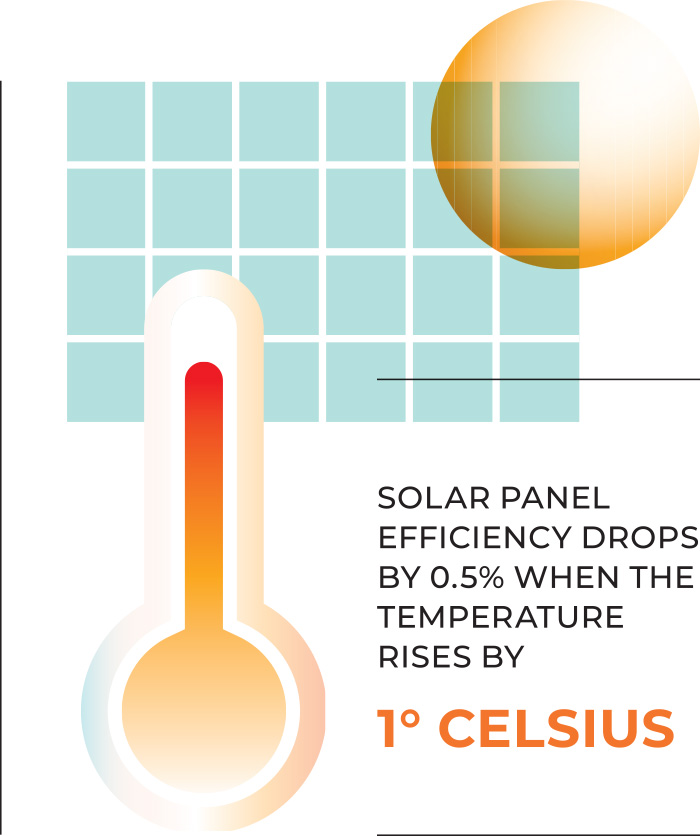
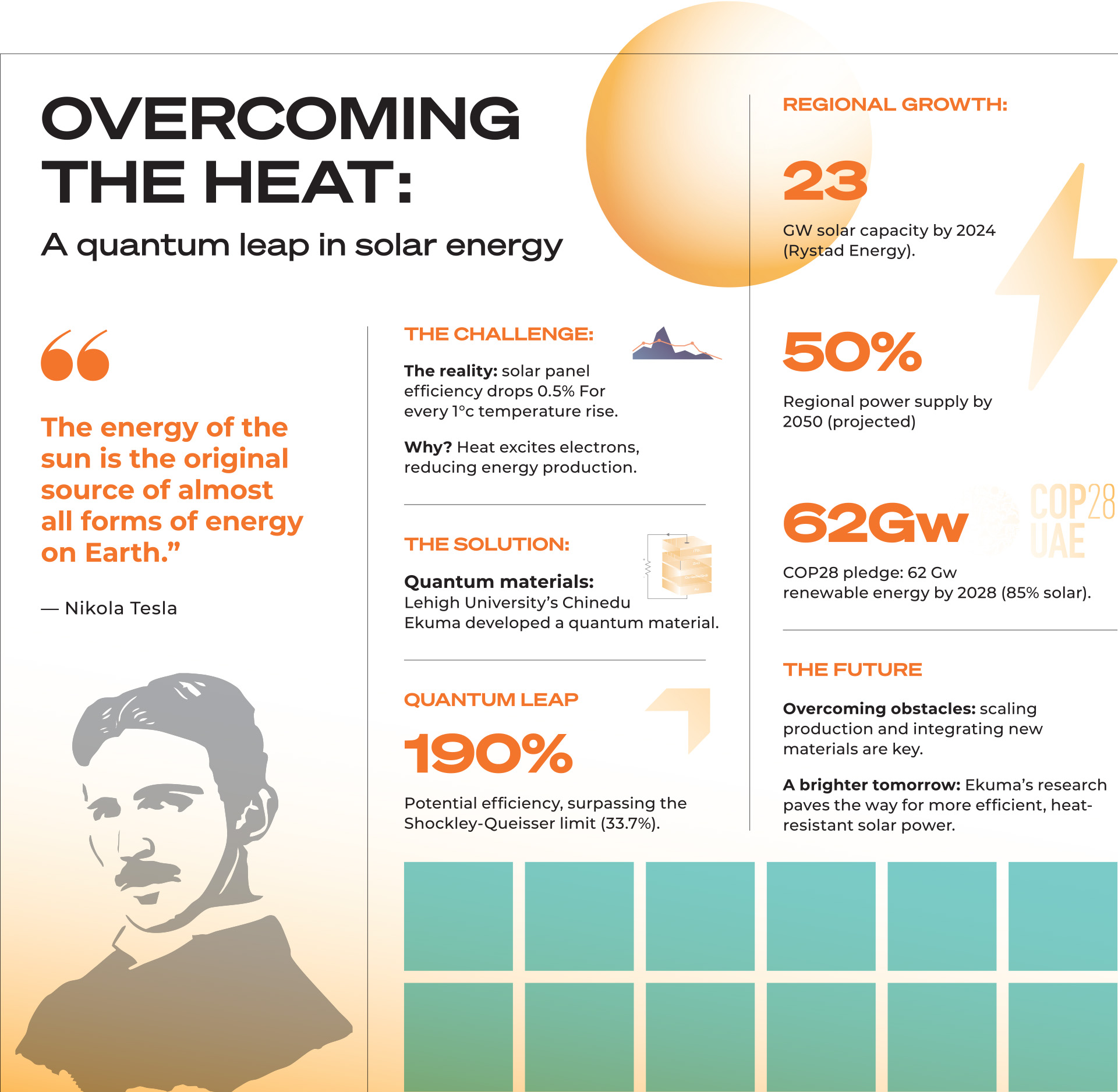
A warming planet, however, reduces the efficiency of solar-energy technology. That’s because solar-panel efficiency drops by .5 percent every time the temperature rises by 1 degree Celsius.
Sun shining on a solar cell excites electrons to a higher energy level due to the charge it creates. But when the cell is hot from the start, electrons are already in this excited state, which in turn produces less electricity
So, what now?
Solar technology is becoming more efficient, however. Researchers are developing cutting-edge materials and manufacturing models; multi-layer photovoltaic cells that absorb light from different parts of the spectrum like ultraviolet, visible light and infrared; and advanced technology like perovskites, whose specific crystal structure is highly efficient at converting sunlight to electricity.
Chinedu Ekuma, a physics professor at Lehigh University, sees the problem, particularly in the warmest climates, and possible new solutions.
“With rising global temperatures, solar panels are at risk of losing efficiency as excessive heat decreases their ability to convert sunlight into electricity.
This can undermine solar energy’s effectiveness in regions experiencing prolonged heat waves, pushing researchers to innovate materials that perform well even under extreme environmental conditions,” Ekuma says.
Ekuma’s research, funded in part by the U.S. Department of Energy, has produced a quantum material creating unparalleled solar-cell efficiency rates expected to contribute to next-generation, high-efficiency solar cells.
“Our newly developed quantum material, which incorporates intermediate band states, allows for a higher level of photon absorption and carrier generation. This innovation facilitates the generation of more than one electron per photon, pushing quantum efficiency beyond traditional limits, up to 190 percent, providing an exciting leap forward for photovoltaic applications,” Ekuma tells KUST Review.
This is especially significant because it implies the potential to exceed the Shockley-Queisser limit, which represents the theoretical maximum efficiency of a single-junction solar cell under standard conditions at 100 percent. In order to do so, the efficiency would have to exceed a maximum solar conversion efficiency of around 33.7 percent.
This limit exists because not all sunlight has the right energy to be converted into electricity. Some bounces off without being absorbed. Some is lost as heat or is relaxed into lower energy states that aren’t used. Some can’t maintain the excited electron state and defaults to its original states before it can be used. And some photons simply don’t have enough energy to boost the electrons.
Obstacles and applications
Ekuma’s team doesn’t foresee major obstacles to implementing their material into current solar energy systems. But scaling up to a commercial level of production and implementing the new material into existing technologies is going to take research and reduced cost, Ekuma says.
Ekuma’s material could pose solutions for countries where the temperatures are among the highest.
These places include the Middle East, where more energy is used for cooling than anywhere else on the planet.
The region has over 300 days of sunshine each year. According to Rystad Energy, it is expected to reach solar capacity of close to 23 gigawatts of power by the end of 2024.
Solar energy is expected to reach close to 50 percent of the regional power supply by 2050.
The Middle East and North Africa Region signed a pledge at the 2023 COP28 event hosted in Dubai to add 62 gigawatts of renewable energy over the following five years. Of that, 85 percent will be solar.
SOLAR IN THE UAE
The UAE has a number of solar energy projects in progress and aims to triple its clean-energy contributions by 2050.
The largest of four major projects is in the Al Dhafra region about 35 kilometers south of Abu Dhabi. The largest single-site solar power plant in the world spans more than 20 square kilometers of open desert. It was operationally ready in June 2023 and was inaugurated just ahead of the COP28 United Nations Climate Change Conference in Dubai.
The plant, fitted with close to 4 million solar panels, can bring electricity to close to 200,000 homes and save 2.4 million tons of carbon emissions annually. This is equivalent to removing nearly half a million cars from the road for one year.
The panel efficiency broke records in January 2020 with its bi-facial technology. January in UAE is ideal for maximum solar panel efficiency as temperatures average 25 degrees Celsius, the optimal temperature for solar.
Summer months, however, can reach 50 degrees, reducing efficiency by 10 to 25 percent.
Khalifa University’s Samuel Sheng Mao says the UAE is continuously working to develop innovative solutions to combat the heat issue.
“An innovation and research and development center under Mohammed bin Rashid Al Maktoum Solar Park is dedicated to testing and developing new solar technologies, including advanced cooling systems and materials adapted to the UAE’s climate. The park is involved in testing bifacial panels, advanced cooling techniques and integrating phase-change materials to enhance efficiency during extreme heat.
Mao is also director of the ASPIRE Research Institute for Sustainable Energy, where Khalifa University researchers have been developing concentrated solar power and thermal energy storage technologies. They have also developed a passive cooling technology to mitigate the thermal loads for next-generation solar cells, he says.
Solutions to improve efficiency also include thermal storage units that can be used during peak demand periods. This balances the load, takes strain off the main energy grid and allows for better distribution management.
One thing is for certain, as the world continues its hot trajectory, solar technologies research will have to keep pace.
“Continuous advancements in materials science and thermal management are expected to enhance the performance of solar panels further, making solar energy a more viable and sustainable option even in extreme climates,” Mao tells KUST Review.
UAE SOLAR ENERGY ADVANCEMENTS
JANUARY 2020
Record-breaking panel efficiency achieved using bi-facial solar technology. January’s average temperature of 25°C supports optimal performance.
JUNE 2023
The world’s largest single-site solar power plant in Al Dhafra becomes operational.
Covering 20 square kilometers, it features 4 million solar panels, powers 200,000 homes, and saves 2.4 million tons of carbon emissions annually.
NOVEMBER 2023
The Al Dhafra plant is inaugurated ahead of COP28 in Dubai.
ONGOING
Khalifa University and the Mohammed bin Rashid Al Maktoum Solar Park focus on: advanced cooling systems and materials for extreme heat. Thermal storage, passive cooling, and next-gen solar cell technologies.
2050
UAE aims to triple its clean-energy contributions, with solar as a key pillar.
More like this: Throwing shade on the desert