
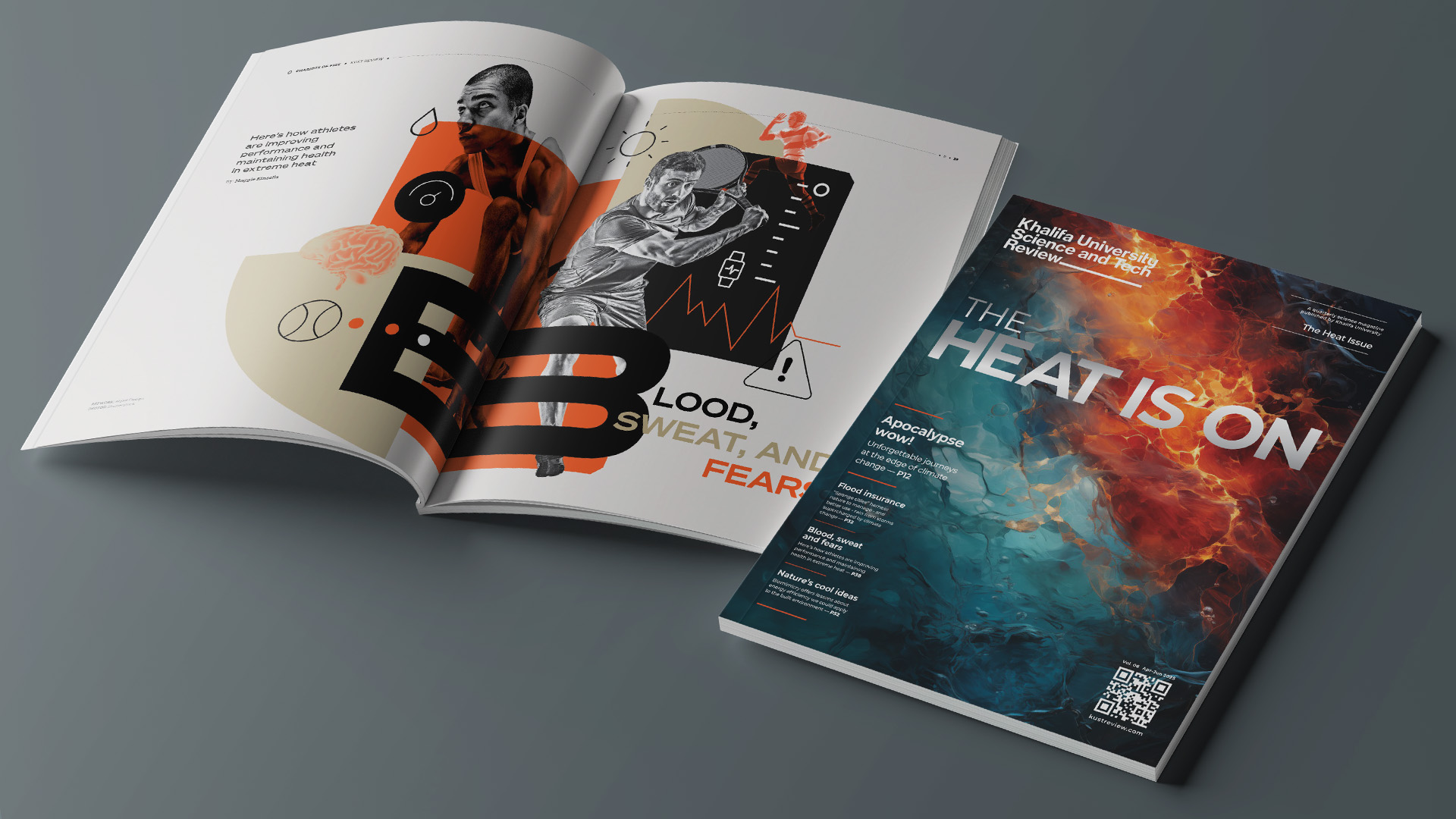
The Heat Is On

A scorching summer made the newspaper front pages and website home pages in 2024 with stories about record high temperatures, power grids struggling to keep up with the demand for air conditioning and more than a thousand heat-related deaths of pilgrims on hajj.


Sadly, 2024 wasn’t an aberration. Soaring temperatures are expected to become ever more common. According to a Guardian survey of many of the world’s leading climate scientists, 80 percent expect temperatures to rise at least 2.5 degrees Celsius above pre-industrial levels. Half of these experts foresee at least a 3C increase. Only 6 percent thought temperatures would be held to the internationally agreed 1.5C limit.


Consequences could be severe and far-ranging as heat fuels famine, conflict, fires, storms and more.


In this issue of KUST Review, we look at a few of the looming dangers, such as how warming oceans feed the red tides that damage economies and even threaten national security. Guest columnist and Khalifa University epidemiologist Dean Everett discusses how a warmer Earth might lead to more human diseases. And senior science writer Jade Sterling describes how climate change might affect locations around the world.


We also look at the ways science is helping to mitigate these dangers, with stories on how reflective surfaces might keep buildings cooler; why “sponge cities” work with nature to prevent floods and conserve water; and how artificial mangroves use the sun’s heat to desalinate water.


You’ll find even more in these pages, on our website, www.KUSTReview.com, and on Facebook, Instagram, LinkedIn, X and YouTube @KUSTReview.


So page, click, subscribe and follow to get the best of our coverage of science in the Middle East and around the world in English and in Arabic.


As always, be informed and stay curious.


Dr. Arif Sultan Al Hammadi

Editor-in-Chief
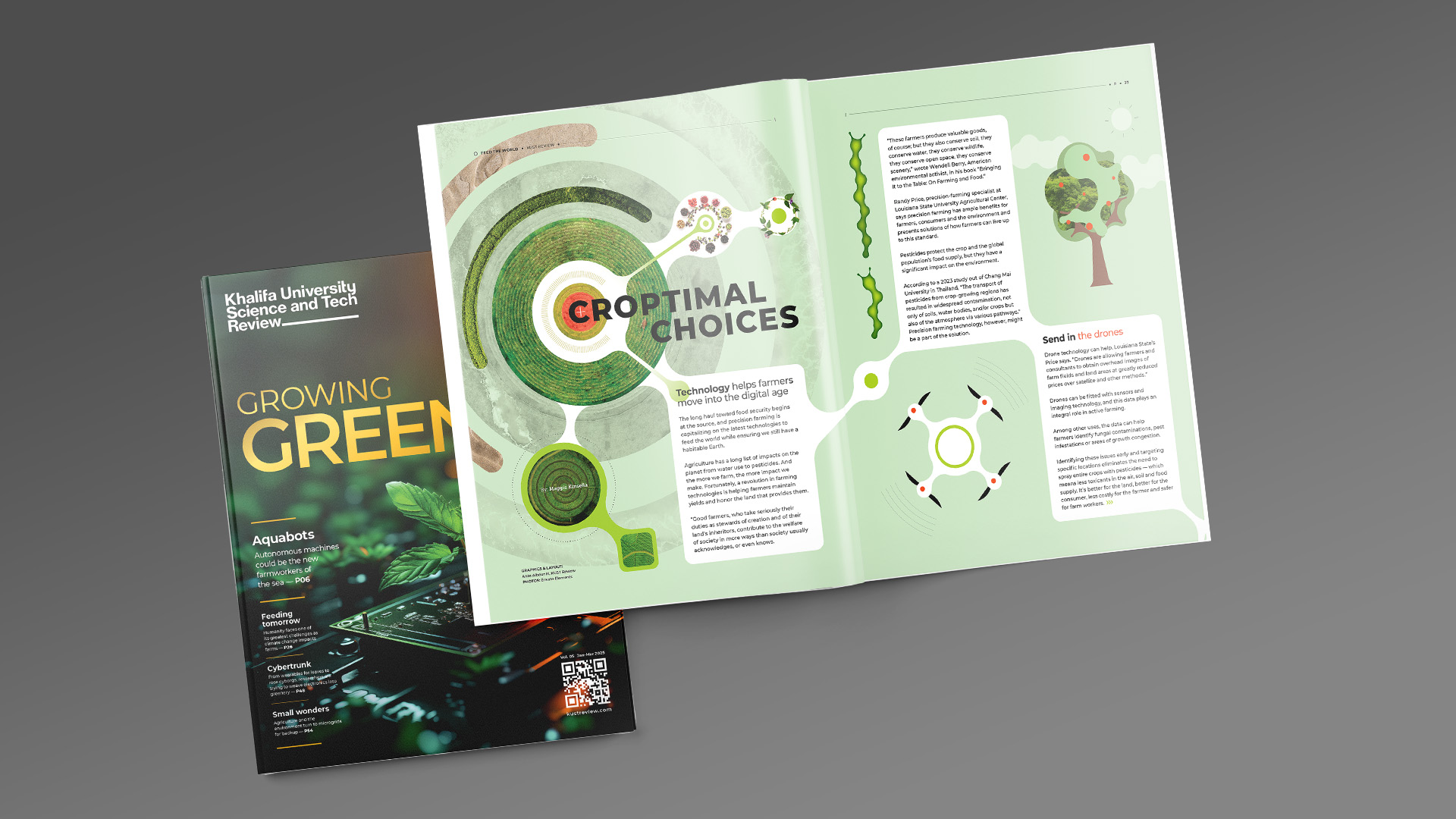
     

Growing Greener

When we think about technology we usually think about the shiny, sterile tech of science-fiction films and clean rooms, all smooth white walls and chrome fixtures.

But one of the most important areas of technology innovation is anything but shiny and sterile: It’s the earthy, fertile technology of producing healthful food for growing populations in a challenging era of climate change.

Agricultural technology – or agtech – is especially important in the Middle East, where clean water is scarce and farmable land is also in short supply. The United Arab Emirates currently imports about 85 percent of the food it consumes. In 2020 its imported-food bill was about U.S.$14 billion, up from the nearly U.S.$10 billion it spent in 2010.

Supply-chain problems of the COVID-19 epidemic put in sharp relief the need to reduce that dependency on imported foods with more homegrown products. And innovators are stepping up to help this desert nation cut short that sometimes fragile and always energy-hungry import chain.

In this issue we look closer at some of the emerging technologies and strategies to bring food production home without straining precious resources. Senior science writer Jade Sterling investigates the challenges of producing food as temperatures rise; editor Suzanne Condie Lambert checks in with researchers who work with the robots that help run aquaculture farms; and science writer Maggie Kinsella reports on vertical farming.

We also have more of the stunning images and design you’ve come to expect from KUST Review. You’ll find even more in these pages, on our website, www.KUSTReview.com, and on Facebook, Instagram, LinkedIn, X and YouTube @KUSTReview. So page, click, subscribe and follow to get the best of our coverage of science in the Middle East and around the world in English and in Arabic.

As always, be informed and stay curious.

Dr. Arif Sultan Al Hammadi
Editor-in-Chief

Rise of AI

The world is changing fast.
But of all of the technologies driving this rapid change, artificial intelligence, or AI, seems to be moving the fastest. Not a day seems to go by without new headlines about the wonders – and dangers – AI might bring:

■   AI will make your job easier by automating repetition. Or it might put you out of a job.
■   It will diminish human error. Unless the human who creates the AI inserts conscious or unconscious biased data.
■   AI gives us tools to be more creative. But AI itself cannot be creative or innovative. And many popular art AIs are trained on arguably stolen art, highlighting how intellectual property laws still lag.
■   For every story about how AI might benefit humanity with instant information, there is another that points out problems with ethics, privacy and more.
In this issue of KUST Review, we investigate some of these issues. Senior science writer Jade Sterling looks at the metaverse and how the technology behind it might change our lives. Writer Maggie Kinsella talks to leaders in the UAE oil industry about how AI is making the business more sustainable. And editor Suzanne Condie Lambert interviews an Abu Dhabi physicist who merges art and science by dancing with robots.

We highlight the hackathon organized by Khalifa University to create the first university in the metaverse space, or as we call it Metaversity. We also feature more of the stunning graphics and design you’ve come to expect in these pages.

You’ll find even more in these pages, on our website, www.KUSTReview.com, and on Facebook, Instagram, LinkedIn, X and YouTube @KUSTReview. So page, click, subscribe and follow to get the best of our coverage of science in the Middle East and around the world in English and in Arabic. As always, be informed and stay curious.

Arif Sultan Al Hammadi
Editor-in-Chief

Give us some space

Certainly when people around the world think of technology innovations in the Middle East, they think of energy production. But space exploration is rapidly climbing on the list of the region’s scientific accomplishments.

The Emirates in 2014 established the UAE Space Agency, and in less than a decade sent a probe to Mars and Emiratis Hazza Al Mansouri and Sultan Al Neyadi into space. And it has many more projects lined up at the gate.

The UAE has invested U.S.$817 million to support the space sector. Meanwhile, Saudi Arabia is also putting considerable resources into space research, promising to invest U.S.$2.1 billion in the sector to facilitate collaborations between government and private industry. Also in the region: Kuwait launched its first satellite in 2023; Oman has plans to build spaceport; and Egypt created a government agency to build and launch its own satellites.

Economic development is a key reason these governments are investing in space. But the pursuit of knowledge for its own sake and cooperation among the peoples of Earth to extend our reach to the stars fulfills a basic human drive as well.

That’s why in this issue we examine space exploration. Senior science writer Jade Sterling looks at how space may be the final frontier for the law; editor Suzanne Condie Lambert writes about the 2D materials that might help humans build settlements on other planets; Maggie Kinsella delves into the troubling issue of space junk; and some of the MENA region’s most talented amateur astrophotographers share images of the cosmos for a stunning photo essay.

You’ll also find a special pull-out poster with a timeline of some of the UAE’s past achievements in space and projects still to come.

Find these stories and more here, on our website (KUSTReview.com) and through our social media channels @KUSTReview.

And as always, we invite you to be informed and stay curious.

Arif Sultan Al Hammadi
Editor-in-Chief

The Carbon Copy

The science is clear: climate change is happening

Global temperatures are at the highest recorded levels. This in turn is affecting weather patterns, bringing not only droughts and heatwaves, but producing storms that last longer and are more intense, driving not only immediate loss of human life and property damage but disease, forced displacements, famine and the extinction of other species.

As a result, many nations have drafted initiatives to lower the carbon production that is driving climate change. And the world is meeting now in Dubai for COP28 to take stock of its progress on the Paris Agreement, the international treaty on climate change.

The UAE was the first nation in the MENA region to draft a net-zero target, adopting a long-term strategy to reduce greenhouse gases and help limit the rise in global temperatures by 2050.

A key element of this strategy is deploying clean-energy solutions to replace carbon-producing fossil fuels. The UAE has invested more than U.S.$40 billion in the sector, with hundreds of millions more in aid and soft loans for clean energy projects.

In this issue of the KUST Review look at this energy transition as the world seeks to move away from the fossil fuels that drive carbon emissions.

We investigate some of the details of this transition, as well as how to live more sustainably. KUST Review Deputy Editor Steve Griffiths talks about making smart cities cyber-secure and -resilient.

Senior science writer Jade Sterling looks at the logistics of the energy transition as well as improvements in aviation fuel. Editor Suzanne Condie Lambert writes about the hydrogen economy and an innovative way to make cement with a significantly reduced carbon footprint. And Maggie Kinsella dives into what to do with the carbon we capture.

You’ll find even more at our website, www.kustreview.com, and on Facebook, Instagram, LinkedIn, X and YouTube @KUSTReview. So page, click, subscribe and follow to get the best of our coverage of science in the Middle East and around the world in English and in Arabic.

As always, be informed and stay curious.

Arif Sultan Al Hammadi
Editor-in-Chief