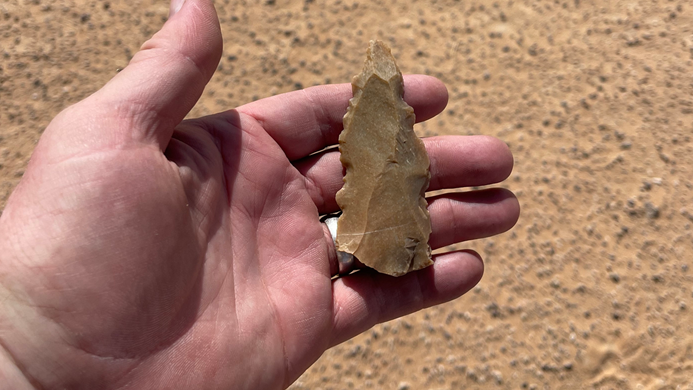

Image: Shutterstock CREDIT: Chris Clarkson

The people who lived in Arabia 125,000 years ago used complex technologies like composite weapons, plant-fiber processing and maybe even poison for hunting.

That’s the conclusion of a new study co-led by Griffith University, King Abdullah University of Science and Technology (KAUST) and the Saudi Heritage Commission, Ministry of Culture.

Their analysis was published in Science and examines artifacts found at ‘Uruq Aljelibah in Saudi Arabia’s Rub’ al-Khali, or Empty Quarter. The site is a well-preserved prehistoric lakeshore.

These findings challenge previous thoughts that Arabia was merely a transit corridor. Instead, the researchers suggest, humans settled and developed complex technology.

CAPTION: The Empty Quarter is desert now, but “during wetter phases, Green Arabia provided the water and other resources that people needed to settle and develop complex ways of life,” Michael Petraglia says.  IMAGE: Chris Clarkson

Researchers recovered more than 5,000 stone artifacts and additional fossil animal remains, providing a window into life during a humid period known as Marine Isotope Stage 5e.

“The lakeshore preserves evidence of a very different Arabia where freshwater, grasslands and trees supported people and abundant wildlife,” says Frans van Buchem of KAUST and co-lead author.

“One of the most significant discoveries is evidence that some stone points were used as hafted hunting weapons,” says Christopher Clarkson of Griffith’s Australian Research Centre for Human Evolution.

Several stone points contained chemical biomarkers linked to Acokanthera schimperi, the arrow-poison tree. The plant is known historically for its toxic cardiac glycosides. Other toxic plant compounds were found on other hunting weapons.

More like this: Archaeologists say today’s plastics are tomorrow’s artifacts

Join our mailing list

Get the latest articles, news and other updates from Khalifa University Science and Tech Review magazine