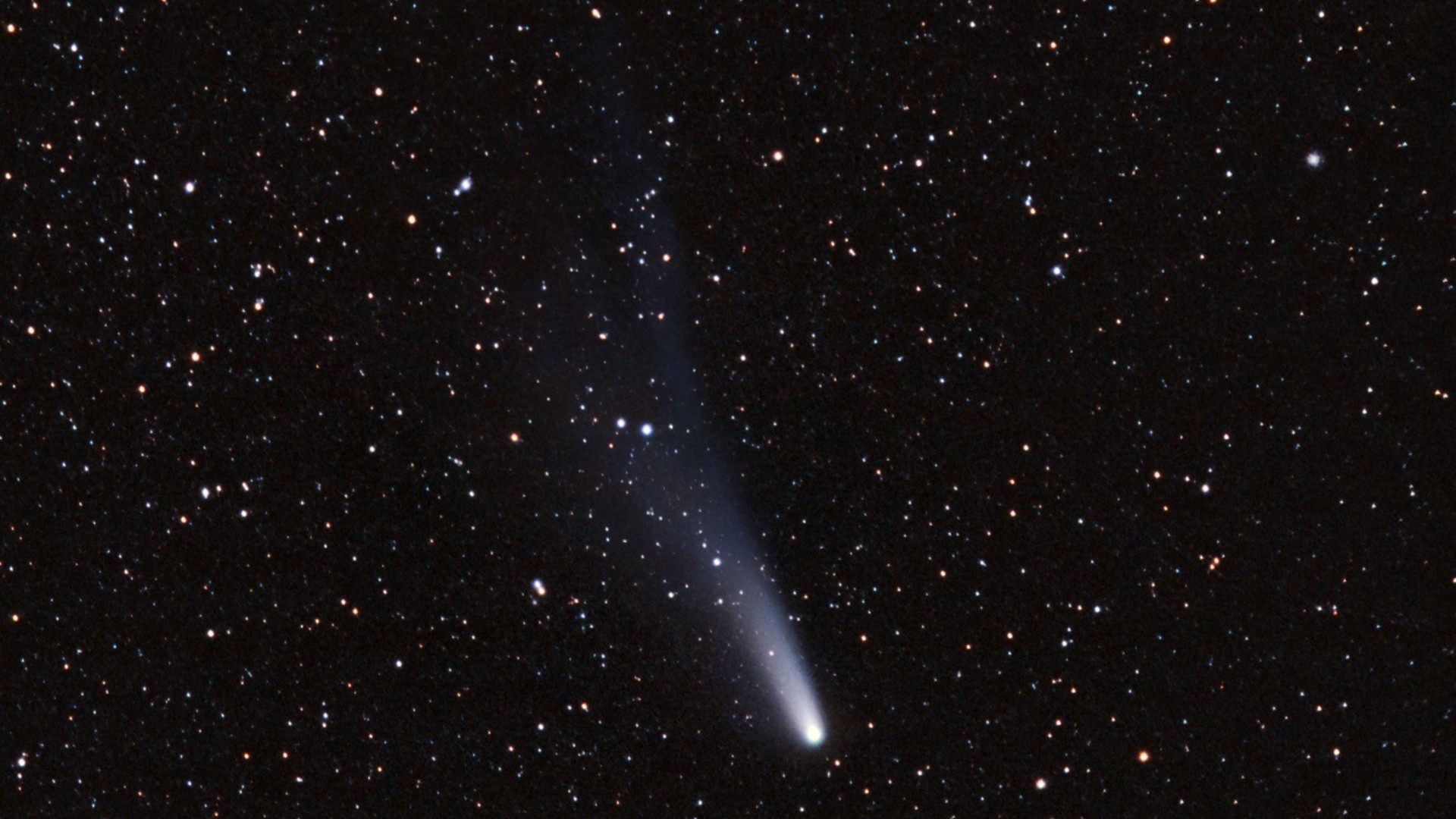

CAPTION: Halley's Comet, photographed during its last appearance in 1986 IMAGE: Shutterstock

Halley’s Comet has captured imaginations for centuries in art and pop culture, from the 11th century Bayeaux Tapestry to “Halley’s Mania” in the 1980s.

It’s also captured the imagination of researchers from Khalifa University and Italy who wondered if they could find a better way to study the comet in 2061 when it completes its roughly 76-year circuit of the solar system and once again is visible to eyes on Earth.

Their paper on open-access archive arXiv proposes a slow rendezvous with the comet, letting a spacecraft keep pace with it for months.

“The 1986 missions saw Halley at enormous relative speed, around 70-80 kilometers per second. That gave humanity precious images, but only a brief look,” says Elena Fantino, a member of KU’s Department of Aerospace Engineering who also contributed to the paper. “A slow rendezvous would let a spacecraft stay with the comet for months or longer.”

The slower approach, she says, changes the science completely.

“We could map the entire nucleus instead of one hemisphere; measure its rotation properly; test whether the nucleus is really a contact binary; watch jets and active regions turn on as Halley approaches the sun; track mass loss; and study how surface features connect to gas and dust activity. In short: 1986 gave snapshots; a rendezvous could give a biography.”

Elena Fantino

Associate Professor in the Department of Aerospace Engineering at Khalifa University

There are plenty of other Halley’s Comet mission proposals, but Fantino says her team’s is a practical mix of technology and proposed route.

“Earlier rendezvous concepts often leaned on things that were difficult, expensive or not actually available: high-power nuclear electric propulsion, very high launch energy or super-heavy launchers,” she says. “This paper proposes a more practical architecture: Launch in 2036 or 2037, use low-thrust electric propulsion, fly by Jupiter, then Saturn, and let Saturn do much of the brutal job of flipping the spacecraft into Halley’s retrograde, steeply inclined orbital plane.”

Early planning is the key, she adds.

“The mission is slow by design,” Fantino says. “The attractive launch windows are in 2036 and 2037, but arrival is around 2060. That means the mission has to leave roughly 24 years before the comet’s 2061 perihelion.
“Also, the timing is dictated by planetary geometry. Jupiter and Saturn have to be in the right places for the gravity assists to work. You cannot just launch ‘a bit later’ and expect the same route. Spacecraft development itself can take a decade, and missing the window could mean missing Halley for another human lifetime,” Fantino says.

Missing that window might not just be a blow to science, but to human culture.

“Halley is a scientific object, but also a cultural clock,” Fantino says. “It is bright, famous, predictable and has been recorded by humans for more than two-thousand years. Most comets feel like visitors; Halley feels like a returning character.

“There’s something especially powerful about planning a mission whose arrival belongs to another generation,” Fantino adds. “Halley links ancient observers, the 1986 spacecraft era, and people alive in 2061 into one long chain of looking up. That is rare. It makes the comet feel less like an object and more like an appointment humanity keeps.”

Khalifa University’s Roberto Flores is the principal author of the paper with contributions from KU Ph.D. students Chiara Pozzi and Alessandro Biolchi and support from the KU Polar Research Center. Their work has been written up in pieces in German and Italian publications.

The paper’s publication was funded by the KU Department of Aerospace Engineering.

More like this: Mining the moon

Join our mailing list

Get the latest articles, news and other updates from Khalifa University Science and Tech Review magazine