

Arable land makes up only about 1 percent of the United Arab Emirates. That’s roughly 50,000 hectares in a country with about 11.5 million people to feed.

But what if microbes that produce bacterial nanocellulose and mycelium could turn sand into something that could sustain plant growth, increasing food security and reducing the environmental costs of importing food from other countries?

That’s the question Khalifa University’s Blaise Tardy and his associates from KU and the Swiss Federal Laboratories for Materials Science and Technology (EMPA) examined in a recent paper in Carbohydrate Polymers.

Tardy previously wrote in KUSTReview.com about adding cellulose to desert sand to increase fertility. This process makes use of such free biomass materials as landscaping trimmings, kitchen scraps and post-consumer waste to create a positive-feedback loop toward a greener desert.

The new paper follows up on that idea. But instead of adding cellulose via biomass, the goal is to introduce microbes and mycelium to grow the fibers that hold water and increase soil cohesion.

It made sense to partner with the Swiss team, Tardy says.

“Our collaborators at EMPA in Switzerland are among the best in the world on these topics,” he says.

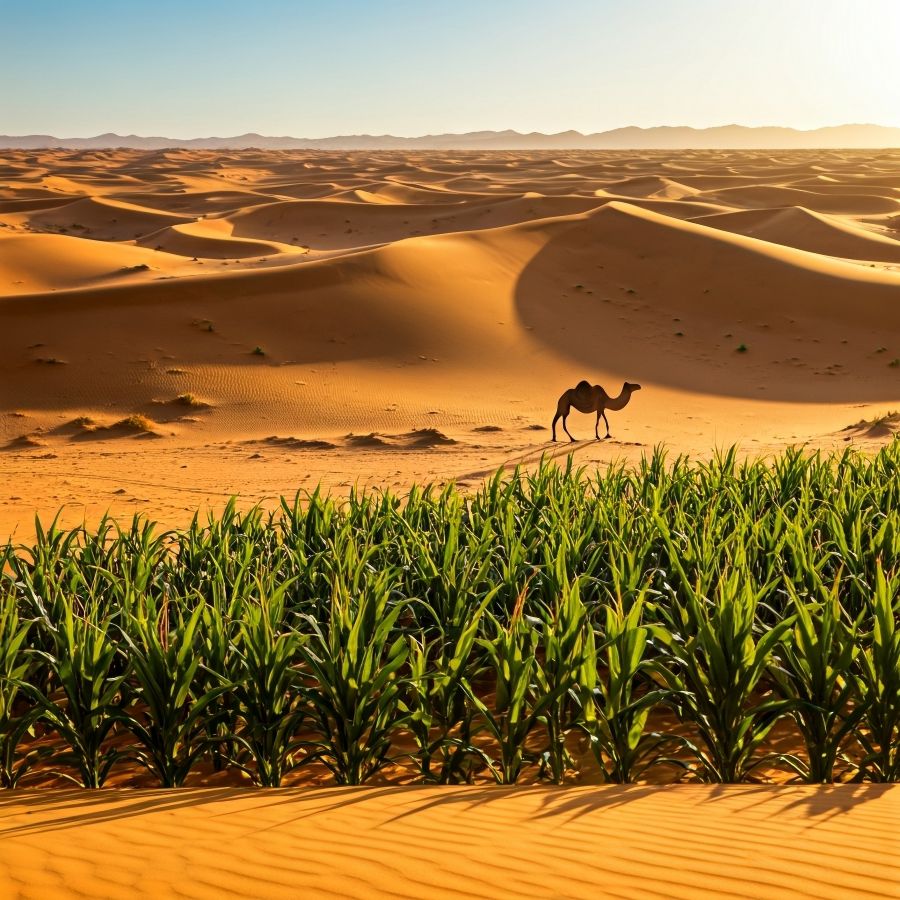
The idea is an intervention that would give desert sand what it needs to sustain plant life.

It’s not so much that the desert can’t grow plants. It’s that the desert can’t hold the water to sustain them, Tardy says.

IMAGE: Shutterstock

“When it rained a lot, you could see on the satellite images: The next day the desert’s green.

“But it was very short-lived because the soil was not ready. So if any of these two papers were implemented there, just waiting for the rain, we would have had crops for maybe three months longer.”

UAE residents don’t have to wait for large initiatives to do their part, though. Tardy recommends the “green bins” that compost kitchen scraps.

“I do it on the balcony, and if you do it properly, for example by adding the right microbial strains that produce mycelium, there are no smells and sometimes I even get mushrooms growing from my compost too,” Tardy says.

More like this: Regreen

Join our mailing list

Get the latest articles, news and other updates from Khalifa University Science and Tech Review magazine