



Workers in the 1970s fields paved the way for sustainability›››
Sustainability

Eugenia Kargbo is Freetown’s “chief heat officer,” an unusual title for a government employee.
Freetown, capital city of Sierra Leone, has always been hot, but it’s getting hotter. Climate change is making the mercury rise, and the urban heat island effect exacerbates the problem: On average, cities are 5 to 9 degrees hotter than rural areas. Kargbo says the data shows everywhere in Freetown is getting hotter, but some communities stay hotter throughout the day.

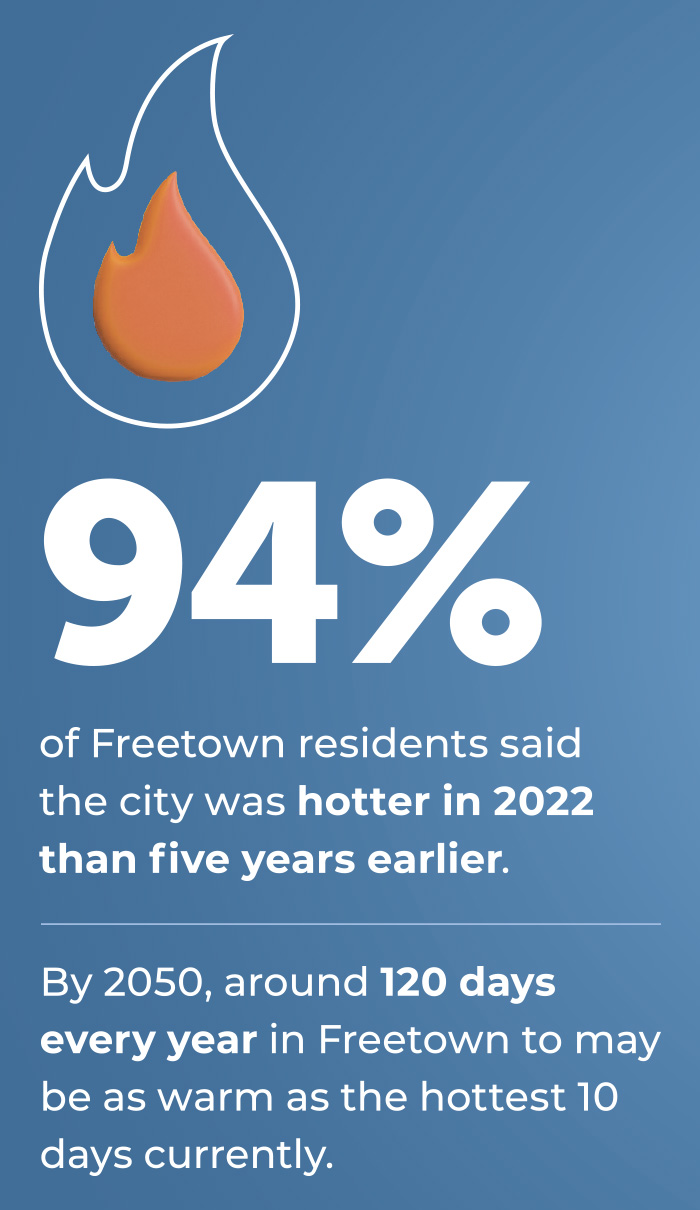
Freetown’s Climate Action Strategy reported 94 percent of residents said the city was hotter in 2022 than five years earlier. They’re not wrong.
Sierra Leone is the 18th most climate-vulnerable country in the world, according to the Notre Dame Global Adaptation Index. And Adrienne Arsht-Rockefeller Foundation Resilience Center data says by 2050, around 120 days every year in Freetown will be as warm as the hottest 10 days currently.
Kargbo had experimented with planting trees throughout the city and installing shading structures made of reflective plastic, but the real improvement was felt when a team of researchers approached her with an ambitious plan: Cover roofs with mirrors to reflect the sun.
Mirrors for Earth’s Energy Rebalancing (MEER) was founded by Harvard University’s Ye Tao. His theory? Develop “nontoxic surface-based reflectors that can redirect solar radiation back into space.”
This isn’t actually so crazy. We know that ice- and snow-covered areas offer the albedo effect, where light-colored surfaces return a large part of the sun’s UV rays back to the atmosphere.
It’s why skiers and pole-trekkers need sunglasses and sunscreen. The planet has a natural “surface-based reflector” mechanism in snow and ice.
But with climate change come increased global temperatures and a dramatic loss of sea ice at the poles, snow in the mountains and glaciers in the north. Darker surfaces absorb a larger fraction of the incoming solar radiation, creating a vicious cycle.
MEER’s project aimed to cover buildings in Freetown with a reflective film made out of recycled PET plastic and aluminum. They started small: Two buildings got the film, another one was painted white and a fourth had a new metal roof installed. The two mirrored buildings were 15 degrees cooler than the surrounding buildings without the film, while the white-roofed building experienced a 3 degree cooling effect. MEER says if the entire neighborhood were covered, the cooling effects would be even greater.

Researchers at the University of Maryland are taking a similar approach. They developed a reflective coating using glass and aluminum oxide particles that can be painted onto roofs and roads.
The team’s “cooling glass” is environmentally stable — able to withstand up to 1,000 degrees — and uses finely ground glass particles to recycle and avoid polymers.
The particle size maximizes infrared emissions and reflects sunlight through the atmosphere back into space. The glass paint also comes in four colors.
George Ban-Weiss, an environmental engineer at the University of Southern California, says it’s simple to paint roofs white or light gray to increase the albedo effect — in theory. In reality, if this happens at a large enough scale, Ban-Weiss says it could have an unintended regional side effect.
In coastal cities, for example, the urban warmth contrasting with the ocean drives a reliable sea breeze. Bring the temperatures closer to each other, and there could be less of this wind, which would mean less clean air and a reduced natural cooling effect.
Not just where roofs are but their shapes matter too. Covering flat roofs would project the rays straight back to space, but slanted roofs could shine on the ground or the city’s inhabitants, heating them instead of the buildings.
One skyscraper in London is notorious for this. 20 Fenchurch St. is covered in glass — normal glass, not cooling glass — and its shape concentrates and reflects the sun’s rays into a beam of light that hits the pavement and makes it hot enough to fry an egg.
“It’s kind of a tug of war,” Ban-Weiss says. “You’ve got a reduction in air temperature to make people more comfortable.” But at the same time, he adds, sunlight reflecting off the side of a building could make pedestrians less comfortable.
Portland State University’s Vivek Shandas studied the heat island effect in over 100 U.S. cities. He says thinking about heat reduction is still very novel in urban planning: “When we’re talking about a place that’s designed in a particular way, how has the climate system been brought into the design of that place? How has the infrastructure been brought into its ability to mediate or moderate the amplifying temperatures? These are the kinds of questions I think we’re really up against here.”
More like this: Solar Impact
Get the latest articles, news and other updates from Khalifa University Science and Tech Review magazine