


Researchers look to nature to pull water from the air›››
GIFT FROM
THE SEA
Artificial mangrove plus the sun’s heat could could slash the costs of desalination 6 Nov 2025
Mangroves provide many benefits for the environment. They store carbon dioxide. They supply habitats for fish and other marine life. And they act as a natural windbreak, protecting the shore from tidal surges.
But what really excites Tiejun Zhang and his team at Khalifa University is the trees’ ability to purify seawater by extracting the salt that enters through their roots.
Purifying seawater is how the UAE gets most of its potable water. The traditional processes of desalination, however, are energy-intensive and create about 141.5 million cubic meters of brine a day around the world. This waste material can damage the environment if it’s pumped back into the sea or brought onshore.
Zhang’s bioinspired artificial mangrove, however, could be the inexpensive breakthrough a thirsty world needs.
The process is simple, Zhang says, and it’s powered entirely by the heat of the sun.
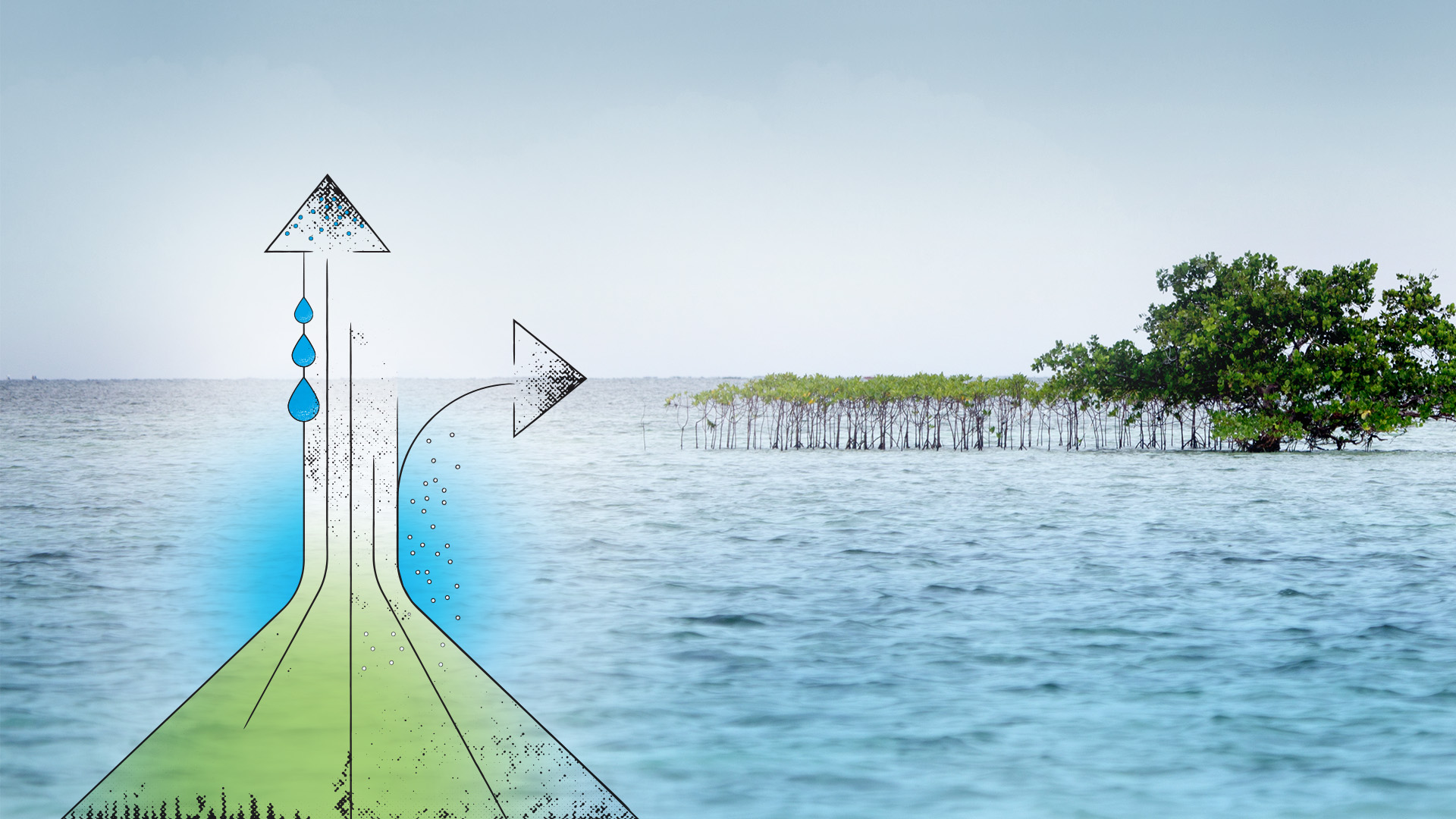
The sun’s heat draws liquid up through a nanostructured titanium mesh using passive capillary action. The salt separates from the water and precipitates on “leaves,” then at night falls onto the floating foam disc that keeps the device upright in water. The process collects about 2.2 liters/m2 of water a day.
The initial device is small, but we can make it much bigger depending on how much water you need.
– Tiejun Zhang, department of engineering at Khalifa University
As a bonus, the researchers are investigating how the collected salt could be separated and used for other purposes.
“Sodium chloride is edible,” he says. “Calcium chloride, magnesium chloride, those are more for industrial processes. Our current technology proves that we can collect the salt. If we pull everything in a mixture, it’s not very valuable. If we can separate (the salts), refine them, and make them pure, then that would be very valuable.”
Zhang thinks the device might eventually be able to draw other valuable materials from seawater, even lithium.
But the applications aren’t just industrial, he says, pointing out that the device is small enough to carry in a backpack. Hikers and people who live off-grid might be able to use the artificial mangroves to purify water for personal use.
And the simple design, featuring titanium mesh and chemical etching to create a nano structure, makes it easily reproducible.
“A high school student could make it,” Zhang says. In the meantime, Zhang and his team are investigating start-up opportunities.
More like this: Vertical farms and 3D-printed reefs part of UAE’s plans for food security
Get the latest articles, news and other updates from Khalifa University Science and Tech Review magazine